THE CLASSIC COLLECTION✦An outlaw’s diary: the CommuneCLASSIC FREE BOOKS
An outlaw’s diary: the Commune
Cécile Tormay
THE CLASSIC COLLECTION · 1896
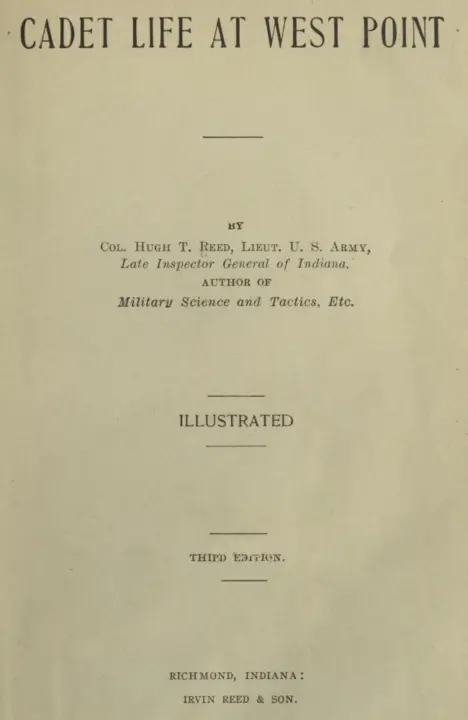
"Cadet Life at West Point" by Hugh T. Reed is a historical account written in the early 20th century, reflecting on military education and experience at the United States Military Academy during the late 19th century. The book delves into the regimented life of cadets and serves as both a memoir and a guide for those interested in pursuing a military career, capturing the challenges and experiences faced during their formative years at this prestigious institution. At the start of this memoir, Reed recounts the fervent desire he had as a young boy to attend West Point, underscoring his early admiration for the military. He describes the meticulous process of seeking appointment as a cadet, detailing his determination to overcome obstacles such as poor eyesight and familial resistance. The narrative introduces his journey from childhood dreams to the rigorous preparations required for admission, establishing a tone that mixes nostalgia with the gravity of the military training environment. As Reed progresses into his experiences at the academy, he provides a glimpse into the strict discipline, camaraderie, and the demanding expectations that shape the life of a plebe, marking the beginning of a compelling exploration of cadet life.
Introduction adapted from the source catalogue; source summaries may be automatically generated.
Free to read · English · 61,239 words · No account needed
MAKE TIME FOR A GOOD BOOK
On by default. Untick to stop anonymous reading totals. Each page counts after 10 seconds in view. How this works.
Anonymous counting is on unless you have switched it off.
13. Name the principal rivers that drain Pennsylvania; where do they rise, at what points do they leave the state and at what points, if any, do they break through highlands?
14. Name all the waters traversed in going by the two commercial water routes from Duluth to the Atlantic Ocean.
15. Name the principal ranges of mountains crossed in going by rail from New York to San Francisco; state the rail route assumed to be traveled.
16. Bound precisely the following states and territories: 1. Montana, 2. Arizona, 3. Arkansas, 4. Wisconsin, 5. Pennsylvania, 6. Georgia. (In bounding, all contiguous states must be mentioned as well as rivers, mountain ranges, etc.)
17. Name the states west of the Mississippi River, drained
wholly or in part by it or its tributaries, and give the
capital of each.
18. Locate accurately the following cities: 1. Austin, 2. Pensacola, 3. Ashville, 4. Winchester, 5. Allegheny, 6. Iloilo, 7. Oswego, 8. Pasadena, 9. Guthrie, 10. Detroit.
19. Going by water from New Orleans, La., to Pittsburgh, Pa., what states would you pass on the left?
20. How many large islands are there in the Hawaiian group? Which is the largest? Which is the most important?
21. Going westward on the 35th parallel of north latitude, from
near Newberne, N. C., what states and large rivers would be
crossed?
22. Describe the chief mountain system of the eastern
hemisphere, and state what island chains of Asia abound in
volcanoes.
23. What are the great river systems of South America? Where are the principal coastal plains?
24. What are the qualifications of a good harbor? Name three
of the best harbors on the Atlantic coast; one on the Pacific
coast.
25. What has made the Middle Atlantic states the principal commercial section of the United States?
HISTORY.—Candidates must be thoroughly familiar with so much of the History of the United States, and of Ancient Greece and Rome as is contained in good high school text-books on these subjects, and must have a good knowledge of the important facts in General Ancient History and in the History of Medieval Europe to the end of the fifteenth century.
In History of the United States, the examination will include questions concerning early discoveries and settlements; the forms of government in the colonies; the causes, leading events, and results of wars; important events in the political and economic history of the nation since its foundation; and the elementary principles of civil government, with special reference to the federal congress, executive and judiciary.
In Ancient History, the examination will include questions on important persons and events in the legendary and authentic history of Greece and Rome, and on general important facts in the history of other ancient peoples, taking some account also of Greek art, of Greek and Roman literature, and especially of Roman government.
Your reading position is saved on this browser. Take it to another device with a library code. Reading pages adapt to text, rather than matching a printed edition.
BEHIND THE BOOK
This eBook is for the use of anyone anywhere in the United States and most other parts of the world at no cost and with almost no restrictions whatsoever. You may copy it, give it away or re-use it under the terms of the Project Gutenberg License included with this eBook or online at www.gutenberg.org. If you are not located in the United States, you will have to check the laws of the country where you are located before using this eBook. Read the source licence.
The original source file, including credits and licence, is retained by this library. Request an original-format copy at no charge. Please include the book title and Project Gutenberg identifier #64925.
KEEP YOUR CURIOSITY GOING
Cécile Tormay

Moritz Busch
John L. Ransom
Frances Wright
Cécile Tormay

Mabel Potter Daggett