THE CLASSIC COLLECTION✦An outlaw’s diary: the CommuneCLASSIC FREE BOOKS
An outlaw’s diary: the Commune
Cécile Tormay
THE CLASSIC COLLECTION · 1909
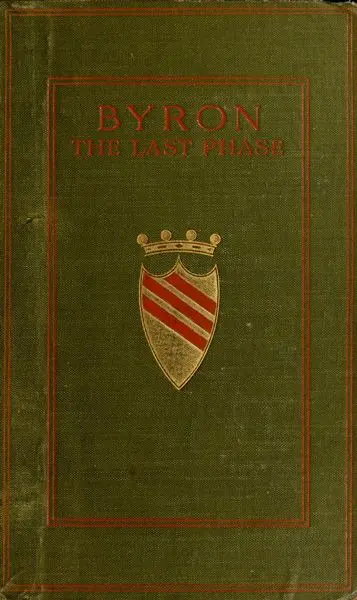
"Byron: The Last Phase" by Richard Edgcumbe is a historical account written in the early 20th century. The work delves into the latter years of the life of Lord Byron, revealing how his experiences and personal transformations, especially during his time in Italy and Greece, diverged from the notorious public persona he had acquired earlier in his life. The narrative particularly focuses on unexplored elements of Byron's character and relationships, particularly involving his friends and lovers. The opening of this biography sets the scene in Pisa around 1821, where Byron has recently arrived with an entourage that includes not just servants but also various pets. Edgcumbe introduces the reader to a contrasting view of Byron—he is described as being visibly changed from the man he once was, showing a disposition more sociable and compassionate. The text meticulously details Byron's physical appearance through the eyes of those who met him, while also hinting at the tumultuous nature of his personal life, including references to his estranged relationships and the lingering impact of his separation from his wife. The introduction builds intrigue around Byron's psychological state and contributions to the Greek War of Independence, setting the stage for a detailed exploration of his character during this pivotal period.
Introduction adapted from the source catalogue; source summaries may be automatically generated.
Free to read · English · 129,526 words · No account needed
MAKE TIME FOR A GOOD BOOK
On by default. Untick to stop anonymous reading totals. Each page counts after 10 seconds in view. How this works.
Anonymous counting is on unless you have switched it off.
'Upon a tone,
A touch of hers, his blood would ebb and flow,
And his cheek change tempestuously--his heart
Unknowing of its cause of agony.'
[49] 'Astarte,' p. 134.
[50] Lady Caroline Lamb also asserted that Byron showed her some letters which contained some such expression as this: "Oh! B----, if we loved one another as we did in childhood--then it was innocent." The reader may judge whether such a remark would be more natural from Augusta, or from Mary Chaworth.
[51] October 14, 1814.
[52] See the poem 'Remember Him': 'Thy soul from long seclusion pure.'
'OPHELIA. O heavenly powers, restore him!' Hamlet, Act III., Scene i.
'The song, celestial from thy voice, But sweet to me from none but thine.' Poetry of Byron, vol. iv.: 'To Thyrza.'
'Siede la terra, dove nata fui,
Su la marina dove il Po discende.'
Inferno, Canto V., 97, 98.
[56] Although not near the source of the Po itself, Byron, at Ferrara, was not very far from the point where the Po di Primaro breaks away from the Po, and, becoming an independent river, flows into the dark blue Adriatic, about midway between Comachio and Ravenna.
[57] Shortly afterwards he translated 'The Episode of Francesca,' line for line, into English verse.
[58] 'Beppo,' stanza 83.
[59] 'Astarte,' p. 166.
[60] Lady Byron and Rev. F. Robertson drew up a memorandum of this
conversation, April 8, 1851.
[61] 'Astarte,' p. 137.
[62] 'Recollections of a Long Life,' by Lord Broughton, vol. ii., p. 297.
[63] Ibid., vol. ii., pp. 219, 239.
[64] 'Lady Byron said that she founded her determination [to part from her husband] on some communication from London.'--'Recollections of a Long Life,' vol. ii., p. 255.
[65] 'There is reason to believe that Lord Chief Justice Cockburn privately saw letters [in 1869] of 1813 and 1814 which proved the fact of incest, and the overwhelming effect of the evidence therein contained.'--'Astarte,' p. 54.
[66] 'Astarte,' p. 77.
[67] Hanson.
[68] Leigh.
[69] 'Recollections of a Long Life,' vol. ii., p. 303.
[70] A fortnight before writing 'Stanzas to the Po.'
[71] 'Short name of three or four letters obliterated.'--'Astarte,' p.
180.
[72] Short name of three or four letters obliterated.
[73] Marianna (Anglice: Mary Anne).
[74] Lady Byron (see 'Astarte,' p. 166).
[75] His sister's society.
[76] In case Byron altered his will.
[77] Vol. v., p. 1.
[78] Tinct. chinæ corticis; tinct. cinchonæ.
Your reading position is saved on this browser. Take it to another device with a library code. Reading pages adapt to text, rather than matching a printed edition.
BEHIND THE BOOK
This eBook is for the use of anyone anywhere in the United States and most other parts of the world at no cost and with almost no restrictions whatsoever. You may copy it, give it away or re-use it under the terms of the Project Gutenberg License included with this eBook or online at www.gutenberg.org. If you are not located in the United States, you will have to check the laws of the country where you are located before using this eBook. Read the source licence.
The original source file, including credits and licence, is retained by this library. Request an original-format copy at no charge. Please include the book title and Project Gutenberg identifier #41809.
KEEP YOUR CURIOSITY GOING
Cécile Tormay

Moritz Busch
John L. Ransom
Frances Wright
Cécile Tormay

Mabel Potter Daggett