THE CLASSIC COLLECTION✦An outlaw’s diary: the CommuneCLASSIC FREE BOOKS
An outlaw’s diary: the Commune
Cécile Tormay
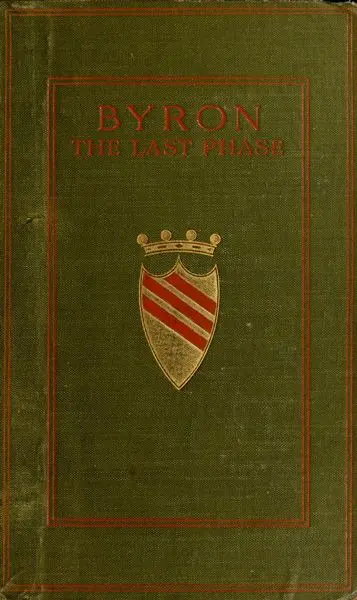
THE CLASSIC COLLECTION · 1909
"Byron: The Last Phase" by Richard Edgcumbe is a historical account written in the early 20th century. The work delves into the latter years of the life of Lord Byron, revealing how his experiences and personal transformations, especially during his time in Italy and Greece, diverged from the notorious public persona he had acquired earlier in his life. The narrative particularly focuses on unexplored elements of Byron's character and relationships, particularly involving his friends and lovers. The opening of this biography sets the scene in Pisa around 1821, where Byron has recently arrived with an entourage that includes not just servants but also various pets. Edgcumbe introduces the reader to a contrasting view of Byron—he is described as being visibly changed from the man he once was, showing a disposition more sociable and compassionate. The text meticulously details Byron's physical appearance through the eyes of those who met him, while also hinting at the tumultuous nature of his personal life, including references to his estranged relationships and the lingering impact of his separation from his wife. The introduction builds intrigue around Byron's psychological state and contributions to the Greek War of Independence, setting the stage for a detailed exploration of his character during this pivotal period.
Introduction adapted from the source catalogue; source summaries may be automatically generated.
Free to read · English · 129,526 words · No account needed
MAKE TIME FOR A GOOD BOOK
On by default. Untick to stop anonymous reading totals. Each page counts after 10 seconds in view. How this works.
Anonymous counting is on unless you have switched it off.
[30] They appear to have met accidentally in Trinity Walks a few days earlier. Edleston did not at first recognize Byron, who had grown so thin.
[31] Edleston, who some time previously had given Byron a 'Cornelian' as a parting gift on leaving Cambridge for the vacation.
[32] Edleston had died five months before Byron heard the sad news.
[33] 'I think it proper to state to you that this stanza alludes to an event which has taken place since my arrival here, and not to the death of any male friend.'--Lord Byron to Mr. Dallas.
[34] That this Thyrza was no passing fancy is proved by Lord Lovelace's statement in 'Astarte' (p. 138): 'He had occasionally spoken of Thyrza to Lady Byron, at Seaham and afterwards in London, always with strong but contained emotion. He once showed his wife a beautiful tress of Thyrza's hair, but never mentioned her real name.'
[35] Captain (afterwards Commodore) Walter Bathurst was mortally wounded at the Battle of Navarino, on October 20, 1827.--'Battles of the British Navy,' Joseph Allen, vol. ii., p. 518.
[36] The last line was in the first draft.
[37] Medwin (edition of 1824), p. 63.
[38] 'A power of fascination rarely, if ever, possessed by any man of his age' ('Recollections of a Long Life,' by Lord Broughton, vol. ii., p. 196).
[39] 'Letters and Journals of Byron,' vol. iii., p. 406, edited by Rowland
E. Prothero.
[40] Moore had rented a cottage in Nottinghamshire, not very remote from
Newstead Abbey.
[41] See 'Letters and Journals of Lord Byron,' edited by Rowland Prothero, vol. ii., pp. 267, 269, 278, 292.
[42] 'Had I not written "The Bride" (in four nights), I must have gone mad by eating my own heart--bitter diet.'--'Journals and Letters,' vol. ii., p. 321.
'Hail be you, Mary, mother and May,
Mild, and meek, and merciable!'
An Ancient Hymn to the Virgin.
[44] Mary was 'the last of a time-honoured race.' The line of the
Chaworths ended with her.
[45] It will be remembered that Byron had announced 'The Corsair' as 'the last production with which he should trespass on public patience for some years.' With the loss of Mary's love his inspiration was gone.
'With hackbut bent, my secret stand,
Dark as the purposed deed, I chose,
And mark'd where, mingling in his band,
Trooped Scottish pikes and English bows.'
SIR WALTER SCOTT: Cadyow Castle.
[47] Mary's allusion to the seal is explained by an entry in Byron's journal, November 14, 1813. The seal is treasured as a memento of Byron by the Musters family.
[48] No one, we presume, will question the identity of the person
mentioned in 'The Dream':
Your reading position is saved on this browser. Take it to another device with a library code. Reading pages adapt to text, rather than matching a printed edition.
BEHIND THE BOOK
This eBook is for the use of anyone anywhere in the United States and most other parts of the world at no cost and with almost no restrictions whatsoever. You may copy it, give it away or re-use it under the terms of the Project Gutenberg License included with this eBook or online at www.gutenberg.org. If you are not located in the United States, you will have to check the laws of the country where you are located before using this eBook. Read the source licence.
The original source file, including credits and licence, is retained by this library. Request an original-format copy at no charge. Please include the book title and Project Gutenberg identifier #41809.
KEEP YOUR CURIOSITY GOING
Cécile Tormay

Moritz Busch
John L. Ransom
Frances Wright
Cécile Tormay

Mabel Potter Daggett