THE CLASSIC COLLECTION✦An outlaw’s diary: the CommuneCLASSIC FREE BOOKS
An outlaw’s diary: the Commune
Cécile Tormay
THE CLASSIC COLLECTION · 1909
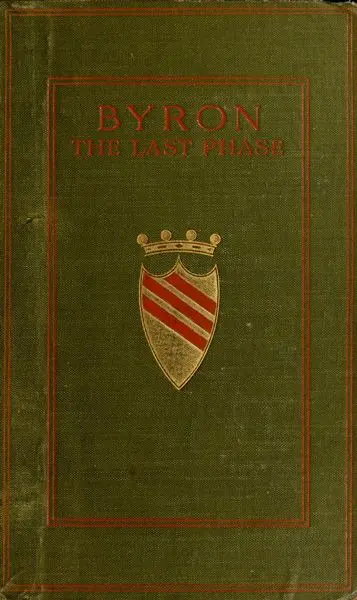
"Byron: The Last Phase" by Richard Edgcumbe is a historical account written in the early 20th century. The work delves into the latter years of the life of Lord Byron, revealing how his experiences and personal transformations, especially during his time in Italy and Greece, diverged from the notorious public persona he had acquired earlier in his life. The narrative particularly focuses on unexplored elements of Byron's character and relationships, particularly involving his friends and lovers. The opening of this biography sets the scene in Pisa around 1821, where Byron has recently arrived with an entourage that includes not just servants but also various pets. Edgcumbe introduces the reader to a contrasting view of Byron—he is described as being visibly changed from the man he once was, showing a disposition more sociable and compassionate. The text meticulously details Byron's physical appearance through the eyes of those who met him, while also hinting at the tumultuous nature of his personal life, including references to his estranged relationships and the lingering impact of his separation from his wife. The introduction builds intrigue around Byron's psychological state and contributions to the Greek War of Independence, setting the stage for a detailed exploration of his character during this pivotal period.
Introduction adapted from the source catalogue; source summaries may be automatically generated.
Free to read · English · 129,526 words · No account needed
MAKE TIME FOR A GOOD BOOK
On by default. Untick to stop anonymous reading totals. Each page counts after 10 seconds in view. How this works.
Anonymous counting is on unless you have switched it off.
Byron, Lord: Letters and Journals of, by Rowland Prothero, 70 n., 256
n., 260 n.;
Life of, by Tom Moore, 365;
Reminiscences of, by G. Finlay, 201;
Sketch of, by Colonel Stanhope, 201
Byron, Captain George (afterwards seventh Lord), 337, 338
Byron, Hon. Augusta. See Leigh, Hon. Mrs. Augusta
Byron, Hon. Augusta Ada (afterwards Lady King and Countess of Lovelace),
Byron's daughter:
separation from her father, 43, 44, 288;
Hobhouse's opinion of, 206, 207;
her health, 363
Byron, Lady (formerly Miss Milbanke):
property and settlements on marriage, 10;
married life, 36, 329 et seq.;
her husband's desire for reconciliation, 36, 46, 206;
on Byron's religion, 77, 78;
the result of first refusal of Byron, 206, 272;
If I am not happy, it will be my own fault, 216;
on Byron's poetry, 219;
on his indiscreet confidences, 270;
her conduct after the birth of Medora, 285, 289, 321 et seq.;
interview with Mrs. Leigh at Reigate, 324;
Mrs. Leigh's long visit to, 336;
birth of a daughter, and her husband's treatment, 337;
steps for a separation taken, 338, 341, 351, 352, 357, 358;
her treatment of the abstracted letters, 340, 357;
attempts to extract a confession from Mrs. Leigh, 322, 324, 341, 357,
361 et seq.;
letters to Mrs. Leigh, 342, 343, 357;
Hodgson's appeal to, 346 et seq.;
text of the signed statement of her conduct, 353 et seq.;
Colonel Doyle's advice, 360;
her husband's letter to Mary Chaworth, 368 et seq.;
and the prospects of Mrs. Leigh's children, 380, 385;
confides in Mrs. Villiers, 381;
letter from Byron, 382;
the weakness of her position, 383, 384;
Cockburn's opinion of, 387;
Lord Lovelace on, 389 et seq.
Campbell, Dr., Presbyterian divine, 55
Campbell, Thomas, Battle of the Baltic, 60
Cariascachi, a Greek chieftain, his treachery, 159 et seq.
Chaworth, Mary (afterwards Mrs. John Musters):
Byron's infatuation for, and references in his poems to, 220 et seq.;
unhappy married life and separation, 243 et seq.;
weakness and repentance, 245 et seq.;
breakdown of health, and reconciliation with her husband, 251;
describes her own character, 252;
birth of Medora, 254, 268;
how the secret was kept by Mrs. Leigh, 255, 285, 287, 317, 321, 362
et seq.;
letters to Byron, 267, 368 et seq.;
last parting with Byron, 283
Childe Harold, what the poem reveals, 228, 229, 232 et seq., 287, 363
Clairmont, Claire:
her anxiety about her daughter Allegra, 22, 23;
her conduct to Byron, 24, 25
Clare, Lord, and Byron, 208
Clermont, Mrs., 337;
her abstraction of Byron's letters, 340 et seq., 378
Cockburn, Sir Alexander, Lord Chief Justice, and the Byron mystery, 358; his opinion of Lady Byron, 387
Coleridge, Ernest Hartley, on identity of Byron's infatuation, 233, 240,
260
Colocotroni, one of the turbulent capitani, 153
Congreve rockets, 92, 93
Corsair, The, what the poem reveals, 240, 262 et seq., 277, 279
Dacre, Lord, 11
Davies, Scrope B., 98, 352;
Byron's letter to, 227
Don Juan, what the poem reveals, 219, 276, 304 et seq.
Dowden, Professor, Life of Shelley: on Byron, 13;
the death of Allegra, 23
Doyle, Colonel Francis:
consulted by Lady Byron as to a separation, 338;
signs Lady Byron's statement of her conduct, 355;
advises Lady Byron to obtain a confession from Mrs. Leigh, 360, 361,
397
Dragomestri, Byron's visit to, 85
Dream, The, what the poem reveals, 289, 290
Duel, The, the poem's application to Mary Chaworth, 298
Your reading position is saved on this browser. Take it to another device with a library code. Reading pages adapt to text, rather than matching a printed edition.
BEHIND THE BOOK
This eBook is for the use of anyone anywhere in the United States and most other parts of the world at no cost and with almost no restrictions whatsoever. You may copy it, give it away or re-use it under the terms of the Project Gutenberg License included with this eBook or online at www.gutenberg.org. If you are not located in the United States, you will have to check the laws of the country where you are located before using this eBook. Read the source licence.
The original source file, including credits and licence, is retained by this library. Request an original-format copy at no charge. Please include the book title and Project Gutenberg identifier #41809.
KEEP YOUR CURIOSITY GOING
Cécile Tormay

Moritz Busch
John L. Ransom
Frances Wright
Cécile Tormay

Mabel Potter Daggett