READ · DISCOVER · ENJOYClassic literature · Always free
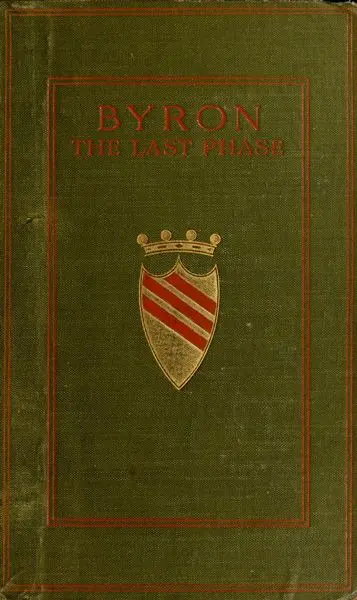
Byron: The Last Phase — digital edition cover

THE CLASSIC COLLECTION · 1909

Byron: The Last Phase

"Byron: The Last Phase" by Richard Edgcumbe is a historical account written in the early 20th century. The work delves into the latter years of the life of Lord Byron, revealing how his experiences and personal transformations, especially during his time in Italy and Greece, diverged from the notorious public persona he had acquired earlier in his life. The narrative particularly focuses on unexplored elements of Byron's character and relationships, particularly involving his friends and lovers. The opening of this biography sets the scene in Pisa around 1821, where Byron has recently arrived with an entourage that includes not just servants but also various pets. Edgcumbe introduces the reader to a contrasting view of Byron—he is described as being visibly changed from the man he once was, showing a disposition more sociable and compassionate. The text meticulously details Byron's physical appearance through the eyes of those who met him, while also hinting at the tumultuous nature of his personal life, including references to his estranged relationships and the lingering impact of his separation from his wife. The introduction builds intrigue around Byron's psychological state and contributions to the Greek War of Independence, setting the stage for a detailed exploration of his character during this pivotal period.

Introduction adapted from the source catalogue; source summaries may be automatically generated.

Start reading ↓

Free to read · English · 129,526 words · No account needed

MAKE TIME FOR A GOOD BOOK

Byron: The Last Phase

On by default. Untick to stop anonymous reading totals. Each page counts after 10 seconds in view. How this works.

Anonymous counting is on unless you have switched it off.

Byron: The Last Phase

INDEX

Adam, Sir F., High Commissioner of the Ionian islands:
his tribute to Byron's character, 202

Agraffa, the scene of Cariascachi's depredations, 162

Allegra, Byron's natural daughter:
her life and death, 22;
Byron's feelings for, 35

Americans, Byron on, 131

Anatoliko, Turkish abandonment of, 68

Argostoli, Byron arrives at, 63

Astarte, by Earl of Lovelace. See Lovelace

Augusta, Stanzas and Epistle to, 290, 324, 364

Barnard, Lady Anne, on Byron's married life, 329 et seq.

Beecher Stowe scandals, 318, 326

Bentham, Jeremy, and Byron, 108 et seq., 119;
amusing anecdote about, 126 et seq.

Berry, Messrs., Byron's wine merchants:
register of Byron's weight, 19

Bible, The, Scott's lines on, 73

Blackwood's Magazine on Byron, 50, 100, 315, 316

Blaquière, Captain, 48;
sails for England, 64;
describes the return of Hatajè to her parents, 137;
eulogy on Byron, 176, 177, 199 et seq.

Blessington, Lady, Conversations of Lord Byron:
describes Byron, 5, 6;
character and reminiscences of Byron, 34 et seq., 40, 41

Bolivar, The, Byron's yacht, sold to Lord Blessington, 32;
her end, 33

Botzari, Marco, 48;
his death, 66

Bowring, Mr., hon. secretary to the Greek Committee, 126

Bride of Abydos, The:
what the poem reveals, 240, 259, 260, 262, 265

Brougham, Mr., spreads the scandal, 340

Broughton, Lord (see Hobhouse, John Cam), Recollections of a Long Life, 201, 247 n., 339 n., 340 n., 359 n.

Browne, Hamilton, goes with Byron to Greece, 47, 48;
Byron's illness, 62;
arrives at Cephalonia, 67

Bruno, Dr., travels with Byron to Greece, 47, 48;
Byron's illness, 59, 62;
medical discussions with Dr. Stravolemo, 79;
his medical treatment of Byron, 124, 163, 166, 168, 169, 193 et
seq.
;
accompanies Byron's body to England, 202;
reply to Fletcher's statement, 403 et seq.;
Dr. Millingen on, 405 et seq.

Brydges, Sir Egerton, 291

Burdett, Sir Francis, 11, 208

Byron, George Gordon (sixth Lord):
arrival and habits of life at Pisa, 3, 11, 20-22;
personal appearance, 4-7;
evidence as to his lameness, 7, 8, 191;
portraits of, 9, 10;
inherits the Noel property on death of Lady Noel, 10, 11;
the society and influence of the Shelleys, 11 et seq.;
discussion on the most perfect ode produced, 11, 12, 58;
religion, 13 et seq.;
habit of vaunting his vices, 17, 18, 78;
abstinence, 18;
weight register, 19;
fracas at Pisa and Montenero, 21, 22;
his natural daughter Allegra, 22 et seq.;
effect of Allegra's death on, 24;
dealings with Leigh Hunt, 26 et seq.;
death of Shelley and Williams, 29, 30;
refuses Shelley's legacy of £2,000, 32;
leaves Pisa with Countess Guiccioli and goes to Albaro, 32;
sells his yacht The Bolivar, 33;
feelings on his own position, and desire for reconciliation with his
wife, 33 et seq.;
admiration for Sir Walter Scott and Shelley, 35;
liaison with Countess Guiccioli, 37, 379, 380;
conduct after separation from his wife, 39 et seq.;
Lady Blessington on, 40;
anomalies, 41;
opinion of his wife, 42;
admiration for his sister, 42;
affection for his child Ada, 43;
craving for celebrity, 45;
takes up the Greek cause, 46;
travels to Greece with money, arms, and retinue, 47;
arrives at Argostoli, 47, 65;
practical sympathy, 48, 67;
an interesting interview with, 48 et seq.;
visits the Fountain of Arethusa, 51-53;
attacks of illness, 51, 52, 59, 62, 63;
excursion to the School of Homer, 54-57;
on the Waverley Novels, 57;
at Vathi, 58;
admiration for Southey, Gifford, and others, 59, 60;
reception at Santa Eufemia, 60;
on actors, 61;
journey over the Black Mountain to Argostoli, 63;
action with regard to dissensions in Greece, 64 et seq.;
resides at Metaxata, 67;
advances £4,000 to the Greeks, 67 et seq.;
appeal to the Greek nation, 69;
motives in coming to Greece, 70, 71, 94;
discussions with Dr. Kennedy on religion, 72 et seq.;
favourite books, 79, 82, 100;
helps to rescue workmen, 80;
sails with money from Zante for Missolonghi to join and help the
Greek fleet, 81, 82;
adventurous voyage, 83-86;
reception at Missolonghi, 88;
releases Turkish prisoners, 89, 90, 132;
preparations against Lepanto, 91;
takes 500 Suliotes into his pay, 91;
and Major Parry, 92 et seq., 143;
Turks blockade Missolonghi, 96;
verses on his birthday, 96;
presentiment that he would never leave Greece, and his intentions, 97;
some reminiscences of, 98 et seq.;
wonderful memory, 102;
a popular idol in Greece, 105;
relations with Mavrocordato, 106, 116;
and Colonel Stanhope, 107 et seq., 120, 121, 122;
Jeremy Bentham, 108;
dealings with the press, 112, 113;
views of the politics of Greece, 114;
effective mode of reproof, 117;
on the useless supplies sent by the London Committee, 119;
abandonment of the Lepanto project, 121;
illness and feelings as to death, 122-125;
dismisses the Suliotes, 125, 142;
anecdote of Jerry Bentham's Cruise, 126 et seq.;
interest in the working classes, 130;
his politics, 131;
on America, 131;
the story of Hatajè, 133 et seq.;
Turkish brig ashore, 139;
firmness and tact in difficulties, 140, 156 et seq.;
desertion of the English artificers, 142, 143;
improvement in his health, 144;
favourite dogs, 145, 227;
daily life, 145, 147;
the unhealthy state of Missolonghi, 146;
bodyguard, 146;
indisposition of, 148;
peasants' respect for, 149;
no desire for self-aggrandizement in Greece, 151 et seq.;
Greek loan raised in London, 156;
receives the freedom of Missolonghi, 157;
Cariascachi's treachery, 159 et seq.;
detailed accounts of his last illness, and death, 163 et seq., 192
et seq., 403 et seq.;
eulogies on, 174 et seq., 201, 205;
Trelawny's opinion of, 178 et seq.;
effect of his death on Greece, 183 et seq., 201;
the funeral oration, 185;
body conveyed to Zante, and thence to England, 198 et seq.;
arrival of the body in England, 202-204;
character sketch by Colonel Stanhope, 205 et seq.;
funeral procession and burial at Hucknall-Torkard, 215, 216;
what the poems reveal, 219 et seq.;
infatuation for Mary Chaworth, 220 et seq.;
mystery of the Thyrza poems, 221 et seq.;
romantic attachment to Edleston, 222, 223, 230, 231;
anecdote of Mary Chaworth's gift, 224;
his mother's death, 227;
on death of his friends, 227, 228;
Childe Harold, 233, 236, 238, 287, 363;
and the Hon. Mrs. George Lamb, 235;
disbelief in existence after death, 239, 240;
in great dejection writes The Giaour, The Bride of Abydos, and
The Corsair, 240, 256 et seq., 277, 278, 281, 303;
and Lady Webster, 240, 241, 259;
persuaded to give up going abroad, 241, 242;
what he wishes the world to believe about Mary Chaworth, 244, 245;
their meetings after her separation from her husband, 246, 258 et
seq.
;
remorse and parting, 249;
suspense and fear preceding the birth of Medora, 253, 260;
reason of separation from his wife, 255;
reproaches Mary Chaworth, 256, 257;
device for a seal, 261, 267;
remarkable letter to Moore, 266;
birth of Medora, 268;
Lara, 268, 271, 273;
partly the cause of the scandal about Mrs. Leigh, 270;
effect of Miss Milbanke's first refusal, 271 et seq.;
Harmodia, 274, 275;
Don Juan, 276, 304 et seq.;
Hebrew Melodies, 277;
Herod's Lament for Mariamne, 278;
his significant communication to his lawyer, 279;
verses to Mary Chaworth, 280, 281;
fear of disgrace, 281;
important correspondence with Murray, 282, 283;
last meeting with Mary Chaworth, 283;
how the secret was kept, 285;
verses to his sister, 286, 287;
The Dream, 289, 290;
Stanzas to Augusta, 290, 364;
Manfred, 291 et seq., 328, 364;
his treatment of the scandal, 291, 317, 320;
The Duel, 293, 298;
The Lament of Tasso, 297;
Stanzas to the Po, 298 et seq., 370;
Last Words on Greece, 311;
on his separation from his wife, 315 et seq.;
Mrs. Leigh's so-called confession, 319 et seq., 356 et seq., 368;
Epistle to Augusta, 324;
story of his married life, 329 et seq.;
Sir Ralph Noel requires a separation, 339;
Lady Jersey's party, 352;
parts for the last time from his sister, 352, 366, 392;
consents to separation from his wife, 352;
Lady Byron's written statement of complaints, 353;
letter to Lady Byron as to his will, 355;
Moore's life of, 365 et seq.;
writes to Moore about the scandal, 367;
letter supposed to be written to Mary Chaworth, 368 et seq.;
letter compared with one to his sister, 372;
writes to Lady Byron as to the memoir of his life, 382;
asks Lady Byron to make provision for Mrs. Leigh's children, 385, 388;
Goethe on, 400, 401

Your reading position is saved on this browser. Take it to another device with a library code. Reading pages adapt to text, rather than matching a printed edition.

BEHIND THE WORDS

About Richard Edgcumbe

Richard Edgcumbe (1843–1937). Explore Byron: The Last Phase in this collection. These books span biography & memoir, history.

Explore this author’s books →

THE READERS’ VERDICT

How did this story stay with you?

Not rated yet
Your rating for Byron: The Last Phase

Be the first to share your verdict.

One rating per browser, which you can change or remove. A necessary browser identifier remembers your vote. How ratings work

A GOOD STORY DESERVES COMPANY

Pass this book along.

A great read is even better when it’s shared.

SEND A LITTLE INSPIRATION

Share this book

BEHIND THE BOOK

Edition & source details.

Title
Byron: The Last Phase
Author
Richard Edgcumbe
First publication (Open Library catalogue match)
1909
Digital edition publisher
Project Gutenberg
Gutenberg release date
2013-01-10
Language
English
Source edition imprint
Not stated in source catalogue
Source identifier
Project Gutenberg #41809
Contributors
No additional named contributors in source metadata

Public-domain source & licence

This eBook is for the use of anyone anywhere in the United States and most other parts of the world at no cost and with almost no restrictions whatsoever. You may copy it, give it away or re-use it under the terms of the Project Gutenberg License included with this eBook or online at www.gutenberg.org. If you are not located in the United States, you will have to check the laws of the country where you are located before using this eBook. Read the source licence.

Full source licence and obtaining an original copy

The original source file, including credits and licence, is retained by this library. Request an original-format copy at no charge. Please include the book title and Project Gutenberg identifier #41809.

the full Project Gutenberg License must appear
prominently whenever any copy of a Project Gutenberg work (any work
on which the phrase “Project Gutenberg” appears, or with which the
phrase “Project Gutenberg” is associated) is accessed, displayed,
performed, viewed, copied or distributed:

This eBook is for the use of anyone anywhere in the United States and most
other parts of the world at no cost and with almost no restrictions
whatsoever. You may copy it, give it away or re-use it under the terms
of the Project Gutenberg™ License included with this eBook or online
at www.gutenberg.org. If you
are not located in the United States, you will have to check the laws
of the country where you are located before using this eBook.

1.E.2. If an individual Project Gutenberg electronic work is
derived from texts not protected by U.S. copyright law (does not
contain a notice indicating that it is posted with permission of the
copyright holder), the work can be copied and distributed to anyone in
the United States without paying any fees or charges. If you are
redistributing or providing access to a work with the phrase “Project
Gutenberg” associated with or appearing on the work, you must comply
either with the requirements of paragraphs 1.E.1 through 1.E.7 or
obtain permission for the use of the work and the Project Gutenberg
trademark as set forth in paragraphs 1.E.8 or 1.E.9.

1.E.3. If an individual Project Gutenberg electronic work is posted
with the permission of the copyright holder, your use and distribution
must comply with both paragraphs 1.E.1 through 1.E.7 and any
additional terms imposed by the copyright holder. Additional terms
will be linked to the Project Gutenberg License for all works
posted with the permission of the copyright holder found at the
beginning of this work.

1.E.4. Do not unlink or detach or remove the full Project Gutenberg
License terms from this work, or any files containing a part of this
work or any other work associated with Project Gutenberg.

1.E.5. Do not copy, display, perform, distribute or redistribute this
electronic work, or any part of this electronic work, without
prominently displaying the sentence set forth in paragraph 1.E.1 with
active links or immediate access to the full terms of the Project
Gutenberg License.

1.E.6. You may convert to and distribute this work in any binary,
compressed, marked up, nonproprietary or proprietary form, including
any word processing or hypertext form. However, if you provide access
to or distribute copies of a Project Gutenberg work in a format
other than “Plain Vanilla ASCII” or other format used in the official
version posted on the official Project Gutenberg website
(www.gutenberg.org), you must, at no additional cost, fee or expense
to the user, provide a copy, a means of exporting a copy, or a means
of obtaining a copy upon request, of the work in its original “Plain
Vanilla ASCII” or other form. Any alternate format must include the
full Project Gutenberg License as specified in paragraph 1.E.1.

1.E.7. Do not charge a fee for access to, viewing, displaying,
performing, copying or distributing any Project Gutenberg works
unless you comply with paragraph 1.E.8 or 1.E.9.

1.E.8. You may charge a reasonable fee for copies of or providing
access to or distributing Project Gutenberg electronic works
provided that:

• You pay a royalty fee of 20% of the gross profits you derive from
the use of Project Gutenberg works calculated using the method
you already use to calculate your applicable taxes. The fee is owed
to the owner of the Project Gutenberg trademark, but he has
agreed to donate royalties under this paragraph to the Project
Gutenberg Literary Archive Foundation. Royalty payments must be paid
within 60 days following each date on which you prepare (or are
legally required to prepare) your periodic tax returns. Royalty
payments should be clearly marked as such and sent to the Project
Gutenberg Literary Archive Foundation at the address specified in
Section 4, “Information about donations to the Project Gutenberg
Literary Archive Foundation.”

• You provide a full refund of any money paid by a user who notifies
you in writing (or by e-mail) within 30 days of receipt that s/he
does not agree to the terms of the full Project Gutenberg™
License. You must require such a user to return or destroy all
copies of the works possessed in a physical medium and discontinue
all use of and all access to other copies of Project Gutenberg™
works.

• You provide, in accordance with paragraph 1.F.3, a full refund of
any money paid for a work or a replacement copy, if a defect in the
electronic work is discovered and reported to you within 90 days of
receipt of the work.

• You comply with all other terms of this agreement for free
distribution of Project Gutenberg™ works.


1.E.9. If you wish to charge a fee or distribute a Project
Gutenberg™ electronic work or group of works on different terms than
are set forth in this agreement, you must obtain permission in writing
from the Project Gutenberg Literary Archive Foundation, the manager of
the Project Gutenberg™ trademark. Contact the Foundation as set
forth in Section 3 below.

1.F.

1.F.1. Project Gutenberg volunteers and employees expend considerable
effort to identify, do copyright research on, transcribe and proofread
works not protected by U.S. copyright law in creating the Project
Gutenberg™ collection. Despite these efforts, Project Gutenberg™
electronic works, and the medium on which they may be stored, may
contain “Defects,” such as, but not limited to, incomplete, inaccurate
or corrupt data, transcription errors, a copyright or other
intellectual property infringement, a defective or damaged disk or
other medium, a computer virus, or computer codes that damage or
cannot be read by your equipment.

1.F.2. LIMITED WARRANTY, DISCLAIMER OF DAMAGES - Except for the “Right
of Replacement or Refund” described in paragraph 1.F.3, the Project
Gutenberg Literary Archive Foundation, the owner of the Project
Gutenberg™ trademark, and any other party distributing a Project
Gutenberg™ electronic work under this agreement, disclaim all
liability to you for damages, costs and expenses, including legal
fees. YOU AGREE THAT YOU HAVE NO REMEDIES FOR NEGLIGENCE, STRICT
LIABILITY, BREACH OF WARRANTY OR BREACH OF CONTRACT EXCEPT THOSE
PROVIDED IN PARAGRAPH 1.F.3. YOU AGREE THAT THE FOUNDATION, THE
TRADEMARK OWNER, AND ANY DISTRIBUTOR UNDER THIS AGREEMENT WILL NOT BE
LIABLE TO YOU FOR ACTUAL, DIRECT, INDIRECT, CONSEQUENTIAL, PUNITIVE OR
INCIDENTAL DAMAGES EVEN IF YOU GIVE NOTICE OF THE POSSIBILITY OF SUCH
DAMAGE.

1.F.3. LIMITED RIGHT OF REPLACEMENT OR REFUND - If you discover a
defect in this electronic work within 90 days of receiving it, you can
receive a refund of the money (if any) you paid for it by sending a
written explanation to the person you received the work from. If you
received the work on a physical medium, you must return the medium
with your written explanation. The person or entity that provided you
with the defective work may elect to provide a replacement copy in
lieu of a refund. If you received the work electronically, the person
or entity providing it to you may choose to give you a second
opportunity to receive the work electronically in lieu of a refund. If
the second copy is also defective, you may demand a refund in writing
without further opportunities to fix the problem.

1.F.4. Except for the limited right of replacement or refund set forth
in paragraph 1.F.3, this work is provided to you ‘AS-IS’, WITH NO
OTHER WARRANTIES OF ANY KIND, EXPRESS OR IMPLIED, INCLUDING BUT NOT
LIMITED TO WARRANTIES OF MERCHANTABILITY OR FITNESS FOR ANY PURPOSE.

1.F.5. Some states do not allow disclaimers of certain implied
warranties or the exclusion or limitation of certain types of
damages. If any disclaimer or limitation set forth in this agreement
violates the law of the state applicable to this agreement, the
agreement shall be interpreted to make the maximum disclaimer or
limitation permitted by the applicable state law. The invalidity or
unenforceability of any provision of this agreement shall not void the
remaining provisions.

1.F.6. INDEMNITY - You agree to indemnify and hold the Foundation, the
trademark owner, any agent or employee of the Foundation, anyone
providing copies of Project Gutenberg™ electronic works in
accordance with this agreement, and any volunteers associated with the
production, promotion and distribution of Project Gutenberg™
electronic works, harmless from all liability, costs and expenses,
including legal fees, that arise directly or indirectly from any of
the following which you do or cause to occur: (a) distribution of this
or any Project Gutenberg work, (b) alteration, modification, or
additions or deletions to any Project Gutenberg work, and (c) any
Defect you cause.

Section 2. Information about the Mission of Project Gutenberg

Project Gutenberg is synonymous with the free distribution of
electronic works in formats readable by the widest variety of
computers including obsolete, old, middle-aged and new computers. It
exists because of the efforts of hundreds of volunteers and donations
from people in all walks of life.

Volunteers and financial support to provide volunteers with the
assistance they need are critical to reaching Project Gutenberg’s
goals and ensuring that the Project Gutenberg collection will
remain freely available for generations to come. In 2001, the Project
Gutenberg Literary Archive Foundation was created to provide a secure
and permanent future for Project Gutenberg and future
generations. To learn more about the Project Gutenberg Literary
Archive Foundation and how your efforts and donations can help, see
Sections 3 and 4 and the Foundation information page at www.gutenberg.org.

Section 3. Information about the Project Gutenberg Literary Archive Foundation

The Project Gutenberg Literary Archive Foundation is a non-profit
501(c)(3) educational corporation organized under the laws of the
state of Mississippi and granted tax exempt status by the Internal
Revenue Service. The Foundation’s EIN or federal tax identification
number is 64-6221541. Contributions to the Project Gutenberg Literary
Archive Foundation are tax deductible to the full extent permitted by
U.S. federal laws and your state’s laws.

The Foundation’s business office is located at 41 Watchung Plaza #516,
Montclair NJ 07042, USA, +1 (862) 621-9288. Email contact links and up
to date contact information can be found at the Foundation’s website
and official page at www.gutenberg.org/contact

Section 4. Information about Donations to the Project Gutenberg
Literary Archive Foundation

Project Gutenberg™ depends upon and cannot survive without widespread
public support and donations to carry out its mission of
increasing the number of public domain and licensed works that can be
freely distributed in machine-readable form accessible by the widest
array of equipment including outdated equipment. Many small donations
($1 to $5,000) are particularly important to maintaining tax exempt
status with the IRS.

The Foundation is committed to complying with the laws regulating
charities and charitable donations in all 50 states of the United
States. Compliance requirements are not uniform and it takes a
considerable effort, much paperwork and many fees to meet and keep up
with these requirements. We do not solicit donations in locations
where we have not received written confirmation of compliance. To SEND
DONATIONS or determine the status of compliance for any particular state
visit www.gutenberg.org/donate.

While we cannot and do not solicit contributions from states where we
have not met the solicitation requirements, we know of no prohibition
against accepting unsolicited donations from donors in such states who
approach us with offers to donate.

International donations are gratefully accepted, but we cannot make
any statements concerning tax treatment of donations received from
outside the United States. U.S. laws alone swamp our small staff.

Please check the Project Gutenberg web pages for current donation
methods and addresses. Donations are accepted in a number of other
ways including checks, online payments and credit card donations. To
donate, please visit: www.gutenberg.org/donate.

Section 5. General Information About Project Gutenberg electronic works

Professor Michael S. Hart was the originator of the Project
Gutenberg concept of a library of electronic works that could be
freely shared with anyone. For forty years, he produced and
distributed Project Gutenberg eBooks with only a loose network of
volunteer support.

Project Gutenberg eBooks are often created from several printed
editions, all of which are confirmed as not protected by copyright in
the U.S. unless a copyright notice is included. Thus, we do not
necessarily keep eBooks in compliance with any particular paper
edition.

Most people start at our website which has the main PG search
facility: www.gutenberg.org.

This website includes information about Project Gutenberg,
including how to make donations to the Project Gutenberg Literary
Archive Foundation, how to help produce our new eBooks, and how to
subscribe to our email newsletter to hear about new eBooks.


KEEP YOUR CURIOSITY GOING

Your next chapter awaits.