THE CLASSIC COLLECTION✦An outlaw’s diary: the CommuneCLASSIC FREE BOOKS
An outlaw’s diary: the Commune
Cécile Tormay
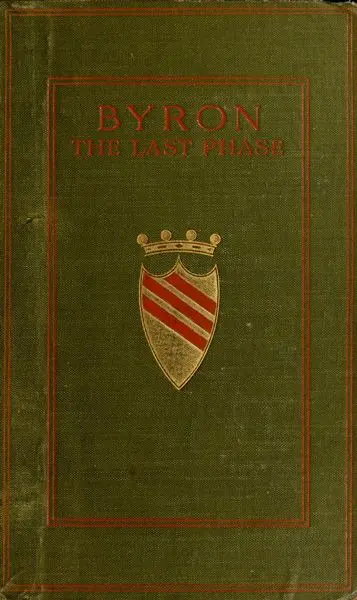
THE CLASSIC COLLECTION · 1909
"Byron: The Last Phase" by Richard Edgcumbe is a historical account written in the early 20th century. The work delves into the latter years of the life of Lord Byron, revealing how his experiences and personal transformations, especially during his time in Italy and Greece, diverged from the notorious public persona he had acquired earlier in his life. The narrative particularly focuses on unexplored elements of Byron's character and relationships, particularly involving his friends and lovers. The opening of this biography sets the scene in Pisa around 1821, where Byron has recently arrived with an entourage that includes not just servants but also various pets. Edgcumbe introduces the reader to a contrasting view of Byron—he is described as being visibly changed from the man he once was, showing a disposition more sociable and compassionate. The text meticulously details Byron's physical appearance through the eyes of those who met him, while also hinting at the tumultuous nature of his personal life, including references to his estranged relationships and the lingering impact of his separation from his wife. The introduction builds intrigue around Byron's psychological state and contributions to the Greek War of Independence, setting the stage for a detailed exploration of his character during this pivotal period.
Introduction adapted from the source catalogue; source summaries may be automatically generated.
Free to read · English · 129,526 words · No account needed
MAKE TIME FOR A GOOD BOOK
On by default. Untick to stop anonymous reading totals. Each page counts after 10 seconds in view. How this works.
Anonymous counting is on unless you have switched it off.
Edleston, a chorister at Cambridge:
Byron saves his life and forms a romantic attachment to, 222;
his death, 230, 231
Elphinstone, Miss Mercer, and Byron, 311
Fenton, Captain, 180
Finlay, George, History of Greece:
the siege of Missolonghi, 70;
Byron's mode of life at Missolonghi, 98 et seq., 148;
on Byron, 176;
Reminiscences of Byron, 201;
Byron's last illness, 405
Fletcher, Byron's valet:
Byron's last ride, 164;
ignorance of the doctors, 165, 166;
Byron's last illness and death, 170, 171, 252;
his statement, 192 et seq.;
accompanies Byron's body to England, 202;
Dr. Bruno's reply to the statement, 403 et seq.;
Dr. Millingen's account of Byron's last illness, 405 et seq.
Florida, the brig, brings the loan to Greece, and conveys back Byron's body, 199 et seq.
Freiber, Dr., German physician, attends Byron, 169
Gamba, Count Pietro:
on Byron's religious opinions, 16, 17;
fracas at Pisa, 20;
goes to Albaro, 32;
travels with Byron to Greece, 47, 48;
on Byron's perseverance and discernment, 65;
on Byron's favourite reading, 79;
Byron's practical sympathy, 80;
accompanies Byron to Missolonghi, 83;
taken prisoner by the Turks, 84;
release and arrival at Missolonghi, 85;
the General Assembly at Missolonghi, 88;
Byron's interview with the two privateer sailors, 91;
becomes editor of the Greek Telegraph, 114;
Byron's illness, 121, 143, 148, 163 et seq.;
arrest of English officers, 157;
Byron's funeral, 184;
conveys Byron's body to Zante, 198
Gamba, Count Ruggiero, Byron's neighbour at Pisa, 3;
leaves Pisa and goes to Montenero, 21;
ordered to leave Montenero, 22;
goes to Albaro, 32;
and Byron, 212
Gamba, Teresa. See Guiccioli, Countess
Gell, Sir William, his writings, 100, 101 n.
George IV. makes 'equivocation' the fashion, 17, 18;
and Sir Walter Scott, 53
Giaour, The, what the poem reveals, 240, 256, 257, 265
Gifford, William, Byron's opinion of, 51, 60
Greece:
Byron sails for, 47;
state of the country and army, 64, 87 et seq., 118, 180;
Byron advances £4,000, 67;
Byron's appeal to the nation, 69, 70;
preparations against Lepanto, 91;
honours offered to Byron, 151, 152;
Congress at Salona, 153;
Greek loan raised in London, 156;
effect of Byron's death on, 175 et seq.
Greece, History of, by G. Finlay, 70;
by Mitford, 100
Greek Chronicle:
Byron's support, 108;
suppression of, 112, 113
Greek Telegraph, 103, 113
Guiccioli, Countess, daughter of Count Ruggiero Gamba:
Byron's neighbour at Pisa, 3, 4, 20;
describes Byron, 7 et seq.;
on the characters of Shelley and Byron, 14, 15;
on Byron's conduct towards Allegra, 23;
on Byron's religion, 74, 78;
anecdote about Mary Chaworth's ring, 224;
Lady of the Land, 298, 301, 370;
and Mrs. Leigh, 379
Hancock, Charles, Byron's banker, 82
Hanson, John, Byron's solicitor, 241, 345, 346
Harmodia, 274, 275
Hatajè, Byron's kindness to, 133 et seq.
Hay, Captain, fracas at Pisa, 20, 21
Hebrew Melodies, 277
Hercules, the, an English brig:
Byron and his suite sail to Greece in it, 47;
Byron lives on board, 64, 65
Herod's Lament for Mariamne, 278
Hesketh, Mr., 158, 159
Heywood, Sergeant, consulted by Lady Byron, 338
Hobhouse, John Cam (afterwards Lord Broughton):
and Byron, 35;
persuades Byron to burn his journal, 102;
destroys one of Byron's poems, 208;
Byron's funeral, 215, 216;
and Lady Byron, 216, 320;
life-long friend of Mrs. Leigh, 319.
See also Broughton, Lord
Hodgson, captain of the Florida, 203
Hodgson, Rev. Francis:
consulted by Mrs. Leigh, 344 et seq.;
appeals to Lady Byron, 346 et seq.
Your reading position is saved on this browser. Take it to another device with a library code. Reading pages adapt to text, rather than matching a printed edition.
BEHIND THE BOOK
This eBook is for the use of anyone anywhere in the United States and most other parts of the world at no cost and with almost no restrictions whatsoever. You may copy it, give it away or re-use it under the terms of the Project Gutenberg License included with this eBook or online at www.gutenberg.org. If you are not located in the United States, you will have to check the laws of the country where you are located before using this eBook. Read the source licence.
The original source file, including credits and licence, is retained by this library. Request an original-format copy at no charge. Please include the book title and Project Gutenberg identifier #41809.
KEEP YOUR CURIOSITY GOING
Cécile Tormay

Moritz Busch
John L. Ransom
Frances Wright
Cécile Tormay

Mabel Potter Daggett