THE CLASSIC COLLECTION✦My diaries, being a personal narrative of events 1888-1914, Part 2 (1900-1914)CLASSIC FREE BOOKS
My diaries, being a personal narrative of events 1888-1914, Part 2 (1900-1914)
Wilfrid Scawen Blunt
THE CLASSIC COLLECTION · 1899
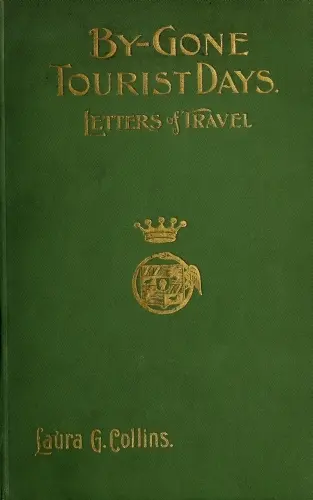
"By-gone Tourist Days: Letters of Travel" by Laura G. Case Collins is a collection of travel letters written in the late 19th century. The letters chronicle the author's extensive travels across Europe, capturing her experiences and reflections in various cities such as London, Edinburgh, Heidelberg, and Paris. Collins' charming narrative style provides a vivid depiction of her observations on culture, architecture, and personal encounters during her journeys. At the start of the work, the author reflects on the tumultuous journey across the Atlantic aboard the steamer Adriatic, where she details the challenges of seasickness and the peculiar beauty of the turbulent ocean. Transitioning to her experiences in England, Collins explores historic cities like Chester and Stratford-upon-Avon, including visits to notable sites such as Shakespeare's birthplace. The opening letters set a tone of wonder and admiration for the landscapes and cultural treasures she encounters, while also sharing personal anecdotes and interactions with locals, effectively intertwining travel journalism with personal memoir.
Introduction adapted from the source catalogue; source summaries may be automatically generated.
Free to read · English · 67,404 words · No account needed
MAKE TIME FOR A GOOD BOOK
On by default. Untick to stop anonymous reading totals. Each page counts after 10 seconds in view. How this works.
Anonymous counting is on unless you have switched it off.
Alexander Swift says, “Every true Scotsman thinks Edinburgh the most picturesque city in the world.” No wonder. It certainly possesses every feature requisite to constitute that preeminence--“hill, crag, castle, rock, blue stretch of sea, the picturesque ridge of the old town, the squares and terraces of the new”--the quaint streets with their ancient houses “peaked and jagged by gable and roof, and windowed from basement to cope” with those small diamond-paned sashes that seem meant only “to make darkness visible,” and yet other streets of a later and more stately architecture; the Nor’ Lock converted into a dreamland of park and gardens; the splendid monuments arresting the eye in every direction to recall the illustrious dead and give proof of the appreciation and taste of the living; the hills, crags and slopes that “stand dressed in living green,” and the squares and terraces a mass of verdure and flowers--all these and more are the charms of this “Edina, Scotia’s darling.” Add to them the innumerable resorts, historic, beautiful, grand!--Oh! everything--all around in every direction, and one’s sympathy leaps forth to meet that of “every Scotsman.”
Now, shall I tell you what a “Bohemian” I have grown to be? Perhaps you will be shocked, but really it is the most fascinating life conceivable, and not to be condemned untried. We go where, and when, and how we please; en grandes dames, in the conventional splendor of full dress and the swellest turnout of the stand, this always “under protest.” Oftener, we set our own “locomotives” to the way and find unsuspected Edens. But oftenest and to my heart’s delight, we mount to a super-royal perch atop of the “tram,” as the street car is called here, and “view the landscape o’er” at such advantage as no crown or throne can command. And that’s the way we went to Morning Side, Edinburgh’s Clifton, and to Portobello, its sea-bathing resort. Don’t be alarmed though; we are not setting a fashion, only following one already established. If only this mode of traveling were practicable for everywhere. Alas! instead the railway comes in to sadly curtail the enchantment of “views.” We had to submit to it in order to see Roslyn Chapel, that ideal morceau of architecture, that exquisite efflorescence of solid rock, that chapel of chapels, “one among ten thousand and altogether lovely.” First we struck through Hawthorden, a walk of three miles, beginning with an ordinary park that quickly led to an ivy-mantled ruin, hung on the very brink of a beetling crag, the rock-ribbed foundation of which dropped almost sheer to a swift and clamorous stream two or three hundred feet below. In this underlying basement of rock, queer caverns had been hewn, but farther back than dates reach. We explored them notwithstanding some hesitation, which, however, gave way to the liveliest enthusiasm. In one we came across a sword of Robert Bruce in an open wire case. The meshes were about an inch in length; by counting them I found the sword measured fifty-eight inches. I wondered how much taller the warrior was than his weapon of warfare! Leaving these caverns we were soon descending a path that brought us to the edge of the stream and then ran along it the rest of the way. Anything wilder or more beautiful is rarely met, but I have seen Trenton Falls in my own native land, and it surpasses. Climbing the hill again at the end of the three miles we reached the chapel. Another day we spent at Dunfermline. In the Abbey we stood on the grave of Robert Bruce; it is right under the pulpit. In the ancient and long-disused, but well-preserved, nave we saw that inexplicable caprice or trick of architecture, one of the great Norman columns that scanned from one place shows the upper half much smaller than the lower; from another, the reverse effect, and from yet another, a pillar of perfect proportion. The ruins of the old palace and part of the abbey are very touching and beautiful. It too has “a den,” as every deep wooded and rocky glen with a stream running through its dark length is called. We sat on the rustic seat under a grand old tree and looked at the ruins and moralized, raved over the vistas, shadows, flashing sunlight and--munched our lunch. Saturday we skimmed away on the wings of the delicious morning as well as the wings of steam to Dalkeith and Newbattle Abbey to spend the day between the two. The former is the favorite seat of the Duke of Buccleugh, the latter that of his son-in-law, the Marquis of Lothian. The ducal palace is positively ugly; but it has its complement of grand state apartments filled with fine pictures and the usual quota of superb articles of vertu and bric-a-brac.
Your reading position is saved on this browser. Take it to another device with a library code. Reading pages adapt to text, rather than matching a printed edition.
BEHIND THE BOOK
This eBook is for the use of anyone anywhere in the United States and most other parts of the world at no cost and with almost no restrictions whatsoever. You may copy it, give it away or re-use it under the terms of the Project Gutenberg License included with this eBook or online at www.gutenberg.org. If you are not located in the United States, you will have to check the laws of the country where you are located before using this eBook. Read the source licence.
The original source file, including credits and licence, is retained by this library. Request an original-format copy at no charge. Please include the book title and Project Gutenberg identifier #48728.
KEEP YOUR CURIOSITY GOING
Wilfrid Scawen Blunt
Wilfrid Scawen Blunt

E. W. (Edgar Watson) Howe

David Patterson (Spirit) Hatch

David Patterson (Spirit) Hatch

David Patterson (Spirit) Hatch