THE CLASSIC COLLECTION✦An outlaw’s diary: the CommuneCLASSIC FREE BOOKS
An outlaw’s diary: the Commune
Cécile Tormay
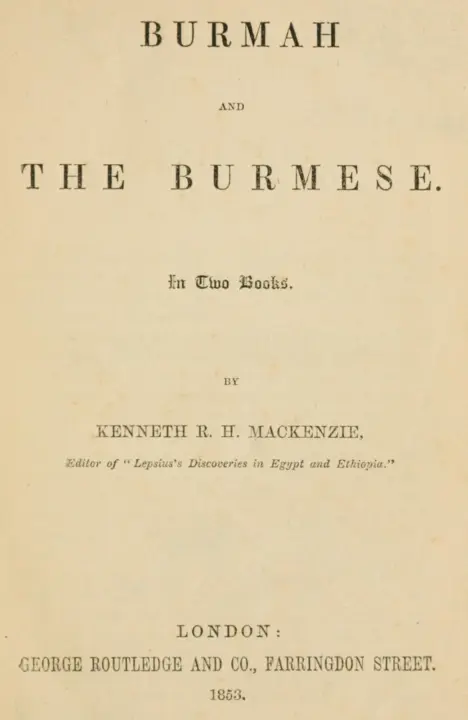
THE CLASSIC COLLECTION · 1853
"Burmah and the Burmese" by Kenneth R. H. Mackenzie is a historical account written in the mid-19th century. The work provides a comprehensive exploration of Burmah (now Myanmar) and its people, focusing on the socio-political landscape, including details about the government, culture, and the backdrop of war during that period. This narrative aims to elucidate the customs and societal conditions of the Burmese, highlighting their strengths, as well as examining the oppressive reign of their king. The opening of the book begins with a preface that discusses the implications of the ongoing war in Burmah while expressing hope that British intervention could lead to improved governance and civil liberties for the Burmese people. Mackenzie touches on the complexities of Burmese civilization, emphasizing both its rich culture and the despotic nature of its rulers. He highlights significant geographical features, such as the Irawadi River, and mentions the wealth of natural resources in the land, alluding to the economic potential that remains untapped under the current governance. The narrative sets the tone for a detailed investigation of Burmese society, its history, and the challenges it faces amid colonial ambitions.
Introduction adapted from the source catalogue; source summaries may be automatically generated.
Free to read · English · 84,457 words · No account needed
MAKE TIME FOR A GOOD BOOK
On by default. Untick to stop anonymous reading totals. Each page counts after 10 seconds in view. How this works.
Anonymous counting is on unless you have switched it off.
[195] Journ. Asiat. Soc. Bengal, vol. v. p. 164.
[196] One of the king of Ava’s titles is Nedwet bhuyen—Sun-descended monarch. Strange coincidence with the Inca boast!
[197] Mr. Judson has given us a translation of a chronological summary, which is of extreme value. It is now, together with the text, in the British Museum.—(Additional MS., No. 12,400.)
[198] Symes, vol. ii. p. 51 sqq.
[199] Ib. id. p. 55.
[200] Symes, vol. ii. p. 58.
[201] Malcom, vol. i. p. 220.
[202] Sangermano, p. 119.
[203] Ibid.
[204] Sangermano, p. 120.
[205] Ibid.
[206] Symes, Ava, vol. i. p. 1.
[207] The particulars will be found in Captain Drury’s paper in No. V. of the Journal of the Asiatic Society of Bengal for 1851; and in Allen’s Indian Mail, vol. x. p. 265.
[208] Burmese Empire, p. 47.
[209] Ava, vol. i. p. 12.
[210] My sketch of the Burmese revolution is derived from Symes.
[211] The first is a Burmese word signifying victory; the second, Pali, for the same.—Crawfurd, vol. ii. p. 281.
[212] Jancigny, Indo-Chine, p. 255.
[213] See book i. chap. ii. p. 40.
[214] Ava, vol. i. p. 34.
[215] So Symes always spells the word. It is now generally spelt Burmans.
[216] Symes, vol. i. pp. 43-49.
[217] Ava, vol. i. pp. 53-55.
[218] Vol. i. pp. 56-57.
[219] Symes, vol. i. p. 67.
[220] Compare the following observations of a late excellent writer upon India. “M. Dupleix’s wonderful talent for diplomacy and intrigue soon obtained signal triumphs. His emissaries were everywhere; and the native princes were all as fickle as faithless. In his intrigues with them he is said to have derived wonderful assistance from his wife, who was born in India, and perfectly understood not only the languages, but also the character of the natives. In his union with this lady, who is described as being even more ambitious than himself, we may probably trace the cause of the essentially Oriental spirit of many of his proceedings.”—Macfarlane’s History of British India, chap. iii. p. 31. We shall, hereafter, have occasion to return to this work, in connection with the Burmese war in 1824-26.
[221] Symes, vol. i. pp. 70-72.
[222] Sangermano, however, shows, by the ordinance of the port, that the seizure of the vessel and its contents was nothing remarkable.—See his Burmese Empire, p. 170.
[223] Vol. i. p. 74.
[224] Book i. chap. vi. p. 103.
[225] Symes, vol. i. p. 76.
[226] Book i. chap. iii. p. 56.
[227] Symes, vol. i. p. 81.
[228] Symes, vol. i. pp. 83-88.
[229] Ava, vol. i. p. 96.
[230] Symes, vol. i. pp. 106-109.
[231] Ib. id. pp. 113-115.
[232] Symes, vol. i. p. 120 sqq.
[233] Burmese Empire, p. 48.
[234] Ava, vol. i. p. 124.
[235] Symes, vol. i. p. 147 sq.
[236] Burmese Empire, p. 49.
[237] Symes, vol. i. p. 150.
[238] Ib. id. p. 151.
[239] Ib. id. p. 191 sqq.
[240] Symes alludes to the fate of Louis XVI.
[241] See book i. chap. iv. p. 78.
[242] I continue the narrative in the words of Sangermano, p. 50.
Your reading position is saved on this browser. Take it to another device with a library code. Reading pages adapt to text, rather than matching a printed edition.
BEHIND THE BOOK
This eBook is for the use of anyone anywhere in the United States and most other parts of the world at no cost and with almost no restrictions whatsoever. You may copy it, give it away or re-use it under the terms of the Project Gutenberg License included with this eBook or online at www.gutenberg.org. If you are not located in the United States, you will have to check the laws of the country where you are located before using this eBook. Read the source licence.
The original source file, including credits and licence, is retained by this library. Request an original-format copy at no charge. Please include the book title and Project Gutenberg identifier #64271.
KEEP YOUR CURIOSITY GOING
Cécile Tormay

Moritz Busch
John L. Ransom
Frances Wright
Cécile Tormay

Mabel Potter Daggett