THE CLASSIC COLLECTION✦An outlaw’s diary: the CommuneCLASSIC FREE BOOKS
An outlaw’s diary: the Commune
Cécile Tormay
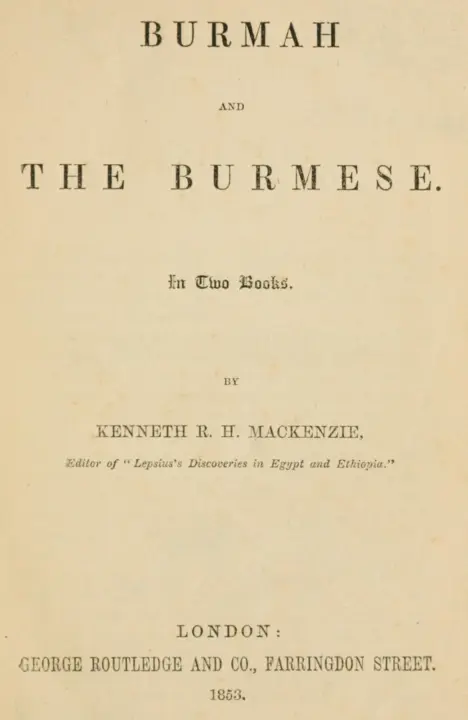
THE CLASSIC COLLECTION · 1853
"Burmah and the Burmese" by Kenneth R. H. Mackenzie is a historical account written in the mid-19th century. The work provides a comprehensive exploration of Burmah (now Myanmar) and its people, focusing on the socio-political landscape, including details about the government, culture, and the backdrop of war during that period. This narrative aims to elucidate the customs and societal conditions of the Burmese, highlighting their strengths, as well as examining the oppressive reign of their king. The opening of the book begins with a preface that discusses the implications of the ongoing war in Burmah while expressing hope that British intervention could lead to improved governance and civil liberties for the Burmese people. Mackenzie touches on the complexities of Burmese civilization, emphasizing both its rich culture and the despotic nature of its rulers. He highlights significant geographical features, such as the Irawadi River, and mentions the wealth of natural resources in the land, alluding to the economic potential that remains untapped under the current governance. The narrative sets the tone for a detailed investigation of Burmese society, its history, and the challenges it faces amid colonial ambitions.
Introduction adapted from the source catalogue; source summaries may be automatically generated.
Free to read · English · 84,457 words · No account needed
MAKE TIME FOR A GOOD BOOK
On by default. Untick to stop anonymous reading totals. Each page counts after 10 seconds in view. How this works.
Anonymous counting is on unless you have switched it off.
[243] According to Malcom (vol. i. p. 157), the fourth son.
[244] His reign, however, included eleven days.—Symes, vol. i. p. 227.
[245] My chief authority is Symes, vol. i. p. 218 sq.
[246] Symes, vol. i. pp. 221-224. Sangermano’s account, it will be perceived, is somewhat different.
[247] Ava, vol. i. p. 231.
[248] See book i. chap. ii. p. 40.
[249] My chief authority is Crawfurd, vol. ii. pp. 1-9.
[250] Ava, vol. ii, p. 5.
[251] Ib. id. p. 6.
[252] Ava, vol. i. p. 131.
[253] Ava, vol. i. p. 133.
[254] Symes, vol. i. p. 138.
[255] Alves in Journal quoted by Symes, vol. i. p. 140.
[256] Bassein.
[257] Symes, vol. i. p. 142.
[258] Marquis Wellesley’s Indian Despatches, &c.
[259] Macfarlane’s History of British India, p. 355.
[260] Macfarlane, l.c.
[261] In 1802 Symes again visited Burmah for a diplomatic purpose; but his letters, while they modify his book, add little of value to our knowledge of the country.
[262] This is, however, very problematical. Mr. Macfarlane cannot have forgotten the whole previous history of European intercourse with the country, and how many distinctions and quibblings were brought forward at different times upon that plea.
[263] Travels, vol. i. p. 159.
[264] See Sangermano, p. 113.
[265] Wilson’s Narrative of the Burmese War, p. 1 of the reprint of 1852.
[266] Wilson, p. 25.
[267] Wilson, p. 29 sq.
[268] Macfarlane’s British India, pp. 450-452.
[269] Burmese War, p. 52, ed. 1852.
[270] Burmese War, p. 54.
[271] Burmese War, p. 56 sq.
[272] Wilson, p. 61.
[273] Crawfurd’s Ava, vol. i. p. 304.
[274] Edinburgh Review, vol. lxxi, p. 361, July, 1840.
[275] Wilson’s Burmese War, p. 63.
[276] The gilt umbrella surmounting the highest pinnacle of the pagoda.
[277] Two Years in Ava, p. 26 sqq. This interesting and well-written book seems to be the production of a naval officer attached to the expedition. It is by far the most attractive narrative of the proceedings in 1824, with which I am acquainted.
[278] Snodgrass, Burmese War, p. 12.
[279] See Two Years in Ava, p. 25.
[280] Snodgrass, p. 6.
[281] Two Years in Ava, p. 24.
[282] Ibid. p. 29. Cf. book i. chap. ii. p. 40 of this work.
[283] Burmese War, pp. 15-20.
[284] Page 16.
[285] Snodgrass, pp. 20-22.
[286] Page 25.
[287] Edinburgh Review, vol. lxxi. p. 358.
[288] Two Years in Ava, p. 40.
[289] Burmese War, p. 27.
[290] Page 43 sq.
[291] A doolie is a species of litter, used in the East to carry the wounded from the field of battle.
[292] Burmese War, pp. 35-37.
[293] Two Years in Ava, p. 56. So, too, did the wild shouts and savage songs of the Mexicans strike on the ears of the watching Spaniards.
[294] Wilson, Burmese War, p. 86 sq., and the authorities quoted there.
[295] Two Years in Ava, p. 60.
[296] Two Years in Ava, p. 66 sq.
[297] I may here mention, that Major Canning, who had accompanied the expedition as political agent, about this time returned to Calcutta by the Nereide, where, debilitated by the marsh fever of Ava, he shortly died.
[298] Burmese War, p. 96.
[299] Book i. chap. ii. p. 39.
Your reading position is saved on this browser. Take it to another device with a library code. Reading pages adapt to text, rather than matching a printed edition.
BEHIND THE BOOK
This eBook is for the use of anyone anywhere in the United States and most other parts of the world at no cost and with almost no restrictions whatsoever. You may copy it, give it away or re-use it under the terms of the Project Gutenberg License included with this eBook or online at www.gutenberg.org. If you are not located in the United States, you will have to check the laws of the country where you are located before using this eBook. Read the source licence.
The original source file, including credits and licence, is retained by this library. Request an original-format copy at no charge. Please include the book title and Project Gutenberg identifier #64271.
KEEP YOUR CURIOSITY GOING
Cécile Tormay

Moritz Busch
John L. Ransom
Frances Wright
Cécile Tormay

Mabel Potter Daggett