THE CLASSIC COLLECTION✦An outlaw’s diary: the CommuneCLASSIC FREE BOOKS
An outlaw’s diary: the Commune
Cécile Tormay
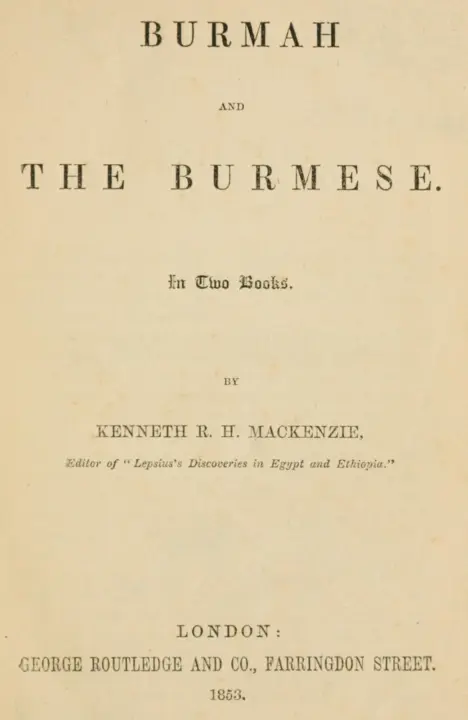
THE CLASSIC COLLECTION · 1853
"Burmah and the Burmese" by Kenneth R. H. Mackenzie is a historical account written in the mid-19th century. The work provides a comprehensive exploration of Burmah (now Myanmar) and its people, focusing on the socio-political landscape, including details about the government, culture, and the backdrop of war during that period. This narrative aims to elucidate the customs and societal conditions of the Burmese, highlighting their strengths, as well as examining the oppressive reign of their king. The opening of the book begins with a preface that discusses the implications of the ongoing war in Burmah while expressing hope that British intervention could lead to improved governance and civil liberties for the Burmese people. Mackenzie touches on the complexities of Burmese civilization, emphasizing both its rich culture and the despotic nature of its rulers. He highlights significant geographical features, such as the Irawadi River, and mentions the wealth of natural resources in the land, alluding to the economic potential that remains untapped under the current governance. The narrative sets the tone for a detailed investigation of Burmese society, its history, and the challenges it faces amid colonial ambitions.
Introduction adapted from the source catalogue; source summaries may be automatically generated.
Free to read · English · 84,457 words · No account needed
MAKE TIME FOR A GOOD BOOK
On by default. Untick to stop anonymous reading totals. Each page counts after 10 seconds in view. How this works.
Anonymous counting is on unless you have switched it off.
[132] Pali Grammar, with a copious vocabulary in the same language. By the Rev. B. Clough, 8vo. Colombo. 1824.
[133] Malcom, vol. i. p. 277.
[134] Vol. i. p. 277.
[135] I must not in this place forget to thank the gentlemen at the Museum for the aid they so courteously and willingly gave me in my examination of their Burmese MSS.
[136] Asiatic Researches, vol. vii. p. 305 sq.
[137] Page 15.
[138] I do not know but that this ought to be written paruæk.—Buchanan.
[139] Buchanan, in Asiatic Researches, vol. vi. p. 307.
[140] Description, p. 141 et sqq.
[141] Asiatic Researches, vol. vi. p. 172.
[142] Asiat. Res. vol. ii. p. 285.
[143] Asiat. Res. vol. vi. p. 174.
[144] Burmese Empire, p. 111 sq.
[145] Burmese Empire, p. 113.
[146] Asiatic Researches, vol. vi. pp. 188-205.
[147] Description, pp. 11-14.
[148] Buchanan, ubi supra, p. 191; and Sangermano, p. 13.
[149] See book i. chap. iii. p. 50.
[150] Asiatic Researches, vol. vi. p. 169 sq.
[151] Loubère, du Royaume de Siam, vol. ii. p. 102.
[152] Malcom, vol. i. p. 275.
[153] Crawfurd, vol. ii. p. 188.
[154] Malcom, vol. i. p. 275.
[155] Book i, chap. i. p. 9.
[156] Sangermano, p. 167.
[157] Sangermano, p. 167.
[158] Book i. chap. iii. p. 56.
[159] Sangermano, p. 126.
[160] Malcom, vol. i. p. 211.
[161] Sangermano, p. 124.
[162] Book i. chap. ii. p. 38.
[163] South-Eastern Asia, vol. i. p. 212.
[164] Sangermano, p. 129.
[165] Sangermano, ubi supra, p. 129.
[166] My principal authority is Sangermano, p. 136.
[167] My chief authority is Sangermano, pp. 144-146.
[168] Burmese Empire, p. 146.
[169] Malcom, vol. i. p. 272.
[170] Vol. i. p. 7, note.
[171] Lib. v. tit. 4, ley 16.
[172] Lib. ix. tit. 2, ley 8.
[173] Lex Salica, tit. 43, sec. 1, 8.
[174] Lib. vi. tit. 4, ley 1.
[175] Lib. vi. tit. 5, leyes 12, 13.
[176] Lex Salica, tit. 11, sec. 1, 3.
[177] Embassy to Ava in the year 1795, vol. ii. p. 41 sqq.; later ed.
vol. i. p. 208 sq.
[178] Called by Sir William Jones, Valmiec.
[179] Honymaan is worshipped by the Hindoos under the form of an ape, and is one of the most frequent objects of their adoration; almost every Hindoo pagoda has this figure delineated in some part of it. Honymaan (Hanuman) is the term used by the Hindoos to denote a large ape. The worship was widely extended even among the Mexicans, who portrayed monkeys in their picture writings. In the Coptic-Egyptian, Haanu signifies monkey.
[180] Asiatic Researches, vol. vi. p. 305.
[181] Stock characters seem as prevalent as at the Victoria or Adelphi.
[182] Journal of the As. Soc. of Bengal, vol. viii. p. 535 sq.
[183] I am partly indebted to Cox, Asiatic Researches, vol. vii. p. 497
sq.
[184] Asiatic Researches, vol. vii. p. 499. Comp. Symes, vol. ii. p. 226,
small ed.
[185] Sangermano, p. 127.
[186] Vol. i. p. 240.
[187] Vol. i. p. 242.
[188] Burmese Empire, p. 128.
[189] My authority is an interesting article in the Journal of the Asiatic Society of Bengal, vol. v. p. 159 sq.
[190] A territory to the southward of Manipur.
[191] Sravasti in Oude.—Wilson.
[192] Yázá is the Burmese pronunciation of Rája.
[193] Book i. chap. iii. p. 47.
[194] Ava, vol. i. p. 270, small edition.
Your reading position is saved on this browser. Take it to another device with a library code. Reading pages adapt to text, rather than matching a printed edition.
BEHIND THE BOOK
This eBook is for the use of anyone anywhere in the United States and most other parts of the world at no cost and with almost no restrictions whatsoever. You may copy it, give it away or re-use it under the terms of the Project Gutenberg License included with this eBook or online at www.gutenberg.org. If you are not located in the United States, you will have to check the laws of the country where you are located before using this eBook. Read the source licence.
The original source file, including credits and licence, is retained by this library. Request an original-format copy at no charge. Please include the book title and Project Gutenberg identifier #64271.
KEEP YOUR CURIOSITY GOING
Cécile Tormay

Moritz Busch
John L. Ransom
Frances Wright
Cécile Tormay

Mabel Potter Daggett