
Last letters from the living dead man
David Patterson (Spirit) Hatch
THE CLASSIC COLLECTION · 1890
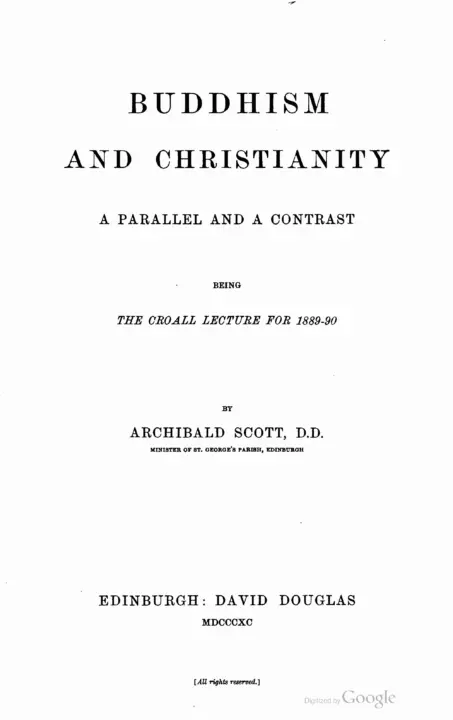
"Buddhism and Christianity: A Parallel and a Contrast" by Archibald Scott is a scholarly examination of the similarities and differences between Buddhism and Christianity, written in the late 19th century. This work presents a series of lectures, focusing on a comparative analysis of the two religions, to illuminate their unique features as well as their shared elements. Scott aims to foster a deeper understanding of both faiths, suggesting that studying these religions can enhance Christian appreciation for its own beliefs. The opening of the text provides a preface where Scott acknowledges the complexity of both religions and expresses a commitment to presenting Buddhism fairly, despite its historical misrepresentations. He highlights the significance of Buddhism as a major world religion that offers insights into human life and ethics. Scott also stresses the importance of comparative theology in strengthening Christianity rather than undermining it, encouraging an impartial study to discern universal truths that resonate within both traditions. He outlines the necessity to explore the distinct origins and developments of each faith while establishing a framework for a fruitful dialogue between the two.
Introduction adapted from the source catalogue; source summaries may be automatically generated.
Free to read · English · 95,734 words · No account needed
MAKE TIME FOR A GOOD BOOK
On by default. Untick to stop anonymous reading totals. Each page counts after 10 seconds in view. How this works.
Anonymous counting is on unless you have switched it off.
Dêvadatta’s Five Points (Kullavagga, vii. 3. 14, 15) all insist upon a more ascetic rule than the Sangha practised.
Footnote 349:
Stanley, Eastern Church, pp. 45, 50.
Footnote 350:
Turnour, “Pali Bud. Annals,” Journ. Asiat. Soc. Beng. vol. vi. p. 729; Wassilief, Le Bouddhisme, etc., p. 18.
Footnote 351:
The beginning of the dissensions is related in Kullavagga vii. with much legendary adornment. There too, in vii. 5, and in Mahavagga, x. 1. 6, the distinction is drawn between “dissension” and “schism,” and the woe predicted for the breaker-up of the Sangha when it was at peace: “He is boiled for a kalpa in Niraya, doomed for so long to a penance of misery.” The reconciler of a divided Sangha was made happy for a kalpa in heaven.
Footnote 352:
T. W. Rhys Davids, Handbook of Buddhism, p. 182.
Footnote 353:
Beal, Chinese Buddhism, p. 101: “a worship of association and
memory.”
Footnote 354:
Agni. Indra, Sūrya; Kern, Buddhismus, vol. ii. p. 156; Sir Monier Williams, Buddhism, p. 175.
Footnote 355:
“A being whose essence (sattva) has become intelligence (bodhu) derived from self-enlightening intellect, and who has only once more to pass through human existence before attaining Buddhahood.”—Eitel, Sanskrit-Chinese Dict., p. 26; Sir Monier Williams’ Buddhism, p. 98.
Footnote 356:
Wassilief, Le Bouddhisme, etc., pp. 124 seq.; Burnouf, Le Lotus
de la bonne Loi, p. 302.
Footnote 357:
Nâgârdjuna, the Nagasēna of the Milindipanha, was the chief representative, if not founder, of one of the Mahāyāna Schools. He has been regarded as a mythical personage, and the name has been supposed to be the generic one of various authors and doctors of the system. For an account of Hināyāna and Mahāyāna doctrine, with its subdivisions, see Wassilief, Le Bouddhisme, etc., pp. 9 seq., 118 seq.; Schlagintweit, Buddhism in Tibet, pp. 19-57. Nâlanda must have been a very important centre in Buddhist times.—Fergusson, Tree and Serpent Worship, p. 79.
Footnote 358:
Dr. Edkins says about 190 A.D.
Footnote 359:
Burnouf, Introd. à l’histoire du Bud. Ind. vol. i. pp. 220, 224 (Paris, 1844); also Burnouf, Le Lotus de la bonne Loi, chap. xxiv. pp. 261-268; also Appendix III. pp. 498-511 (Paris, 1852).
Footnote 360:
Müller, Gifford Lectures, Natural Religion, p. 543; Dr. Beal, Buddhism in China, p. 123; Sir Monier Williams, Buddhism, p. 195.
Footnote 361:
Hodgson, Illustrations of the Literature and Religion of the Buddhists, p. 30; Burnouf, Introduction, etc., pp. 116-121; also in note at p. 118, quoting Hodgson.
Footnote 362:
Your reading position is saved on this browser. Take it to another device with a library code. Reading pages adapt to text, rather than matching a printed edition.
BEHIND THE BOOK
This eBook is for the use of anyone anywhere in the United States and most other parts of the world at no cost and with almost no restrictions whatsoever. You may copy it, give it away or re-use it under the terms of the Project Gutenberg License included with this eBook or online at www.gutenberg.org. If you are not located in the United States, you will have to check the laws of the country where you are located before using this eBook. Read the source licence.
The original source file, including credits and licence, is retained by this library. Request an original-format copy at no charge. Please include the book title and Project Gutenberg identifier #67171.
KEEP YOUR CURIOSITY GOING
David Patterson (Spirit) Hatch

David Patterson (Spirit) Hatch

David Patterson (Spirit) Hatch

Edwin Abbott Abbott

Richard Watson
T. G. (Theophilus Gould) Steward