
Last letters from the living dead man
David Patterson (Spirit) Hatch
THE CLASSIC COLLECTION · 1890
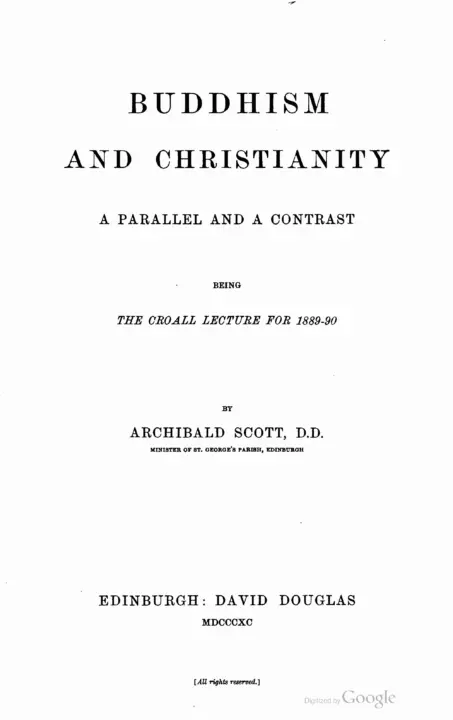
"Buddhism and Christianity: A Parallel and a Contrast" by Archibald Scott is a scholarly examination of the similarities and differences between Buddhism and Christianity, written in the late 19th century. This work presents a series of lectures, focusing on a comparative analysis of the two religions, to illuminate their unique features as well as their shared elements. Scott aims to foster a deeper understanding of both faiths, suggesting that studying these religions can enhance Christian appreciation for its own beliefs. The opening of the text provides a preface where Scott acknowledges the complexity of both religions and expresses a commitment to presenting Buddhism fairly, despite its historical misrepresentations. He highlights the significance of Buddhism as a major world religion that offers insights into human life and ethics. Scott also stresses the importance of comparative theology in strengthening Christianity rather than undermining it, encouraging an impartial study to discern universal truths that resonate within both traditions. He outlines the necessity to explore the distinct origins and developments of each faith while establishing a framework for a fruitful dialogue between the two.
Introduction adapted from the source catalogue; source summaries may be automatically generated.
Free to read · English · 95,734 words · No account needed
MAKE TIME FOR A GOOD BOOK
On by default. Untick to stop anonymous reading totals. Each page counts after 10 seconds in view. How this works.
Anonymous counting is on unless you have switched it off.
Footnote 319:
Mahâparanibhâna Sutta, ii. 33. 35.
Footnote 320:
1 Corinthians xiv.
Footnote 321:
“Das Christenthum ist das allerveränderlichste; das ist sein besonderer Ruhm.”—Rothe, Stille Stunden, p. 357.
Footnote 322:
Acts xxviii. 13; Rom. xv. 24; 2 Tim. iv. 10; 1 Peter i. 1.
Footnote 323:
Greg. Nyss. Op. iii. 574.
Footnote 324:
Keim, Rom und Christenthum, p. 417.
Footnote 325:
Uhlhorn, Conflict of Christianity, pp. 54, 90.
Footnote 326:
Neander, Church History, vol. i. pp. 10, 40.
Footnote 327:
Orig. cont. Cels. iii. 44-54; Tatian, c. 33; Minut. Felix, Octav. 8. 12; Tertull. Apolog. 37 et passim.
Footnote 328:
Newman, Grammar of Assent, pp. 460 seq.
Footnote 329:
Kullavagga, iv. 14. 25; also ibid. vii. 1. 5; Sacred Books of the
East, vol. xx.
Footnote 330:
E. Burnouf, Science of Religions, p. 288, notes the analogy between Pryadarsi and “a man greatly beloved” in Daniel ix. 23.
Footnote 331:
See Lotus de la bonne Loi, App. x. p. 659 seq.: Prinsep’s trans., Jour. Asiat. Soc. Beng. vol. vii. pp. 219 seq.; Prof. H. H. Wilson’s, vol. xii. of Jour. Asiat. Soc. Beng. pp. 153 seq.
Footnote 332:
Wheeler, History of India, vol. iii. p. 214.
Footnote 333:
T. W. Rhys Davids, Handbook of Buddhism, p. 225.
Footnote 334:
Dipavamso, chap. viii.
Footnote 335:
T. W. Rhys Davids, Handbook of Buddhism, p. 259.
Footnote 336:
Buddhist Records of the Western World, trans. by Prof. Beal, vol. i.; Fo-Kwo-ki, chap. xxii. p. xlix, vol. ii; Hiuen Tsiang, B. vi. pp. 13, 14.
Footnote 337:
Lassen, Indische Alterth. vol. ii. p. 1078; vol. iv. p. 741.
Footnote 338:
Dr. Beal, Buddhism in China, p. 61; Dr. Edkins, Chinese Buddhism,
Preface, p. i.
Footnote 339:
Buddhism in Tibet, E. Schlagintweit, pp. 61-75.
Footnote 340:
Comparative Progress of Ancient and Modern Missions.
Footnote 341:
Dr. Maclear, Gradual Conversion of Europe, pp. 6-12.
Footnote 342:
Nouveau Journ. Asiat. pp. 106, 137, 139.
Footnote 343:
Dr. Edkins, Chinese Buddhism, pp. 84, 207.
Footnote 344:
“It may be safely asserted that no Aryan race, while existing in anything like purity, was ever converted to Buddhism, or could permanently adopt its doctrines.”—Fergusson, Tree and Serpent Worship, p. 67. The old Turanian race, far from being savage, or even barbarous, not only laid the basis of Chinese civilisation, but seems to have been also the first civiliser of Western Asia, and the first to spread art and science along the southern coasts of Europe. The Iberian, Etruscan, Phœnician, Hittite, even Egyptian monuments, are now acknowledged to be relics of this mighty race, which must have sent horde after horde over Asia and Europe long before the historic advance westwards in the thirteenth century A.D.; its latest invasion of India may have been represented, not by Scythian ancestors of Buddha, but the Sikhs.—Conder, “Early Races of Western Asia,” Journ. Anthrop. Inst. August 1889, pp. 30-43.
Footnote 345:
Sir Monier Williams, Buddhism, Introduction; Eitel, Lectures on
Buddhism.
Footnote 346:
Sir Monier Williams, Buddhism, pp. 114, 156.
Footnote 347:
Wassilief, Le Bouddhisme, etc., pp. 14, 18.
Footnote 348:
Your reading position is saved on this browser. Take it to another device with a library code. Reading pages adapt to text, rather than matching a printed edition.
BEHIND THE BOOK
This eBook is for the use of anyone anywhere in the United States and most other parts of the world at no cost and with almost no restrictions whatsoever. You may copy it, give it away or re-use it under the terms of the Project Gutenberg License included with this eBook or online at www.gutenberg.org. If you are not located in the United States, you will have to check the laws of the country where you are located before using this eBook. Read the source licence.
The original source file, including credits and licence, is retained by this library. Request an original-format copy at no charge. Please include the book title and Project Gutenberg identifier #67171.
KEEP YOUR CURIOSITY GOING
David Patterson (Spirit) Hatch

David Patterson (Spirit) Hatch

David Patterson (Spirit) Hatch

Edwin Abbott Abbott

Richard Watson
T. G. (Theophilus Gould) Steward