
Last letters from the living dead man
David Patterson (Spirit) Hatch
THE CLASSIC COLLECTION · 1890
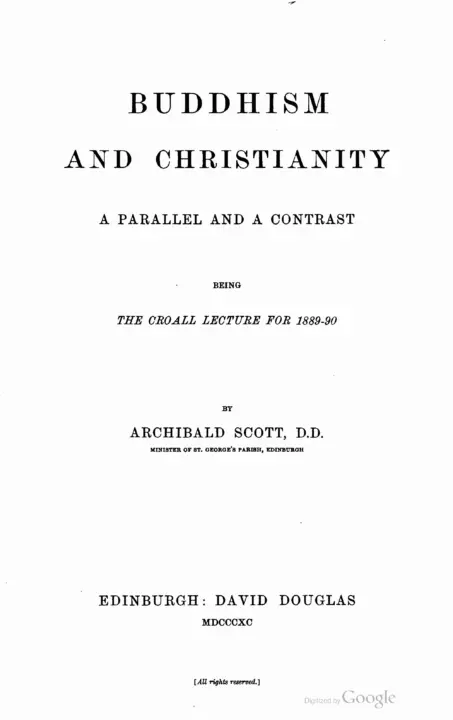
"Buddhism and Christianity: A Parallel and a Contrast" by Archibald Scott is a scholarly examination of the similarities and differences between Buddhism and Christianity, written in the late 19th century. This work presents a series of lectures, focusing on a comparative analysis of the two religions, to illuminate their unique features as well as their shared elements. Scott aims to foster a deeper understanding of both faiths, suggesting that studying these religions can enhance Christian appreciation for its own beliefs. The opening of the text provides a preface where Scott acknowledges the complexity of both religions and expresses a commitment to presenting Buddhism fairly, despite its historical misrepresentations. He highlights the significance of Buddhism as a major world religion that offers insights into human life and ethics. Scott also stresses the importance of comparative theology in strengthening Christianity rather than undermining it, encouraging an impartial study to discern universal truths that resonate within both traditions. He outlines the necessity to explore the distinct origins and developments of each faith while establishing a framework for a fruitful dialogue between the two.
Introduction adapted from the source catalogue; source summaries may be automatically generated.
Free to read · English · 95,734 words · No account needed
MAKE TIME FOR A GOOD BOOK
On by default. Untick to stop anonymous reading totals. Each page counts after 10 seconds in view. How this works.
Anonymous counting is on unless you have switched it off.
Buddhism, p. 80; Dr. Rhys Davids states that a new or cloister name was given on admission, in exchange for the family one (Hibbert Lectures, p. 39), but Professor Oldenberg alleges that this is supported only by solitary cases (Buddha, etc., p. 353 note).
Footnote 281:
Mahavagga, i. 30. 1-4; also ibid. vi. 14. 6; and Kullavagga, vi.
1-2.
Footnote 282:
Mahavagga, i. 78. 1-5.
Footnote 283:
Mahavagga, i. 79. 1-3.
Footnote 284:
Mahavagga, i. 25. 1-24, for the duties of novice to his Upagghâya; ibid. i. 32, Kullavagga, viii. 13, 14, for his duties to his Âkariya. The duties to both are the same, but the Upagghâya seems to have been the more important of the two tutors.
Footnote 285:
Dr. Rhys Davids, Handbook of Buddhism, p. 169.
Footnote 286:
Dhammapada, 200; Sacred Books of the East, vol. x. Part i.
Footnote 287:
Pâtimokkha; Pakittiyá Dhammâ, 10; said to be because he might kill or harm some living creature.
Footnote 288:
Sir Edwin Arnold, Light of Asia, p. 95.
Footnote 289:
Kullavagga, v. vi. viii. passim; Mahavagga, i. 25. 15.
Footnote 290:
Dhammapada, 141, 142; Sacred Books of the East, vol. x. Part i.
Footnote 291:
Sir Edwin Arnold, Light of Asia, pp. 95, 96.
Footnote 292:
Mahavagga, i. 31. 4.
Footnote 293:
Introduction to Dhammapada, Sacred Books of the East, vol. x. p. xliv: a long list quoted from the Northern Scripture by Dr. Edkins in Chinese Buddhism.
Footnote 294:
The question was thrice put, “Are ye pure?” Mahavagga, ii. 1-36.
Footnote 295:
See for a specimen the Kullavaga, v. 21; Sacred Books of the East,
vol. xx.
Footnote 296:
Bishop of Colombo, in Nineteenth Century, July 1888.
Footnote 297:
Mahavagga, iv. 1. 18; Sacred Books of the East, vol. xiii.
Footnote 298:
Weber, Indische Studien, x. 118; Metrical translations by Dr. John Muir, p. 250, where Professor Eggeling is quoted.
Footnote 299:
Mahâ-pagâpati the Gotami, his aunt and nurse (Kullavaga, x. 1) whose entreaty, through Ananda, led him to found the Order of Bikkhuni, seems more than a name. Visâkhâ, “the rich and bountiful,” is another type of votary (Mahavagga, viii. 15).
Footnote 300:
Buddhist Jataka Stories, translated by Rhys Davids, pp. 87, 90; Bigandet, Life of Gaudama, old ed., pp. 156, 168.
Footnote 301:
Dhammapada, 284; Sacred Books of the East, vol. x.
Footnote 302:
Book of the Great Decease, v. 23; Sacred Books of the East, vol. xi.
Footnote 303:
Eitel, Lectures on Buddhism, p. 10.
Footnote 304:
Kullavagga, x. 1. 3, 4; Sacred Books of the East, vol. xx.
Footnote 305:
Clement of Alexandria gives prominence to the value of marriage and of the family life, Strom. vii., Paedag. iii. So Tertullian, Ad Uxorem, ii. c. 8.
Footnote 306:
Principal Donaldson, Contemporary Review, Sept. 1889.
Footnote 307:
Sir Henry S. Maine, Early History of Institutions, p. 341.
Footnote 308:
Kullavagga, x. 1. 6.
Footnote 309:
Kullavagga, x. 1. 27.
Footnote 310:
Pâtimokkha; Pakittiyâ Dhammâ, 6, 7, 27, 66, 67.
Footnote 311:
Your reading position is saved on this browser. Take it to another device with a library code. Reading pages adapt to text, rather than matching a printed edition.
BEHIND THE BOOK
This eBook is for the use of anyone anywhere in the United States and most other parts of the world at no cost and with almost no restrictions whatsoever. You may copy it, give it away or re-use it under the terms of the Project Gutenberg License included with this eBook or online at www.gutenberg.org. If you are not located in the United States, you will have to check the laws of the country where you are located before using this eBook. Read the source licence.
The original source file, including credits and licence, is retained by this library. Request an original-format copy at no charge. Please include the book title and Project Gutenberg identifier #67171.
KEEP YOUR CURIOSITY GOING
David Patterson (Spirit) Hatch

David Patterson (Spirit) Hatch

David Patterson (Spirit) Hatch

Edwin Abbott Abbott

Richard Watson
T. G. (Theophilus Gould) Steward