
Last letters from the living dead man
David Patterson (Spirit) Hatch
THE CLASSIC COLLECTION · 1890
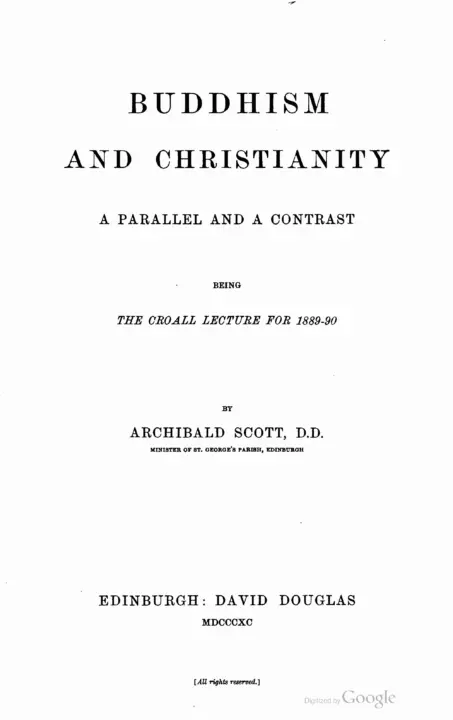
"Buddhism and Christianity: A Parallel and a Contrast" by Archibald Scott is a scholarly examination of the similarities and differences between Buddhism and Christianity, written in the late 19th century. This work presents a series of lectures, focusing on a comparative analysis of the two religions, to illuminate their unique features as well as their shared elements. Scott aims to foster a deeper understanding of both faiths, suggesting that studying these religions can enhance Christian appreciation for its own beliefs. The opening of the text provides a preface where Scott acknowledges the complexity of both religions and expresses a commitment to presenting Buddhism fairly, despite its historical misrepresentations. He highlights the significance of Buddhism as a major world religion that offers insights into human life and ethics. Scott also stresses the importance of comparative theology in strengthening Christianity rather than undermining it, encouraging an impartial study to discern universal truths that resonate within both traditions. He outlines the necessity to explore the distinct origins and developments of each faith while establishing a framework for a fruitful dialogue between the two.
Introduction adapted from the source catalogue; source summaries may be automatically generated.
Free to read · English · 95,734 words · No account needed
MAKE TIME FOR A GOOD BOOK
On by default. Untick to stop anonymous reading totals. Each page counts after 10 seconds in view. How this works.
Anonymous counting is on unless you have switched it off.
Kuenen, Hibbert Lectures, pp. 251 seq. The doctrine that it bore nobler fruit is expressly contradicted by some. See Âpastamba, pres. ii. pat. ix. khan. 23; also pres. ii. pat. ix. k. 24. 15; Sacred Books of the East, vol. ii. pp. 156, 159.
Footnote 255:
The way of “Works”—ceremonial and sacrificial religion; the way of “Faith”—devotion (heart) to the deities without works; the way of “Knowledge,” or true enlightenment.—Sir Monier Williams, Buddhism, p. 95.
Footnote 256:
Saint-Hilaire, Le Bouddha, etc., p. 152.
Footnote 257:
Not without protest, however, by fathers and doctors of the Church. See Hermas, Simil. v.; Clem. Strom. iii.; Tertullian, De Jejunio, p. 123 seq.; De Pallio, p. 181 seq.
Footnote 258:
Gieseler, Eccles. Hist. vol. i. pp. 289 seq.; Neander’s Church Hist. vol. iii. pp. 305 seq.
Footnote 259:
Hom. on St. Matth. 69, 70.
Footnote 260:
Montalembert, Monks of the West, vol. i. p. 319; Neander’s Church History, vol. iii. pp. 338, 339.
Footnote 261:
Cassian, Collationes, ii. 5-8; De Instit. Monachi, x.; De capitalibus vitiis, quoted by Farrar, Lives of the Fathers, vol. ii. p. 224; Burton, Anatomy of Melancholy, ii. 510.
Footnote 262:
Monks of the West, vol. i. p. 27.
Footnote 263:
Sutta Nipâta, 75-81; Sacred Books of the East, vol. x. p. ii.
Footnote 264:
Theod. Eccles. Hist. lib. iv. cap. 26.
Footnote 265:
“They prayed for the whole world.”—Chrysost. H. 78, In Johannem.
Footnote 266:
Oldenberg, Buddha, etc., pp. 317, 318.
Footnote 267:
Mahavagga, viii. 15; Sacred Books of the East, vol. xvii.
Footnote 268:
“I am not aware of any instances in which the pariah of the age is mentioned as a member of the Order.” “According to Buddhist dogmatics, a good Sudra or Vaisya could only hope to be re-born as a Kshatrya, and this clearly indicates that the distinctions of castes had by no means vanished or become worthless in Buddha’s consciousness” (Buddha, etc., p. 156).
Footnote 269:
Mahavagga, i. 39. 76; Sacred Books of the East, vol. xiii.
Footnote 270:
Christianity does not, as Goethe averred, “prefer what is despised and feeble,” but as in God’s eyes nothing is despised and abject, so, in fellowship with the Father, Christ cherished the maimed and lame and blind, though hated of the soul of the natural man, and this disposition will ever be a “mark” or “note” of the true Church of Christ.
Footnote 271:
Kuenen, Hibbert Lectures, 1882, p. 284; Rhys Davids, Hibbert Lectures,
1881, p. 155.
Footnote 272:
Oldenberg, Buddha, etc., pp. 181, 182.
Footnote 273:
The Scotsman, August 17th, 1889.
Footnote 274:
E. Burnouf, Science des Religions, p. 94.
Footnote 275:
Mahavagga, i. 49. 6.
Footnote 276:
Ibid. i. 54. 5; Sacred Books of the East, vol. xiii.
Footnote 277:
Mahavagga, i. 7. 10-15; Sacred Books of the East, vol. xiii.
Footnote 278:
Mahavagga, i. 29.
Footnote 279:
Ibid. i. 76. 1-10.
Footnote 280:
Your reading position is saved on this browser. Take it to another device with a library code. Reading pages adapt to text, rather than matching a printed edition.
BEHIND THE BOOK
This eBook is for the use of anyone anywhere in the United States and most other parts of the world at no cost and with almost no restrictions whatsoever. You may copy it, give it away or re-use it under the terms of the Project Gutenberg License included with this eBook or online at www.gutenberg.org. If you are not located in the United States, you will have to check the laws of the country where you are located before using this eBook. Read the source licence.
The original source file, including credits and licence, is retained by this library. Request an original-format copy at no charge. Please include the book title and Project Gutenberg identifier #67171.
KEEP YOUR CURIOSITY GOING
David Patterson (Spirit) Hatch

David Patterson (Spirit) Hatch

David Patterson (Spirit) Hatch

Edwin Abbott Abbott

Richard Watson
T. G. (Theophilus Gould) Steward