
Switch off
Oliver Optic
THE CLASSIC COLLECTION · 1895
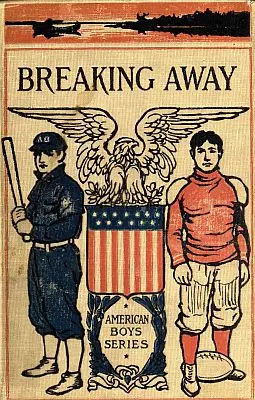
"Breaking Away; or, The Fortunes of a Student" by Oliver Optic is a novel written in the mid-19th century. The story centers around Ernest Thornton, a fourteen-year-old student who grapples with the challenges of school discipline, social dynamics, and a longing for family connections. Through his experiences, readers are introduced to themes of rebellion against authority, the struggles of the underdog, and the quest for personal integrity. At the start of the narrative, Ernest is summoned by the strict principal, Mr. Parasyte, accused of fighting with a popular student, William Poodles. As the events unfold, it becomes clear that the school environment is rife with favoritism and injustice, with Poodles enjoying the privilege of being the principal's pet. The opening portion sets the stage for Ernest’s inner conflict as he faces expulsion for defending himself, leading to a rebellion among his peers who stand against the tyranny of their schoolmaster. As tensions rise, it becomes evident that Ernest values truth and loyalty, and the groundwork is laid for a confrontation between student solidarity and oppressive authority.
Introduction adapted from the source catalogue; source summaries may be automatically generated.
Free to read · English · 58,815 words · No account needed
MAKE TIME FOR A GOOD BOOK
On by default. Untick to stop anonymous reading totals. Each page counts after 10 seconds in view. How this works.
Anonymous counting is on unless you have switched it off.
"Can't you guess?" asked another boy; and there seemed to be a general desire to anticipate the terrible things the principal would attempt in order to reduce the rebellious pupils to subjection.
"I am no Yankee, and I can't guess. I can mention several things he
might do."
"Tell us, if you please!" called out one of the more timid of the
boys.
"Very likely he will attempt to starve us out by surrounding the island with boats, and preventing us from obtaining provisions. He must know that we have a very small stock of eatables on hand."
"We will trust to our commodore to break his lines, if he blockades
our camp," laughed Tom Rush.
"He may come with a force of men in the night, and take away the
boats."
"You said we should keep a watch at night," suggested Fred Mason.
"We hope the commodore will be able to protect his squadron," said Bob
Hale.
"I shall do my best to insure the safety of the boats, or to run the blockade, if one is established," I replied, with becoming modesty; and in fact I was getting so excited over the prospect, that I rather hoped there would be an attempt to blockade us, or to carry off the boats, that I might have an opportunity to exercise my talent for navigation and strategy.
"And Mr. Parasyte may collect a force, and come over to capture the whole of us. He can charge us with stealing his boats, or something of that sort. He has already obtained a warrant for the arrest of Thornton, and to have him taken away from us would be about the worst thing that could happen," said Vallington.
"We will not let them take him," interposed a belligerent student.
"What will you do?"
"Pitch the sheriff overboard," replied the spunky speaker.
"That will not do," I added. "I hope no fellow will think of such a thing as resisting an officer of the law."
"No, that wouldn't do," continued Vallington. "If Mr. Greene could not arrest Thornton because he was out of his county, Mr. Parasyte will get a sheriff from the proper county to do the job."
"That's so," said Bob Hale. "He will do his worst, you may depend upon
that."
"I have an idea!" I shouted, under the inspiration of my new thought; and it really seemed to me like a brilliant suggestion.
"What is it?" demanded our leader.
"Suppose we change our quarters?"
"Where shall we go?"
"To Pine Island. It is about seven miles from here, or nine miles and a half from Parkville," I answered.
Your reading position is saved on this browser. Take it to another device with a library code. Reading pages adapt to text, rather than matching a printed edition.
BEHIND THE BOOK
This eBook is for the use of anyone anywhere in the United States and most other parts of the world at no cost and with almost no restrictions whatsoever. You may copy it, give it away or re-use it under the terms of the Project Gutenberg License included with this eBook or online at www.gutenberg.org. If you are not located in the United States, you will have to check the laws of the country where you are located before using this eBook. Read the source licence.
The original source file, including credits and licence, is retained by this library. Request an original-format copy at no charge. Please include the book title and Project Gutenberg identifier #22433.
KEEP YOUR CURIOSITY GOING
Coulson Kernahan

Maurice Baring
Frances Wright
Cécile Tormay

Frederic Jesup Stimson

W. H. P. (William Henry Pope) Jarvis
