
Switch off
Oliver Optic
THE CLASSIC COLLECTION · 1895
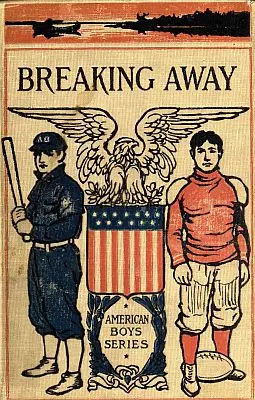
"Breaking Away; or, The Fortunes of a Student" by Oliver Optic is a novel written in the mid-19th century. The story centers around Ernest Thornton, a fourteen-year-old student who grapples with the challenges of school discipline, social dynamics, and a longing for family connections. Through his experiences, readers are introduced to themes of rebellion against authority, the struggles of the underdog, and the quest for personal integrity. At the start of the narrative, Ernest is summoned by the strict principal, Mr. Parasyte, accused of fighting with a popular student, William Poodles. As the events unfold, it becomes clear that the school environment is rife with favoritism and injustice, with Poodles enjoying the privilege of being the principal's pet. The opening portion sets the stage for Ernest’s inner conflict as he faces expulsion for defending himself, leading to a rebellion among his peers who stand against the tyranny of their schoolmaster. As tensions rise, it becomes evident that Ernest values truth and loyalty, and the groundwork is laid for a confrontation between student solidarity and oppressive authority.
Introduction adapted from the source catalogue; source summaries may be automatically generated.
Free to read · English · 58,815 words · No account needed
MAKE TIME FOR A GOOD BOOK
On by default. Untick to stop anonymous reading totals. Each page counts after 10 seconds in view. How this works.
Anonymous counting is on unless you have switched it off.
On the one hand, if I apologized to Poodles and the principal, the "powers that be" would be vindicated, and the authority of the master fully established. On the other hand, if I declined to do so, and the sentence of expulsion was carried out, the boys were in sympathy with me, and the rebellion might break out afresh, and end in the total dissolution of the establishment. Under these circumstances, it was not strange that Mr. Parasyte desired to see me again.
"I hope you have carefully considered your position, Thornton," said
he.
"I have," I replied; "and I am willing to apologize to you, but not to
Poodles."
"That is something gained," added he; and I could see his face brighten up under the influence of a hope.
"My manner was defiant, and my conduct disobedient. I am willing to apologize to you for this, and to submit to such punishment as you think proper to inflict."
"That is very well; but it does not fully meet the difficulty. You
must also apologize to Poodles, which you are aware may be done in
private."
"I cannot do it, sir, either in public or in private. Poodles was
wholly and entirely to blame."
"I think not; when I settled the case it was closed up, and it must not be opened again; at least not till some new testimony is obtained. I cannot eat my own words."
"You may obtain new testimony, if you desire," I suggested.
"What?"
"Poodles signed the declaration that he had performed the examples on the papers without assistance."
"He did. Have you any doubt that such is the case?" asked Mr. Parasyte, though he must have been satisfied that Poodles did not work out the examples.
"I am entirely confident that he did not perform them. Mr. Parasyte," I continued, earnestly, "I desire to stay at the Institute. It would be very bad for me to be turned out, and I am willing to confess I have done wrong. If you give Poodles the paper with the examination on it, and he can perform one half of the examples, even now, without help, I will apologize to him in public or in private."
"That looks very fair, but it is not," replied the principal, rubbing his head, as if to stimulate his ideas.
"If Poodles can do the problems, I shall be willing to believe that I am mistaken. In my opinion, he cannot perform a single one of them, let alone the whole of them."
"I object to this proceeding," said he, impatiently. "It will be equivalent to my making a confession."
Your reading position is saved on this browser. Take it to another device with a library code. Reading pages adapt to text, rather than matching a printed edition.
BEHIND THE BOOK
This eBook is for the use of anyone anywhere in the United States and most other parts of the world at no cost and with almost no restrictions whatsoever. You may copy it, give it away or re-use it under the terms of the Project Gutenberg License included with this eBook or online at www.gutenberg.org. If you are not located in the United States, you will have to check the laws of the country where you are located before using this eBook. Read the source licence.
The original source file, including credits and licence, is retained by this library. Request an original-format copy at no charge. Please include the book title and Project Gutenberg identifier #22433.
KEEP YOUR CURIOSITY GOING
Coulson Kernahan

Maurice Baring
Frances Wright
Cécile Tormay

Frederic Jesup Stimson

W. H. P. (William Henry Pope) Jarvis
