THE CLASSIC COLLECTION✦The romance of the animal worldCLASSIC FREE BOOKS
The romance of the animal world
Edmund Selous
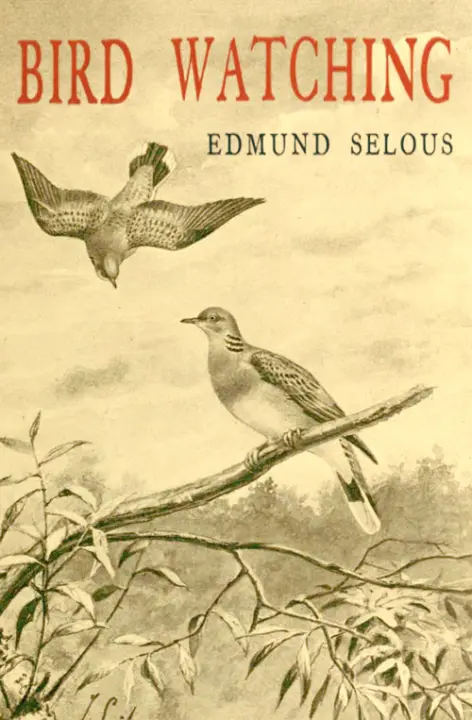
THE CLASSIC COLLECTION · 1901
"Bird Watching" by Edmund Selous is a nature observation book written in the early 20th century. It focuses on the detailed observations of various bird species and their behaviors, primarily narrated from the author's perspective. This book will appeal to readers interested in ornithology, nature writing, or anyone who enjoys immersing themselves in the world of wildlife. The opening of "Bird Watching" sets the stage for the author's personal experiences with birdwatching, emphasizing a more intimate and casual exploration rather than formal scientific studies. Selous introduces readers to the great plover, or stone-curlew, describing its physical appearance and habits with great detail. He paints vivid scenes of the bird sitting, preening, and engaging in lively acts, reflecting on the social dynamics among the birds and their behaviors during different times of the day. Through his observations, the author seeks to convey both factual details and the emotions stirred by witnessing these creatures in their natural habitat, inviting readers to join him in discovering the joys of birdwatching.
Introduction adapted from the source catalogue; source summaries may be automatically generated.
Free to read · English · 100,843 words · No account needed
MAKE TIME FOR A GOOD BOOK
On by default. Untick to stop anonymous reading totals. Each page counts after 10 seconds in view. How this works.
Anonymous counting is on unless you have switched it off.
A pair of ravens on our island are also molested by the gulls, and when either of them flies from one point to another of the coast in their neighbourhood its path is marked by a constant succession of "annoying incidents" of this nature. That these stately birds should have to put up with rudeness from mere gulls does not seem right; but so it is, nor did I ever see either of the two make any serious attempt to over-awe them. Personally, I must say that I was at first so little impressed by these ravens, that for a long time I did them the injustice of looking upon them as carrion crows. Certainly, the hoarse, bellowing croak which they uttered as they flew round when disturbed by me impressed me and made me wonder, but their size appeared altogether incompatible with the state of being a raven. I suppose the great frowning precipices over which they commonly circled had a dwarfing effect upon it, but they were manifestly smaller than any of the gulls which molested them, and this I was not prepared for from the specimens which I have seen in museums or languishing in captivity. That they were ravens however, is, I think, certain from the very peculiar croaking note to which I have alluded, and which they uttered at this time almost constantly.
When I came to the island these birds had already hatched out their young, of which there were four lying in a loose cradle of what looked like sticks, but could not have been, since these were nowhere procurable. It was a mass of something having the general appearance of a battered and flattened rook's nest, but what the actual materials of which it was constructed were, I am unable to say. The nest was on a ledge half-way down the face of a huge precipice forming one side of a fissure in the coast-line--the mouth of an immature fiord--dug out in the course of ages by the slow but ceaseless sapping of the sea. From the summit of the opposite side I could look across at and down upon it, having an excellent view. The young birds--five in number--who were well fledged, and within, perhaps, a fortnight of leaving the nest, lay in it very flatly with their wings half spread out, and so motionless that for some time, upon first seeing them, I almost thought they must be dead. The sudden yet softly sudden rearing itself up of one with an expressive opening of the beak--expressive of "surely, surely, it must be meal-time again now"--gave a delightful assurance that this was not the case, and then there were more such risings and expressed convictions. At intervals only, however, for it was wonderful how still the young birds would lie for quite a long time, and so closely inwoven within the cup of the nest that it was only when they stirred that five became a possibility. The ledge being quite bare and open, the nest with the young in it, making a black bull's-eye in the midst of a great sheet of white, was conspicuously apparent. Several times I saw the young birds move themselves backwards to the inner edge of the nest, and then void their excrements over it, so that only a little of the quite outer portion was contaminated. By this means the nest is kept clean and dry, whilst all around it is defiled. It would seem as though this power of ejecting their excrements to a distance which various birds possess was, sometimes at least, in proportion to the size and bulk of the nest which they construct. The nest of the shag, for instance (and in a still greater degree that of the common cormorant), is a great mass of seaweed and other materials, and the force with which the excrement is shot out over this, both by the young and the parent birds, astonishes one, as does also its upward direction. I had always felt surprise when seeing cormorants and shags perform this natural function whilst standing on the rocks, but it was not till I had watched the latter birds for hour after hour, as they sat on their nests, that I understood (or thought I understood) the significance of it. In spite of the popular saying, it does not seem probable that all young birds act in this way, and many nests are so constructed that it would hardly be possible for them to do so. In most cases everything necessary for sanitation or convenience could be effected afterwards by the parent birds, but this would not be the case with ravens and cormorants, or with other such carnivorous or fish-eating species. Perhaps, therefore, the power which I speak of may stand in joint relation to the diet and habits of the bird, and the kind of nest which it builds.
Your reading position is saved on this browser. Take it to another device with a library code. Reading pages adapt to text, rather than matching a printed edition.
BEHIND THE BOOK
This eBook is for the use of anyone anywhere in the United States and most other parts of the world at no cost and with almost no restrictions whatsoever. You may copy it, give it away or re-use it under the terms of the Project Gutenberg License included with this eBook or online at www.gutenberg.org. If you are not located in the United States, you will have to check the laws of the country where you are located before using this eBook. Read the source licence.
The original source file, including credits and licence, is retained by this library. Request an original-format copy at no charge. Please include the book title and Project Gutenberg identifier #50175.
KEEP YOUR CURIOSITY GOING

Charles G. (Charles Griffith) Ross
Hannah Webster Foster

Emily Lawless
Edwin Hamlin Carr

Charles De Lano Hine
Andrew Ure