THE CLASSIC COLLECTION✦Outline Studies in the New Testament for Bible TeachersCLASSIC FREE BOOKS
Outline Studies in the New Testament for Bible Teachers
Jesse Lyman Hurlbut
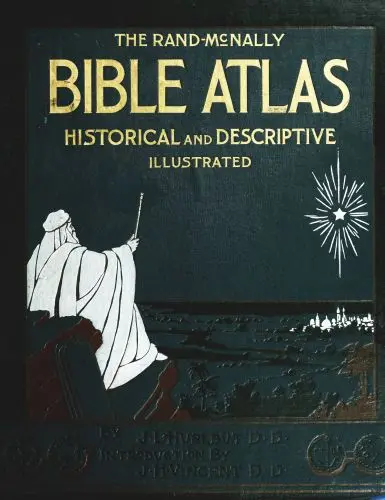
THE CLASSIC COLLECTION · 1884
"Bible Atlas: A Manual of Biblical Geography and History" by Jesse Lyman Hurlbut is a detailed reference work that blends biblical geography and history, likely written in the late 19th century. This manual is designed specifically for teachers and students of the Bible and includes maps, charts, and illustrated views of significant biblical locations. The book aims to provide readers with a thorough understanding of the historical context and geography surrounding biblical events, enhancing the study of these ancient texts. At the start of the manual, the introduction sets the stage by discussing the Bible as an ancient, multifaceted work that intertwines history, poetry, and doctrine. It highlights the importance of understanding the geographical and historical framework of the Bible to grasp its narratives accurately. The author, along with a supporting introduction by Bishop John H. Vincent, emphasizes how vital it is for readers and students to connect the biblical narratives with their real-world counterparts in ancient lands, underscoring that without such contextual knowledge, the richness and reality of the scriptures may be lost. This foundation prepares the reader to engage deeply with the content of the atlas as it unfolds.
Introduction adapted from the source catalogue; source summaries may be automatically generated.
Free to read · English · 85,838 words · No account needed
MAKE TIME FOR A GOOD BOOK
On by default. Untick to stop anonymous reading totals. Each page counts after 10 seconds in view. How this works.
Anonymous counting is on unless you have switched it off.
These are named with greater particularity, because they were those which rose to prominence early in the history, and those with which the Hebrews were brought into closer relations, either as enemies or as friends. Four principal races are given, some of which were greatly subdivided. The homes of these races were in Africa, Eastern Arabia, with a fringe of sea-coast along the eastern Mediterranean, and the great Mesopotamian valley, in which arose the earliest world empires. They have been sometimes called Turanians. It is by no means probable that all these nations should be regarded as the descendants of Ham, the son of Noah. In this list are evidently grouped together some races whose territory was contiguous, but whose physical appearance and language show no relationship.
1. =Cush= is, throughout the Bible, the word translated Ethiopia. Generally this refers to the region south of Egypt, now known as Abyssinia; but in Gen. 2:13, Isa. 11:11, and Ezek. 38:5, the reference must be to an Asiatic Cush, in Mesopotamia. The subdivisions of the Cushite tribes in Gen. 10:7-12, show that the earliest great Oriental monarchies were of this race. These subdivisions are as follows:
(1.) Seba. These were, probably, the Ethiopians of Meroë, on the Nile, anciently called Saba; in Isa. 43:3 and 45:14, connected with the Egyptians.
(2.) Havilah. This is supposed to refer to Arabia, or at least a
part of it.
(3.) Sabtah. This may refer to the Sabbatha, or Sabota, of Pliny and Ptolemy, on the southern shore of Arabia.
(4.) Raamah, with whom are associated his sons or descendants, Sheba and Dedan, occupied the eastern shore of Arabia, near the Persian Gulf.
(5.) Sabtechah. This is unknown, but, from the relation of the previous names, may have been in the southeastern portion of Arabia.
(6.) Nimrod is named as a descendant of Cush (perhaps the only name of an individual in the list), and the founder of the early Babylonian empire.
2. =Mizraim= is the name everywhere used for Egypt in the Hebrew. The word is in the dual form, representing the two divisions of the country, and corresponding to the two crowns on all the royal effigies. Several branches of this race are especially mentioned.
(1.) Ludim. Not the same with the Lud of verse 22, but from its associations plainly in Africa. The location has been given as Nubia, but is very doubtful.
(2.) Anamim. An unknown people, whose identity was early lost in some
other race.
(3.) Lehabim. These are elsewhere in Scripture called Lubim, and were the Libyans, or people of Libya, west of Egypt, on the southern shore of the Mediterranean.
(4.) Naphtuhim. Probably the Na-Ptah of the Egyptian monuments, having their home at Memphis, south of the Delta.
Your reading position is saved on this browser. Take it to another device with a library code. Reading pages adapt to text, rather than matching a printed edition.
Jesse Lyman Hurlbut
Jesse Lyman Hurlbut
Jesse Lyman Hurlbut
Jesse Lyman Hurlbut
BEHIND THE BOOK
This eBook is for the use of anyone anywhere in the United States and most other parts of the world at no cost and with almost no restrictions whatsoever. You may copy it, give it away or re-use it under the terms of the Project Gutenberg License included with this eBook or online at www.gutenberg.org. If you are not located in the United States, you will have to check the laws of the country where you are located before using this eBook. Read the source licence.
The original source file, including credits and licence, is retained by this library. Request an original-format copy at no charge. Please include the book title and Project Gutenberg identifier #41140.
KEEP YOUR CURIOSITY GOING

David Patterson (Spirit) Hatch

David Patterson (Spirit) Hatch

David Patterson (Spirit) Hatch
Cécile Tormay

Moritz Busch
John L. Ransom