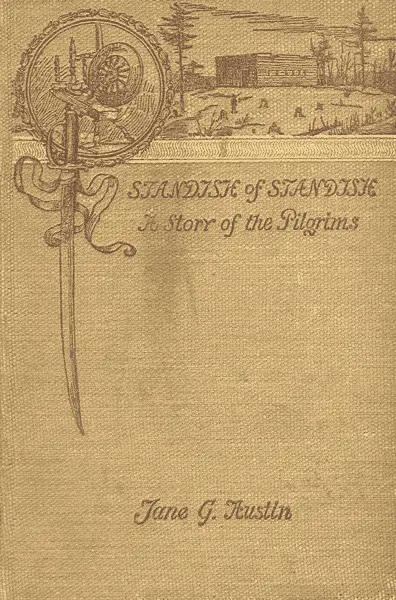
Standish of Standish: A Story of the Pilgrims
Jane G. (Jane Goodwin) Austin

THE CLASSIC COLLECTION · 1891
"Betty Alden: The First-Born Daughter of the Pilgrims" by Jane G. Austin is a historical novel written in the late 19th century. The book explores the life of Betty Alden, the daughter of John and Priscilla Alden, as it intricately weaves her story with the broader historical context of the Pilgrims’ struggles and triumphs in the New World. The narrative likely emphasizes the lives and societal roles of women during this early American period, highlighting Betty's significance as a pivotal character. The opening of the novel introduces the reader to a lively dialogue between characters, revealing the tense political atmosphere in Plymouth as they navigate suspicions of treason among new arrivals, particularly figures like John Lyford and John Oldhame. Priscilla Alden and Barbara Standish engage in spirited banter about the men’s reluctance to heed warnings from women, setting the tone for a community grappling with external threats and internal discord. Through witty exchanges, the characters establish a vivid portrayal of life in Plymouth, hinting at Betty's future involvement in the conflicts that surround her family and colony.
Introduction adapted from the source catalogue; source summaries may be automatically generated.
Free to read · English · 109,719 words · No account needed
MAKE TIME FOR A GOOD BOOK
On by default. Untick to stop anonymous reading totals. Each page counts after 10 seconds in view. How this works.
Anonymous counting is on unless you have switched it off.
“No, no;--and yet--and yet”--muttered the doctor, whose common sense found itself sadly at war with a whimsical fancy he had conceived for Lyford, who was to be sure a university-bred man, and an accomplished botanist, thus affording to the alumnus of Peter-house, Cambridge, opportunity, which he did not often enjoy, for conversation on his favorite topics.
His annoyance found, however, no farther expression until, entering the Fort, he pettishly exclaimed, “Well, if we are to find an honest man we shall need Diogenes’ lantern, or at any rate a twopenny dip or so.”
“’Tis the gathering storm,” replied Bradford in a depressed voice, as he stood upon the threshold of the low-ceiled chamber, lighted only by narrow slits intended more for defense than comfort. The bare benches were already occupied by some eighty or ninety men, their pointed hats, sombre doublets, and burnished “pieces” showing grotesquely through the gloom which seemed to solidify the shadows and exaggerate the lights, while an occasional flash of lightning added the last effect to the picture.
A restless movement, a sense rather than a sound of expectancy, a feeling of controversy, of doubt, of possible resistance, was in the air, and Bradford’s sensitive organization responded at once to the thrill.
“Pray for us mightily to-day, Elder, pray for unworthy me,” whispered he, as the two ascended the platform at the head of the hall, where stood the governor’s armchair with seats at either hand for his five assistants, and benches for such persons as should be invited to occupy them.
To this appeal the Elder responded only by a searching glance from eyes of cold and wintry gray, and, passing on, he took his place at the governor’s right hand, while Allerton and Doctor Fuller seated themselves at the left. Winslow’s place was left vacant, and Standish, instead of assuming his, stood near the door, fully armed and equipped, watching Master Oldhame, who, with Lyford and several of their insolent followers, came strolling up the hill, laughing loudly, and displaying an exaggerated carelessness of demeanor.
As they entered, Standish, quietly placing himself between the two principals and their following, waved the latter to seats at the rear of the hall, and, courteously addressing the former, said,--
“The governor and council crave your presence upon the platform,
gentlemen.”
“And why so much ceremony to-day, Captain Standish?” demanded Oldhame in a blustering attempt to imitate the suavity of the soldier. “We have had the privilege and the honor, if there be any, of sitting upon yon platform more than once already, and need not to be marshaled thither to-day more than on other days.”
Your reading position is saved on this browser. Take it to another device with a library code. Reading pages adapt to text, rather than matching a printed edition.
Jane G. (Jane Goodwin) Austin
BEHIND THE BOOK
This eBook is for the use of anyone anywhere in the United States and most other parts of the world at no cost and with almost no restrictions whatsoever. You may copy it, give it away or re-use it under the terms of the Project Gutenberg License included with this eBook or online at www.gutenberg.org. If you are not located in the United States, you will have to check the laws of the country where you are located before using this eBook. Read the source licence.
The original source file, including credits and licence, is retained by this library. Request an original-format copy at no charge. Please include the book title and Project Gutenberg identifier #67608.
KEEP YOUR CURIOSITY GOING
Cécile Tormay

Moritz Busch
Coulson Kernahan
John L. Ransom

Maurice Baring
Frances Wright