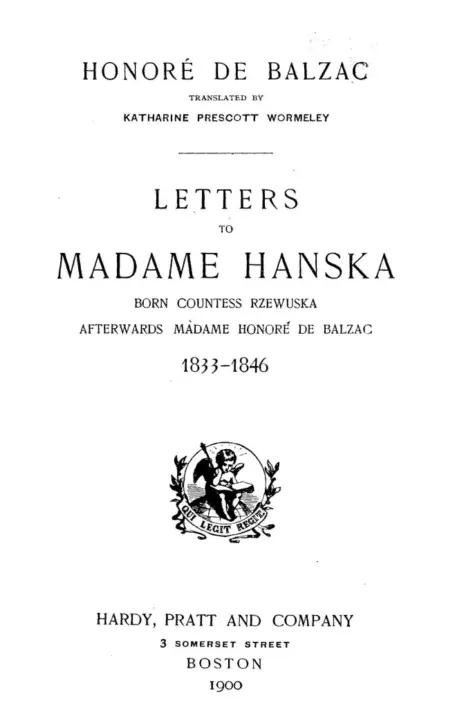
Letters to Madame Hanska, born Countess Rzewuska, afterwards Madame Honoré de Balzac, 1833-1846
Honoré de Balzac
THE CLASSIC COLLECTION · 1839
"Beatrix" by Honoré de Balzac is a novel published in 1839. Young Calyste du Guénic loves the celebrated writer Félicité des Touches, but she doesn't return his affections. He then falls for the beautiful but cruel marchioness Béatrix de Rochefide, setting off a complex romantic entanglement. Félicité sacrifices her own heart to help Calyste pursue Béatrix, while rivals complicate his quest. This tale of unrequited love and romantic obsession explores the devastating consequences of passion and the struggle between desire and duty.
Introduction adapted from the source catalogue; source summaries may be automatically generated.
Free to read · English · 117,200 words · No account needed
MAKE TIME FOR A GOOD BOOK
On by default. Untick to stop anonymous reading totals. Each page counts after 10 seconds in view. How this works.
Anonymous counting is on unless you have switched it off.
“I promised you this tale of the past, and here it is,” said Camille. “The person from whom I received that letter yesterday, and who may be here to-morrow, is the Marquise de Rochefide. The old marquis (whose family is not as old as yours), after marrying his eldest daughter to a Portuguese grandee, was anxious to find an alliance among the higher nobility for his son, in order to obtain for him the peerage he had never been able to get for himself. The Comtesse de Montcornet told him of a young lady in the department of the Orne, a Mademoiselle Beatrix-Maximilienne-Rose de Casteran, the youngest daughter of the Marquis de Casteran, who wished to marry his two daughters without dowries in order to reserve his whole fortune for the Comte de Casteran, his son. The Casterans are, it seems, of the bluest blood. Beatrix, born and brought up at the chateau de Casteran, was twenty years old at the time of her marriage in 1828. She was remarkable for what you provincials call originality, which is simply independence of ideas, enthusiasm, a feeling for the beautiful, and a certain impulse and ardor toward the things of Art. You may believe a poor woman who has allowed herself to be drawn along the same lines, there is nothing more dangerous for a woman. If she follows them, they lead her where you see me, and where the marquise came,--to the verge of abysses. Men alone have the staff on which to lean as they skirt those precipices,--a force which is lacking to most women, but which, if we do possess it, makes abnormal beings of us. Her old grandmother, the dowager de Casteran, was well pleased to see her marry a man to whom she was superior in every way. The Rochefides were equally satisfied with the Casterans, who connected them with the Verneuils, the d’Esgrignons, the Troisvilles, and gave them a peerage for their son in that last big batch of peers made by Charles X., but revoked by the revolution of July. The first days of marriage are perilous for little minds as well as for great loves. Rochefide, being a fool, mistook his wife’s ignorance for coldness; he classed her among frigid, lymphatic women, and made that an excuse to return to his bachelor life, relying on the coldness of the marquise, her pride, and the thousand barriers that the life of a great lady sets up about a woman in Paris. You’ll know what I mean when you go there. People said to Rochefide: ‘You are very lucky to possess a cold wife who will never have any but head passions. She will always be content if she can shine; her fancies are purely artistic, her desires will be satisfied if she can make a salon, and collect about her distinguished minds; her debauches will be in music and her orgies literary.’ Rochefide, however, is not an ordinary fool; he has as much conceit and vanity as a clever man, which gives him a mean and squinting jealousy, brutal when it comes to the surface, lurking and cowardly for six months, and murderous the seventh. He thought he was deceiving his wife, and yet he feared her,--two causes for tyranny when the day came on which the marquise let him see that she was charitably assuming indifference to his unfaithfulness. I analyze all this in order to explain her conduct. Beatrix had the keenest admiration for me; there is but one step, however, from admiration to jealousy. I have one of the most remarkable salons in Paris; she wished to make herself another; and in order to do so she attempted to draw away my circle. I don’t know how to keep those who wish to leave me. She obtained the superficial people who are friends with every one from mere want of occupation, and whose object is to get out of a salon as soon as they have entered it; but she did not have time to make herself a real society. In those days I thought her consumed with a desire for celebrity of one kind or another. Nevertheless, she has really much grandeur of soul, a regal pride, distinct ideas, and a marvellous facility for apprehending and understanding all things; she can talk metaphysics and music, theology and painting. You will see her, as a mature woman, what the rest of us saw her as a bride. And yet there is something of affectation about her in all this. She has too much the air of knowing abstruse things,--Chinese, Hebrew, hieroglyphics perhaps, or the papyrus that they wrapped round mummies. Personally, Beatrix is one of those blondes beside whom Eve the fair would seem a Negress. She is slender and straight and white as a church taper; her face is long and pointed; the skin is capricious, to-day like cambric, to-morrow darkened with little speckles beneath its surface, as if her blood had left a deposit of dust there during the night. Her forehead is magnificent, though rather daring. The pupils of her eyes are pale sea-green, floating on their white balls under thin lashes and lazy eyelids. Her eyes have dark rings around them often; her nose, which describes one-quarter of a circle, is pinched about the nostrils; very shrewd and clever, but supercilious. She has an Austrian mouth; the upper lip has more character than the lower, which drops disdainfully. Her pale cheeks have no color unless some very keen emotion moves her. Her chin is rather fat; mine is not thin, and perhaps I do wrong to tell you that women with fat chins are exacting in love. She has one of the most exquisite waists I ever saw; the shoulders are beautiful, but the bust has not developed as well, and the arms are thin. She has, however, an easy carriage and manner, which redeems all such defects and sets her beauties in full relief. Nature has given her that princess air which can never be acquired; it becomes her, and reveals at sudden moments the woman of high birth. Without being faultlessly beautiful, or prettily pretty, she produces, when she chooses, ineffaceable impressions. She has only to put on a gown of cherry velvet with clouds of lace, and wreathe with roses that angelic hair of hers, which resembles floods of light, and she becomes divine. If, on some excuse or other, she could wear the costume of the time when women had long, pointed bodices, rising, slim and slender, from voluminous brocaded skirts with folds so heavy that they stood alone, and could hide her arms in those wadded sleeves with ruffles, from which the hand comes out like a pistil from a calyx, and could fling back the curls of her head into the jewelled knot behind her head, Beatrix would hold her own victoriously with ideal beauties like that--”
Your reading position is saved on this browser. Take it to another device with a library code. Reading pages adapt to text, rather than matching a printed edition.
Honoré de Balzac
Honoré de Balzac
Honoré de Balzac
Honoré de Balzac
BEHIND THE BOOK
This eBook is for the use of anyone anywhere in the United States and most other parts of the world at no cost and with almost no restrictions whatsoever. You may copy it, give it away or re-use it under the terms of the Project Gutenberg License included with this eBook or online at www.gutenberg.org. If you are not located in the United States, you will have to check the laws of the country where you are located before using this eBook. Read the source licence.
The original source file, including credits and licence, is retained by this library. Request an original-format copy at no charge. Please include the book title and Project Gutenberg identifier #1957.
KEEP YOUR CURIOSITY GOING
Coulson Kernahan

Maurice Baring
Frances Wright
Cécile Tormay

Frederic Jesup Stimson

W. H. P. (William Henry Pope) Jarvis