READ · DISCOVER · ENJOYClassic literature · Always free
THE CLASSIC COLLECTION✦BeatrixHonoré de BalzacCLASSIC FREE BOOKS

THE CLASSIC COLLECTION · 1839

Beatrix

"Beatrix" by Honoré de Balzac is a novel published in 1839. Young Calyste du Guénic loves the celebrated writer Félicité des Touches, but she doesn't return his affections. He then falls for the beautiful but cruel marchioness Béatrix de Rochefide, setting off a complex romantic entanglement. Félicité sacrifices her own heart to help Calyste pursue Béatrix, while rivals complicate his quest. This tale of unrequited love and romantic obsession explores the devastating consequences of passion and the struggle between desire and duty.

Introduction adapted from the source catalogue; source summaries may be automatically generated.

Start reading ↓

Free to read · English · 117,200 words · No account needed

MAKE TIME FOR A GOOD BOOK

Beatrix

On by default. Untick to stop anonymous reading totals. Each page counts after 10 seconds in view. How this works.

Anonymous counting is on unless you have switched it off.

Beatrix

And Felicite showed Calyste a fine copy of a picture by Mieris, in which was a woman robed in white satin, standing with a paper in her hand, and singing with a Brabancon seigneur, while a Negro beside them poured golden Spanish wine into a goblet, and the old housekeeper in the background arranged some biscuits.

“Fair women, blonds,” said Camille, “have the advantage over us poor brown things of a precious diversity; there are a hundred ways for a blonde to charm, and only one for a brunette. Besides, blondes are more womanly; we are too like men, we French brunettes--Well, well!” she cried, “pray don’t fall in love with Beatrix from the portrait I am making of her, like that prince, I forget his name, in the Arabian Nights. You would be too late, my dear boy.”

These words were said pointedly. The admiration depicted on the young man’s face was more for the picture than for the painter whose faire was failing of its purpose. As she spoke, Felicite was employing all the resources of her eloquent physiognomy.

“Blond as she is, however,” she went on, “Beatrix has not the grace of her color; her lines are severe; she is elegant, but hard; her face has a harsh contour, though at times it reveals a soul with Southern passions; an angel flashes out and then expires. Her eyes are thirsty. She looks best when seen full face; the profile has an air of being squeezed between two doors. You will see if I am mistaken. I will tell you now what made us intimate friends. For three years, from 1828 to 1831, Beatrix, while enjoying the last fetes of the Restoration, making the round of the salons, going to court, taking part in the fancy-balls of the Elysee-Bourbon, was all the while judging men, and things, events, and life itself, from the height of her own thought. Her mind was busy. These first years of the bewilderment the world caused her prevented her heart from waking up. From 1830 to 1831 she spent the time of the revolutionary disturbance at her husband’s country-place, where she was bored like a saint in paradise. On her return to Paris she became convinced, perhaps justly, that the revolution of July, in the minds of some persons purely political, would prove to be a moral revolution. The social class to which she belonged, not being able, during its unhoped-for triumph in the fifteen years of the Restoration to reconstruct itself, was about to go to pieces, bit by bit, under the battering-ram of the bourgeoisie. She heard the famous words of Monsieur Laine: ‘Kings are departing!’ This conviction, I believe was not without its influence on her conduct. She took an intellectual part in the new doctrines, which swarmed, during the three years succeeding July, 1830, like gnats in the sunshine, and turned some female heads. But, like all nobles, Beatrix, while thinking these novel ideals superb, wanted always to protect the nobility. Finding before long that there was no place in this new regime for individual superiority, seeing that the higher nobility were beginning once more the mute opposition it had formerly made to Napoleon,--which was, in truth, its wisest course under an empire of deeds and facts, but which in an epoch of moral causes was equivalent to abdication,--she chose personal happiness rather than such eclipse. About the time we were all beginning to breathe again, Beatrix met at my house a man with whom I had expected to end my days,--Gennaro Conti, the great composer, a man of Neapolitan origin, though born in Marseilles. Conti has a brilliant mind; as a composer he has talent, though he will never attain to the first rank. Without Rossini, without Meyerbeer, he might perhaps have been taken for a man of genius. He has one advantage over those men,--he is in vocal music what Paganini is on the violin, Liszt on the piano, Taglioni in the ballet, and what the famous Garat was; at any rate he recalls that great singer to those who knew him. His is not a voice, my friend, it is a soul. When its song replies to certain ideas, certain states of feeling difficult to describe in which a woman sometimes finds herself, that woman is lost. The marquise conceived the maddest passion for him, and took him from me. The act was provincial, I allow, but it was all fair play. She won my esteem and friendship by the way she behaved to me. She thought me a woman who was likely to defend her own; she did not know that to me the most ridiculous thing in the world is such a struggle. She came to see me. That woman, proud as she is, was so in love that she told me her secret and made me the arbiter of her destiny. She was really adorable, and she kept her place as woman and as marquise in my eyes. I must tell you, dear friend, that while women are sometimes bad, they have hidden grandeurs in their souls that men can never appreciate. Well, as I seem to be making my last will and testament like a woman on the verge of old age, I shall tell you that I was ever faithful to Conti, and should have been till death, and yet I know him. His nature is charming, apparently, and detestable beneath its surface. He is a charlatan in matters of the heart. There are some men, like Nathan, of whom I have already spoken to you, who are charlatans externally, and yet honest. Such men lie to themselves. Mounted on their stilts, they think they are on their feet, and perform their jugglery with a sort of innocence; their humbuggery is in their blood; they are born comedians, braggarts; extravagant in form as a Chinese vase; perhaps they even laugh at themselves. Their personality is generous; like Murat’s kingly garments, it attracts danger. But Conti’s duplicity will be known only to the women who love him. In his art he has that deep Italian jealousy which led the Carlone to murder Piola, and stuck a stiletto into Paesiello. That terrible envy lurks beneath the warmest comradeship. Conti has not the courage of his vice; he smiles at Meyerbeer and flatters him, when he fain would tear him to bits. He knows his weakness, and cultivates an appearance of sincerity; his vanity still further leads him to play at sentiments which are far indeed from his real heart. He represents himself as an artist who receives his inspirations from heaven; Art is something saintly and sacred to him; he is fanatic; he is sublime in his contempt for worldliness; his eloquence seems to come from the deepest convictions. He is a seer, a demon, a god, an angel. Calyste, although I warn you about him, you will be his dupe. That Southern nature, that impassioned artist is cold as a well-rope. Listen to him: the artist is a missionary. Art is a religion, which has its priests and ought to have its martyrs. Once started on that theme, Gennaro reaches the most dishevelled pathos that any German professor of philosophy ever spluttered to his audience. You admire his convictions, but he hasn’t any. Bearing his hearers to heaven on a song which seems a mysterious fluid shedding love, he casts an ecstatic glance upon them; he is examining their enthusiasm; he is asking himself: ‘Am I really a god to them?’ and he is also thinking: ‘I ate too much macaroni to-day.’ He is insatiable of applause, and he wins it. He delights, he is beloved; he is admired whensoever he will. He owes his success more to his voice than to his talent as a composer, though he would rather be a man of genius like Rossini than a performer like Rubini. I had committed the folly of attaching myself to him, and I was determined and resigned to deck this idol to the end. Conti, like a great many artists, is dainty in all his ways; he likes his ease, his enjoyments; he is always carefully, even elegantly dressed. I do respect his courage; he is brave; bravery, they say, is the only virtue into which hypocrisy cannot enter. While we were travelling I saw his courage tested; he risked the life he loved; and yet, strange contradiction! I have seen him, in Paris, commit what I call the cowardice of thought. My friend, all this was known to me. I said to the poor marquise: ‘You don’t know into what a gulf you are plunging. You are the Perseus of a poor Andromeda; you release me from my rock. If he loves you, so much the better! but I doubt it; he loves no one but himself.’ Gennaro was transported to the seventh heaven of pride. I was not a marquise, I was not born a Casteran, and he forgot me in a day. I then gave myself the savage pleasure of probing that nature to the bottom. Certain of the result, I wanted to see the twistings and turnings Conti would perform. My dear child, I saw in one week actual horrors of sham sentiment, infamous buffooneries of feeling. I will not tell you about them; you shall see the man here in a day or two. He now knows that I know him, and he hates me accordingly. If he could stab me with safety to himself I shouldn’t be alive two seconds. I have never said one word of all this to Beatrix. The last and constant insult Geranno offers me is to suppose that I am capable of communicating my sad knowledge of him to her; but he has no belief in the good feeling of any human being. Even now he is playing a part with me; he is posing as a man who is wretched at having left me. You will find what I may call the most penetrating cordiality about him; he is winning; he is chivalrous. To him, all women are madonnas. One must live with him long before we get behind the veil of this false chivalry and learn the invisible signs of his humbug. His tone of conviction about himself might almost deceive the Deity. You will be entrapped, my dear child, by his catlike manners, and you will never believe in the profound and rapid arithmetic of his inmost thought. But enough; let us leave him. I pushed indifference so far as to receive them together in my house. This circumstance kept that most perspicacious of all societies, the great world of Paris, ignorant of the affair. Though intoxicated with pride, Gennaro was compelled to dissimulate; and he did it admirably. But violent passions will have their freedom at any cost. Before the end of the year, Beatrix whispered in my ear one evening: ‘My dear Felicite, I start to-morrow for Italy with Conti.’ I was not surprised; she regarded herself as united for life to Gennaro, and she suffered from the restraints imposed upon her; she escaped one evil by rushing into a greater. Conti was wild with happiness,--the happiness of vanity alone. ‘That’s what it is to love truly,’ he said to me. ‘How many women are there who would sacrifice their lives, their fortune, their reputation?’--‘Yes, she loves you,’ I replied, ‘but you do not love her.’ He was furious, and made me a scene; he stormed, he declaimed, he depicted his love, declaring that he had never supposed it possible to love as much. I remained impassible, and lent him money for his journey, which, being unexpected, found him unprepared. Beatrix left a letter for her husband and started the next day for Italy. There she has remained two years; she has written to me several times, and her letters are enchanting. The poor child attaches herself to me as the only woman who will comprehend her. She says she adores me. Want of money has compelled Gennaro to accept an offer to write a French opera; he does not find in Italy the pecuniary gains which composers obtain in Paris. Here’s the letter I received yesterday from Beatrix. Take it and read it; you can now understand it,--that is, if it is possible, at your age, to analyze the things of the heart.”

Your reading position is saved on this browser. Take it to another device with a library code. Reading pages adapt to text, rather than matching a printed edition.

More from this author

BEHIND THE WORDS

About Honoré de Balzac

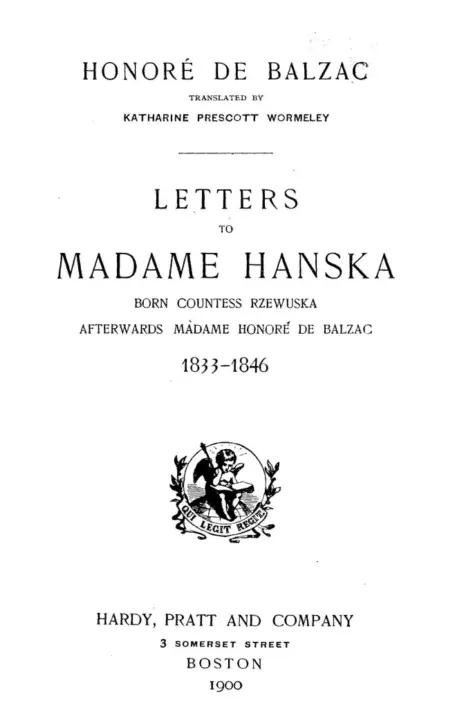
Honoré de Balzac (1799–1850). Explore Letters to Madame Hanska, born Countess Rzewuska, afterwards Madame Honoré de Balzac, 1833-1846, Mercadet: A Comedy in Three Acts, Vautrin: A Drama in Five Acts and other works in this collection. These books span essays & ideas, drama & theatre, classic fiction.

Explore this author’s books →

THE READERS’ VERDICT

How did this story stay with you?

Not rated yet
Your rating for Beatrix

Be the first to share your verdict.

One rating per browser, which you can change or remove. A necessary browser identifier remembers your vote. How ratings work

A GOOD STORY DESERVES COMPANY

Pass this book along.

A great read is even better when it’s shared.

SEND A LITTLE INSPIRATION

Share this book

BEHIND THE BOOK

Edition & source details.

Title
Beatrix
Author
Honoré de Balzac
First publication (Open Library catalogue match)
1839
Digital edition publisher
Project Gutenberg
Gutenberg release date
2004-06-01
Language
English
Source edition imprint
Not stated in source catalogue
Source identifier
Project Gutenberg #1957
Contributors
Katharine Prescott Wormeley (trl)

Public-domain source & licence

This eBook is for the use of anyone anywhere in the United States and most other parts of the world at no cost and with almost no restrictions whatsoever. You may copy it, give it away or re-use it under the terms of the Project Gutenberg License included with this eBook or online at www.gutenberg.org. If you are not located in the United States, you will have to check the laws of the country where you are located before using this eBook. Read the source licence.

Full source licence and obtaining an original copy

The original source file, including credits and licence, is retained by this library. Request an original-format copy at no charge. Please include the book title and Project Gutenberg identifier #1957.

the full Project Gutenberg License must appear
prominently whenever any copy of a Project Gutenberg work (any work
on which the phrase “Project Gutenberg” appears, or with which the
phrase “Project Gutenberg” is associated) is accessed, displayed,
performed, viewed, copied or distributed:

This eBook is for the use of anyone anywhere in the United States and most
other parts of the world at no cost and with almost no restrictions
whatsoever. You may copy it, give it away or re-use it under the terms
of the Project Gutenberg™ License included with this eBook or online
at www.gutenberg.org. If you
are not located in the United States, you will have to check the laws
of the country where you are located before using this eBook.

1.E.2. If an individual Project Gutenberg electronic work is
derived from texts not protected by U.S. copyright law (does not
contain a notice indicating that it is posted with permission of the
copyright holder), the work can be copied and distributed to anyone in
the United States without paying any fees or charges. If you are
redistributing or providing access to a work with the phrase “Project
Gutenberg” associated with or appearing on the work, you must comply
either with the requirements of paragraphs 1.E.1 through 1.E.7 or
obtain permission for the use of the work and the Project Gutenberg
trademark as set forth in paragraphs 1.E.8 or 1.E.9.

1.E.3. If an individual Project Gutenberg electronic work is posted
with the permission of the copyright holder, your use and distribution
must comply with both paragraphs 1.E.1 through 1.E.7 and any
additional terms imposed by the copyright holder. Additional terms
will be linked to the Project Gutenberg License for all works
posted with the permission of the copyright holder found at the
beginning of this work.

1.E.4. Do not unlink or detach or remove the full Project Gutenberg
License terms from this work, or any files containing a part of this
work or any other work associated with Project Gutenberg.

1.E.5. Do not copy, display, perform, distribute or redistribute this
electronic work, or any part of this electronic work, without
prominently displaying the sentence set forth in paragraph 1.E.1 with
active links or immediate access to the full terms of the Project
Gutenberg License.

1.E.6. You may convert to and distribute this work in any binary,
compressed, marked up, nonproprietary or proprietary form, including
any word processing or hypertext form. However, if you provide access
to or distribute copies of a Project Gutenberg work in a format
other than “Plain Vanilla ASCII” or other format used in the official
version posted on the official Project Gutenberg website
(www.gutenberg.org), you must, at no additional cost, fee or expense
to the user, provide a copy, a means of exporting a copy, or a means
of obtaining a copy upon request, of the work in its original “Plain
Vanilla ASCII” or other form. Any alternate format must include the
full Project Gutenberg License as specified in paragraph 1.E.1.

1.E.7. Do not charge a fee for access to, viewing, displaying,
performing, copying or distributing any Project Gutenberg works
unless you comply with paragraph 1.E.8 or 1.E.9.

1.E.8. You may charge a reasonable fee for copies of or providing
access to or distributing Project Gutenberg electronic works
provided that:

• You pay a royalty fee of 20% of the gross profits you derive from
the use of Project Gutenberg works calculated using the method
you already use to calculate your applicable taxes. The fee is owed
to the owner of the Project Gutenberg trademark, but he has
agreed to donate royalties under this paragraph to the Project
Gutenberg Literary Archive Foundation. Royalty payments must be paid
within 60 days following each date on which you prepare (or are
legally required to prepare) your periodic tax returns. Royalty
payments should be clearly marked as such and sent to the Project
Gutenberg Literary Archive Foundation at the address specified in
Section 4, “Information about donations to the Project Gutenberg
Literary Archive Foundation.”

• You provide a full refund of any money paid by a user who notifies
you in writing (or by e-mail) within 30 days of receipt that s/he
does not agree to the terms of the full Project Gutenberg™
License. You must require such a user to return or destroy all
copies of the works possessed in a physical medium and discontinue
all use of and all access to other copies of Project Gutenberg™
works.

• You provide, in accordance with paragraph 1.F.3, a full refund of
any money paid for a work or a replacement copy, if a defect in the
electronic work is discovered and reported to you within 90 days of
receipt of the work.

• You comply with all other terms of this agreement for free
distribution of Project Gutenberg™ works.


1.E.9. If you wish to charge a fee or distribute a Project
Gutenberg™ electronic work or group of works on different terms than
are set forth in this agreement, you must obtain permission in writing
from the Project Gutenberg Literary Archive Foundation, the manager of
the Project Gutenberg™ trademark. Contact the Foundation as set
forth in Section 3 below.

1.F.

1.F.1. Project Gutenberg volunteers and employees expend considerable
effort to identify, do copyright research on, transcribe and proofread
works not protected by U.S. copyright law in creating the Project
Gutenberg™ collection. Despite these efforts, Project Gutenberg™
electronic works, and the medium on which they may be stored, may
contain “Defects,” such as, but not limited to, incomplete, inaccurate
or corrupt data, transcription errors, a copyright or other
intellectual property infringement, a defective or damaged disk or
other medium, a computer virus, or computer codes that damage or
cannot be read by your equipment.

1.F.2. LIMITED WARRANTY, DISCLAIMER OF DAMAGES - Except for the “Right
of Replacement or Refund” described in paragraph 1.F.3, the Project
Gutenberg Literary Archive Foundation, the owner of the Project
Gutenberg™ trademark, and any other party distributing a Project
Gutenberg™ electronic work under this agreement, disclaim all
liability to you for damages, costs and expenses, including legal
fees. YOU AGREE THAT YOU HAVE NO REMEDIES FOR NEGLIGENCE, STRICT
LIABILITY, BREACH OF WARRANTY OR BREACH OF CONTRACT EXCEPT THOSE
PROVIDED IN PARAGRAPH 1.F.3. YOU AGREE THAT THE FOUNDATION, THE
TRADEMARK OWNER, AND ANY DISTRIBUTOR UNDER THIS AGREEMENT WILL NOT BE
LIABLE TO YOU FOR ACTUAL, DIRECT, INDIRECT, CONSEQUENTIAL, PUNITIVE OR
INCIDENTAL DAMAGES EVEN IF YOU GIVE NOTICE OF THE POSSIBILITY OF SUCH
DAMAGE.

1.F.3. LIMITED RIGHT OF REPLACEMENT OR REFUND - If you discover a
defect in this electronic work within 90 days of receiving it, you can
receive a refund of the money (if any) you paid for it by sending a
written explanation to the person you received the work from. If you
received the work on a physical medium, you must return the medium
with your written explanation. The person or entity that provided you
with the defective work may elect to provide a replacement copy in
lieu of a refund. If you received the work electronically, the person
or entity providing it to you may choose to give you a second
opportunity to receive the work electronically in lieu of a refund. If
the second copy is also defective, you may demand a refund in writing
without further opportunities to fix the problem.

1.F.4. Except for the limited right of replacement or refund set forth
in paragraph 1.F.3, this work is provided to you ‘AS-IS’, WITH NO
OTHER WARRANTIES OF ANY KIND, EXPRESS OR IMPLIED, INCLUDING BUT NOT
LIMITED TO WARRANTIES OF MERCHANTABILITY OR FITNESS FOR ANY PURPOSE.

1.F.5. Some states do not allow disclaimers of certain implied
warranties or the exclusion or limitation of certain types of
damages. If any disclaimer or limitation set forth in this agreement
violates the law of the state applicable to this agreement, the
agreement shall be interpreted to make the maximum disclaimer or
limitation permitted by the applicable state law. The invalidity or
unenforceability of any provision of this agreement shall not void the
remaining provisions.

1.F.6. INDEMNITY - You agree to indemnify and hold the Foundation, the
trademark owner, any agent or employee of the Foundation, anyone
providing copies of Project Gutenberg™ electronic works in
accordance with this agreement, and any volunteers associated with the
production, promotion and distribution of Project Gutenberg™
electronic works, harmless from all liability, costs and expenses,
including legal fees, that arise directly or indirectly from any of
the following which you do or cause to occur: (a) distribution of this
or any Project Gutenberg work, (b) alteration, modification, or
additions or deletions to any Project Gutenberg work, and (c) any
Defect you cause.

Section 2. Information about the Mission of Project Gutenberg

Project Gutenberg is synonymous with the free distribution of
electronic works in formats readable by the widest variety of
computers including obsolete, old, middle-aged and new computers. It
exists because of the efforts of hundreds of volunteers and donations
from people in all walks of life.

Volunteers and financial support to provide volunteers with the
assistance they need are critical to reaching Project Gutenberg’s
goals and ensuring that the Project Gutenberg collection will
remain freely available for generations to come. In 2001, the Project
Gutenberg Literary Archive Foundation was created to provide a secure
and permanent future for Project Gutenberg and future
generations. To learn more about the Project Gutenberg Literary
Archive Foundation and how your efforts and donations can help, see
Sections 3 and 4 and the Foundation information page at www.gutenberg.org.

Section 3. Information about the Project Gutenberg Literary Archive Foundation

The Project Gutenberg Literary Archive Foundation is a non-profit
501(c)(3) educational corporation organized under the laws of the
state of Mississippi and granted tax exempt status by the Internal
Revenue Service. The Foundation’s EIN or federal tax identification
number is 64-6221541. Contributions to the Project Gutenberg Literary
Archive Foundation are tax deductible to the full extent permitted by
U.S. federal laws and your state’s laws.

The Foundation’s business office is located at 41 Watchung Plaza #516,
Montclair NJ 07042, USA, +1 (862) 621-9288. Email contact links and up
to date contact information can be found at the Foundation’s website
and official page at www.gutenberg.org/contact

Section 4. Information about Donations to the Project Gutenberg
Literary Archive Foundation

Project Gutenberg™ depends upon and cannot survive without widespread
public support and donations to carry out its mission of
increasing the number of public domain and licensed works that can be
freely distributed in machine-readable form accessible by the widest
array of equipment including outdated equipment. Many small donations
($1 to $5,000) are particularly important to maintaining tax exempt
status with the IRS.

The Foundation is committed to complying with the laws regulating
charities and charitable donations in all 50 states of the United
States. Compliance requirements are not uniform and it takes a
considerable effort, much paperwork and many fees to meet and keep up
with these requirements. We do not solicit donations in locations
where we have not received written confirmation of compliance. To SEND
DONATIONS or determine the status of compliance for any particular state
visit www.gutenberg.org/donate.

While we cannot and do not solicit contributions from states where we
have not met the solicitation requirements, we know of no prohibition
against accepting unsolicited donations from donors in such states who
approach us with offers to donate.

International donations are gratefully accepted, but we cannot make
any statements concerning tax treatment of donations received from
outside the United States. U.S. laws alone swamp our small staff.

Please check the Project Gutenberg web pages for current donation
methods and addresses. Donations are accepted in a number of other
ways including checks, online payments and credit card donations. To
donate, please visit: www.gutenberg.org/donate.

Section 5. General Information About Project Gutenberg electronic works

Professor Michael S. Hart was the originator of the Project
Gutenberg concept of a library of electronic works that could be
freely shared with anyone. For forty years, he produced and
distributed Project Gutenberg eBooks with only a loose network of
volunteer support.

Project Gutenberg eBooks are often created from several printed
editions, all of which are confirmed as not protected by copyright in
the U.S. unless a copyright notice is included. Thus, we do not
necessarily keep eBooks in compliance with any particular paper
edition.

Most people start at our website which has the main PG search
facility: www.gutenberg.org.

This website includes information about Project Gutenberg,
including how to make donations to the Project Gutenberg Literary
Archive Foundation, how to help produce our new eBooks, and how to
subscribe to our email newsletter to hear about new eBooks.


KEEP YOUR CURIOSITY GOING

Your next chapter awaits.


