
The lost dirigible
Ralph Henry Barbour
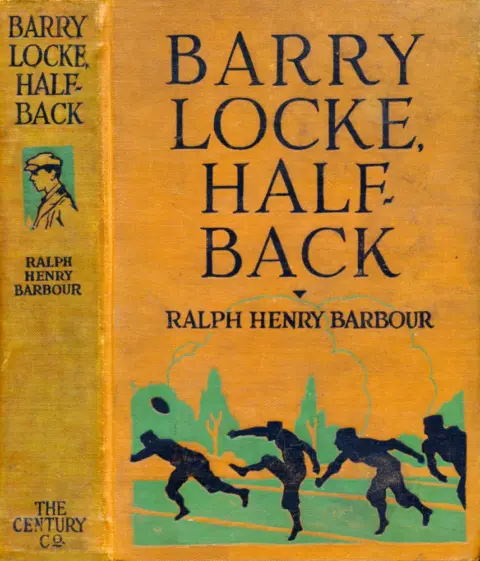
THE CLASSIC COLLECTION · 1925
"Barry Locke, half-back" by Ralph Henry Barbour is a school sports novel written in the early 20th century. It follows Barry Locke, a new boy at Broadmoor School, as he navigates housing mishaps, shifting friendships, and the pull between football, baseball, and school cliques; key figures include his status‑minded friend Clyde Allen, the wry and grounded Crawford “Peaches” Jones, and sensitive violinist Alonzo “Zo” Fessenden.
The opening of the book traces Barry’s arrival in the Connecticut village of Wessex, where a promised dorm room falls through and he instead boards with kindly Mrs. Lyle, meeting her daughter Betty, the quirky specimen-collector Toby Nott, and the affable Peaches Jones. Barry registers, samples campus life, buys a sturdy second‑hand desk, and endures Clyde’s attempts to steer him toward “the right sort” of friends and clubs while discouraging baseball and Jones. On “Pup Night” he intervenes when Third Class boys try to drag the panicked Fourth Class Zo Fessenden to the pond, scuffling with Rusty Waterman until Peaches steps in, and the three begin a quiet friendship. These chapters establish Barry’s daily routine, early football Saturdays, and the warm porch camaraderie at the Lyles, while hinting at the social divides Barry must choose his way through.
Introduction adapted from the source catalogue; source summaries may be automatically generated.
Free to read · English · 66,507 words · No account needed
MAKE TIME FOR A GOOD BOOK
On by default. Untick to stop anonymous reading totals. Each page counts after 10 seconds in view. How this works.
Anonymous counting is on unless you have switched it off.
“Oh, yes, I remember. Was that at eight? All right. Let’s see.” He consulted a sheet of paper. “W.L.L.O. That’s it. I’ll see if there’s anything doing yet.” He manipulated the knobs of the dials again, at first with no result. “That’s funny,” he muttered.
Mr. Lyle consulted his watch.
“Seven fifty-six,” he said. “Likely it isn’t time yet.”
“Oh, they don’t always start just on the minute,” said Peaches. “Do
they, Mill?”
“Not always.” Mill turned the knobs some more and then stood up and leaned over the table. “Maybe the wiring’s loose,” he muttered. He said something else, probably to himself, since it was not intelligible to the audience, while leaning over the dark space behind the table. Then, although it still lacked three minutes of being eight o’clock,――Mr. Benjy set his watch every day by the station clock,――a rather high-pitched voice suddenly broke into the expectant silence:
“Station W.L.L.O., Onondaga University Experimental Station, Onondaga, New York, broadcasting. The first number on our program this evening will be a paper read by Professor N. B. Brown, D.S., S.D., R.O.T., of the Department of Zoölogy, Onondaga University. Station W.L.L.O., broadcasting.”
There was a pause.
“Much more distinct,” said Mr. Benjy, looking around for confirmation. Mrs. Lyle nodded. “Different,” she whispered. “Sounds almost as if――”
Toby was leaning forward and gazing absorbedly at the horn, seeking enlightenment on the care of Antonio. Betty, her eyes dancing, was looking questioningly at Peaches’ impassive countenance. After a brief moment a deeper voice came to them, somewhat muffled but very distinct. Toby’s intent frown indicated almost painful effort.
“Ladies and gentlemen,” began the unseen lecturer, “I shall speak to you this evening, very briefly, on the subject of ‘The Care and Feeding of Batrachians.’ Batrachians, as most of you know, are frogs, toads, snakes, and similar insects of a zoöphagous nature.”
“What’s he mean――‘insects’?” demanded Toby, in a hoarse and protesting
whisper.
Peaches said, “S-sh!” and frowned him into silence. The voice of the professor possessed quite a different tone than those who had preceded him. It was no clearer, but it gave the impression of coming from a point much nearer than Onondaga, New York. The professor did not seem used to public addresses, either, for he hesitated frequently and frequently repeated himself.
Your reading position is saved on this browser. Take it to another device with a library code. Reading pages adapt to text, rather than matching a printed edition.
Ralph Henry Barbour
Ralph Henry Barbour

Ralph Henry Barbour

Ralph Henry Barbour
BEHIND THE BOOK
This eBook is for the use of anyone anywhere in the United States and most other parts of the world at no cost and with almost no restrictions whatsoever. You may copy it, give it away or re-use it under the terms of the Project Gutenberg License included with this eBook or online at www.gutenberg.org. If you are not located in the United States, you will have to check the laws of the country where you are located before using this eBook. Read the source licence.
The original source file, including credits and licence, is retained by this library. Request an original-format copy at no charge. Please include the book title and Project Gutenberg identifier #78118.
KEEP YOUR CURIOSITY GOING
Coulson Kernahan

Maurice Baring
Frances Wright
Cécile Tormay

Frederic Jesup Stimson

W. H. P. (William Henry Pope) Jarvis