
The lost dirigible
Ralph Henry Barbour
THE CLASSIC COLLECTION · 1925
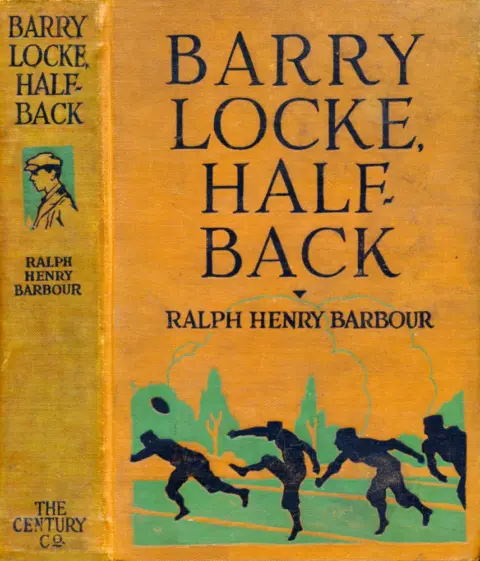
"Barry Locke, half-back" by Ralph Henry Barbour is a school sports novel written in the early 20th century. It follows Barry Locke, a new boy at Broadmoor School, as he navigates housing mishaps, shifting friendships, and the pull between football, baseball, and school cliques; key figures include his status‑minded friend Clyde Allen, the wry and grounded Crawford “Peaches” Jones, and sensitive violinist Alonzo “Zo” Fessenden.
The opening of the book traces Barry’s arrival in the Connecticut village of Wessex, where a promised dorm room falls through and he instead boards with kindly Mrs. Lyle, meeting her daughter Betty, the quirky specimen-collector Toby Nott, and the affable Peaches Jones. Barry registers, samples campus life, buys a sturdy second‑hand desk, and endures Clyde’s attempts to steer him toward “the right sort” of friends and clubs while discouraging baseball and Jones. On “Pup Night” he intervenes when Third Class boys try to drag the panicked Fourth Class Zo Fessenden to the pond, scuffling with Rusty Waterman until Peaches steps in, and the three begin a quiet friendship. These chapters establish Barry’s daily routine, early football Saturdays, and the warm porch camaraderie at the Lyles, while hinting at the social divides Barry must choose his way through.
Introduction adapted from the source catalogue; source summaries may be automatically generated.
Free to read · English · 66,507 words · No account needed
MAKE TIME FOR A GOOD BOOK
On by default. Untick to stop anonymous reading totals. Each page counts after 10 seconds in view. How this works.
Anonymous counting is on unless you have switched it off.
But it appeared that Jones had spoiled the party. Silence fell. Even Fessenden grew quiet. Then some one laughed awkwardly and the spell was broken.
“Well,” said Jones, in mild astonishment, “what’s the difficulty? Let’s go. Any one will do; or any two.”
“Where’s your license to butt in?” growled Rusty, nursing his jaw
tenderly.
“Why, hello! Is that you, Waterman? That was a nice one you stopped just now. They ought to have you on the nine, Rusty! Well, if the game’s over, Locke, let’s wander. Who’s this chap?”
“He’s a pup,” answered Rusty, aggrievedly. “We were lugging him down to the pond when this fresh guy here came up and shot off his mouth. Said we mustn’t. I told him to beat it and then he wanted to fight. You’d think we were doing something we oughtn’t! Isn’t this Pup Night, Peaches?”
“As ever was!” agreed Jones, heartily. “And if you fellows expect to see any of the fun, you’d better get a move on. It’s long after eight.”
“Well, we’re going to take this brat with us,” said Rusty. But his tone lacked conviction. Jones shook his head.
“Not to-night,” he said gently. “Fade away, Rusty.”
“You’ve got a lot of gall,” began Rusty, blusteringly.
“I’ll say he has,” agreed one of the others. “This isn’t any of your business, Jones.”
“Is that,” Jones inquired amiably, “your considered opinion?”
“Yes, it is, if you want to know.” Assurance, however, decreased perceptibly toward the end of the statement.
“Well,” said Jones, “you look――or you would look if I could see you――like a fellow ready to back his opinions. How about it?”
“Oh, dry up!” The retort was delivered in retreat, so to say, for the speaker was already moving cautiously in a direction which could never bring him any nearer Jones than he had been, even if persisted in indefinitely. Jones allowed the argument to close. So did all the others. Rusty laughed with a creditable simulation of unconcern and moved too.
“If you’re going to make a――a serious affair of it――” he began
sarcastically.
“That’s it,” said Jones. “International complications, World Court and all that, Rusty. Good night.” Jones re-donned his coat. The party was at an end, disrupted, broken in halves. One half went schoolward, discussing the affair, in dissatisfied mutters; the other set off toward the Andersons’ house. Nearing the light, Jones turned a puzzled regard on Fessenden.
“Well, son, what was your trouble? Think they were going to murder you?”
Fessenden shook his head, gulped, but made no answer.
Your reading position is saved on this browser. Take it to another device with a library code. Reading pages adapt to text, rather than matching a printed edition.
Ralph Henry Barbour
Ralph Henry Barbour

Ralph Henry Barbour

Ralph Henry Barbour
BEHIND THE BOOK
This eBook is for the use of anyone anywhere in the United States and most other parts of the world at no cost and with almost no restrictions whatsoever. You may copy it, give it away or re-use it under the terms of the Project Gutenberg License included with this eBook or online at www.gutenberg.org. If you are not located in the United States, you will have to check the laws of the country where you are located before using this eBook. Read the source licence.
The original source file, including credits and licence, is retained by this library. Request an original-format copy at no charge. Please include the book title and Project Gutenberg identifier #78118.
KEEP YOUR CURIOSITY GOING
Coulson Kernahan

Maurice Baring
Frances Wright
Cécile Tormay

Frederic Jesup Stimson

W. H. P. (William Henry Pope) Jarvis