
The lost dirigible
Ralph Henry Barbour
THE CLASSIC COLLECTION · 1925
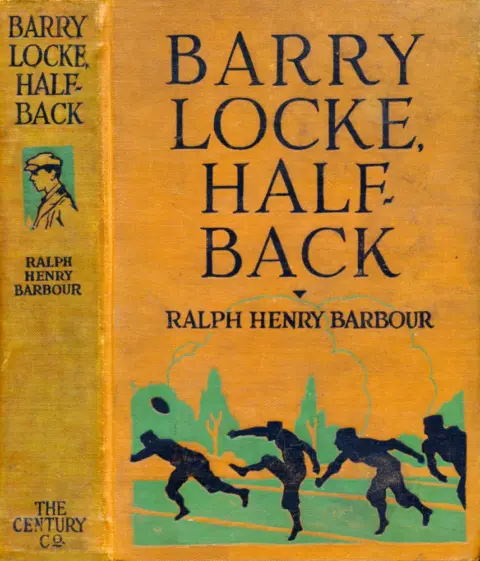
"Barry Locke, half-back" by Ralph Henry Barbour is a school sports novel written in the early 20th century. It follows Barry Locke, a new boy at Broadmoor School, as he navigates housing mishaps, shifting friendships, and the pull between football, baseball, and school cliques; key figures include his status‑minded friend Clyde Allen, the wry and grounded Crawford “Peaches” Jones, and sensitive violinist Alonzo “Zo” Fessenden.
The opening of the book traces Barry’s arrival in the Connecticut village of Wessex, where a promised dorm room falls through and he instead boards with kindly Mrs. Lyle, meeting her daughter Betty, the quirky specimen-collector Toby Nott, and the affable Peaches Jones. Barry registers, samples campus life, buys a sturdy second‑hand desk, and endures Clyde’s attempts to steer him toward “the right sort” of friends and clubs while discouraging baseball and Jones. On “Pup Night” he intervenes when Third Class boys try to drag the panicked Fourth Class Zo Fessenden to the pond, scuffling with Rusty Waterman until Peaches steps in, and the three begin a quiet friendship. These chapters establish Barry’s daily routine, early football Saturdays, and the warm porch camaraderie at the Lyles, while hinting at the social divides Barry must choose his way through.
Introduction adapted from the source catalogue; source summaries may be automatically generated.
Free to read · English · 66,507 words · No account needed
MAKE TIME FOR A GOOD BOOK
On by default. Untick to stop anonymous reading totals. Each page counts after 10 seconds in view. How this works.
Anonymous counting is on unless you have switched it off.
There was a somewhat decrepit picket fence in front, and a gate which obligingly swung inward or outward, but creaked complainingly either way. A short brick walk between narrow beds of salvia and geraniums and flaming nasturtiums led to the open doorway. It also led to a boy who sat on the edge of the low porch and, clasping a knee in a pair of very brown hands, unwinkingly observed their approach. However, when they had traversed half the walk he spoke.
“Hello, Allen,” he said.
“Hello,” answered Clyde; and then, as Barry dropped his suit-case and reached for his handkerchief, he added perfunctorily: “This is Mr. Locke, Mr. Jones. You fellows might as well get acquainted. Didn’t know you hung out here, though, Jones.”
The boy on the porch arose and shook hands with Barry. He had hair that was neither brown nor red but some shade between, a lean, deeply tanned face, two very blue eyes, and a smile that Barry liked immensely. But the smile vanished when the youth dropped again to his seat and replied to Clyde:
“That’s strange, I’ve been here some time.”
“Oh,” said Clyde, in the tone of one dismissing an unimportant topic. “Well, we’d better find Mrs. Lyle, Barry.”
“She’s gone to town,” said Jones. “Locke’s room is in front, on this side.” He pointed a thumb over his left shoulder. “You can’t miss it.”
“I’ll go up with you,” said Clyde. “Oh, by the way, what about your trunk? Did you give your check to the man at the station?”
Barry shook his head ruefully:
“I didn’t think a thing about it!”
“You’re a wonder!” jeered Clyde. “Guess it’s a good thing you’ve got me here to look after you, kid.”
“I beg your pardon?” said Jones, somewhat surprisingly.
“I was speaking to Locke,” answered Clyde, shortly. Barry saw the scowl that accompanied the words, and wondered. Jones nodded imperturbably.
“My error,” he murmured. His gaze returned to the road.
Clyde led the way inside, along a narrow hall, and up a stairway. He was muttering to himself, but Barry caught fragments. “Fresh bounder” was one of them. Evidently Clyde and the brown-skinned youth downstairs were not very friendly. Clyde seemed to have regained his equanimity, however, by the time they reached the second floor. There were four doors in sight, one at the head of the stairs, one, that of the bath-room, half-way along the hall, and two more after the stair-well had been passed. That to the right was barely ajar, the other stood wide. Clyde, in advance, paused impressively on the threshold and waved a hand.
Your reading position is saved on this browser. Take it to another device with a library code. Reading pages adapt to text, rather than matching a printed edition.
Ralph Henry Barbour
Ralph Henry Barbour

Ralph Henry Barbour

Ralph Henry Barbour
BEHIND THE BOOK
This eBook is for the use of anyone anywhere in the United States and most other parts of the world at no cost and with almost no restrictions whatsoever. You may copy it, give it away or re-use it under the terms of the Project Gutenberg License included with this eBook or online at www.gutenberg.org. If you are not located in the United States, you will have to check the laws of the country where you are located before using this eBook. Read the source licence.
The original source file, including credits and licence, is retained by this library. Request an original-format copy at no charge. Please include the book title and Project Gutenberg identifier #78118.
KEEP YOUR CURIOSITY GOING
Coulson Kernahan

Maurice Baring
Frances Wright
Cécile Tormay

Frederic Jesup Stimson

W. H. P. (William Henry Pope) Jarvis