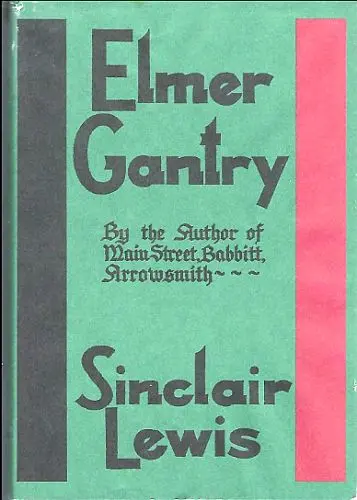
Elmer Gantry
Sinclair Lewis
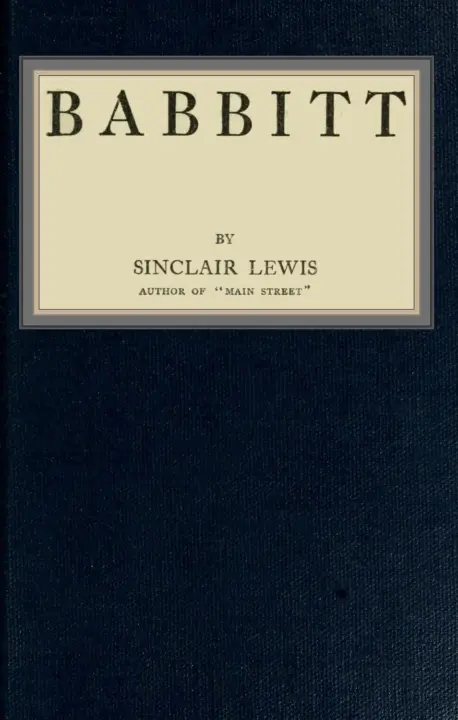
THE CLASSIC COLLECTION · 1922
"Babbitt" by Sinclair Lewis is a satirical novel published in 1922. It follows George F. Babbitt, a middle-aged real estate broker who appears to embody the American Dream—success, conformity, and middle-class respectability. Yet beneath his comfortable existence lies growing dissatisfaction. When his best friend's life unravels, Babbitt begins questioning everything he once valued, launching into rebellion against social conventions. His journey explores the emptiness of conformity and the cost of living according to others' expectations in 1920s America.
Introduction adapted from the source catalogue; source summaries may be automatically generated.
Free to read · English · 126,072 words · No account needed
MAKE TIME FOR A GOOD BOOK
On by default. Untick to stop anonymous reading totals. Each page counts after 10 seconds in view. How this works.
Anonymous counting is on unless you have switched it off.
As all converts, whether to a religion, love, or gardening, find as by magic that though hitherto these hobbies have not seemed to exist, now the whole world is filled with their fury, so, once he was converted to dissipation, Babbitt discovered agreeable opportunities for it everywhere.
He had a new view of his sporting neighbor, Sam Doppelbrau. The Doppelbraus were respectable people, industrious people, prosperous people, whose ideal of happiness was an eternal cabaret. Their life was dominated by suburban bacchanalia of alcohol, nicotine, gasoline, and kisses. They and their set worked capably all the week, and all week looked forward to Saturday night, when they would, as they expressed it, “throw a party;” and the thrown party grew noisier and noisier up to Sunday dawn, and usually included an extremely rapid motor expedition to nowhere in particular.
One evening when Tanis was at the theater, Babbitt found himself being lively with the Doppelbraus, pledging friendship with men whom he had for years privily denounced to Mrs. Babbitt as a “rotten bunch of tin-horns that I wouldn’t go out with, not if they were the last people on earth.” That evening he had sulkily come home and poked about in front of the house, chipping off the walk the ice-clots, like fossil footprints, made by the steps of passers-by during the recent snow. Howard Littlefield came up snuffling.
“Still a widower, George?”
“Yump. Cold again to-night.”
“What do you hear from the wife?”
“She’s feeling fine, but her sister is still pretty sick.”
“Say, better come in and have dinner with us to-night, George.”
“Oh--oh, thanks. Have to go out.”
Suddenly he could not endure Littlefield’s recitals of the more interesting statistics about totally uninteresting problems. He scraped at the walk and grunted.
Sam Doppelbrau appeared.
“Evenin’, Babbitt. Working hard?”
“Yuh, lil exercise.”
“Cold enough for you to-night?”
“Well, just about.”
“Still a widower?”
“Uh-huh.”
“Say, Babbitt, while she’s away-- I know you don’t care much for booze-fights, but the Missus and I’d be awfully glad if you could come in some night. Think you could stand a good cocktail for once?”
“Stand it? Young fella, I bet old Uncle George can mix the best cocktail in these United States!”
“Hurray! That’s the way to talk! Look here: There’s some folks coming to the house to-night, Louetta Swanson and some other live ones, and I’m going to open up a bottle of pre-war gin, and maybe we’ll dance a while. Why don’t you drop in and jazz it up a little, just for a change?”
“Well-- What time they coming?”
Your reading position is saved on this browser. Take it to another device with a library code. Reading pages adapt to text, rather than matching a printed edition.
Sinclair Lewis
Sinclair Lewis
Sinclair Lewis
Sinclair Lewis
BEHIND THE BOOK
This eBook is for the use of anyone anywhere in the United States and most other parts of the world at no cost and with almost no restrictions whatsoever. You may copy it, give it away or re-use it under the terms of the Project Gutenberg License included with this eBook or online at www.gutenberg.org. If you are not located in the United States, you will have to check the laws of the country where you are located before using this eBook. Read the source licence.
The original source file, including credits and licence, is retained by this library. Request an original-format copy at no charge. Please include the book title and Project Gutenberg identifier #1156.
KEEP YOUR CURIOSITY GOING
Coulson Kernahan

Maurice Baring
Frances Wright
Cécile Tormay

Frederic Jesup Stimson

W. H. P. (William Henry Pope) Jarvis