THE CLASSIC COLLECTION✦An outlaw’s diary: the CommuneCLASSIC FREE BOOKS
An outlaw’s diary: the Commune
Cécile Tormay
THE CLASSIC COLLECTION · 1857
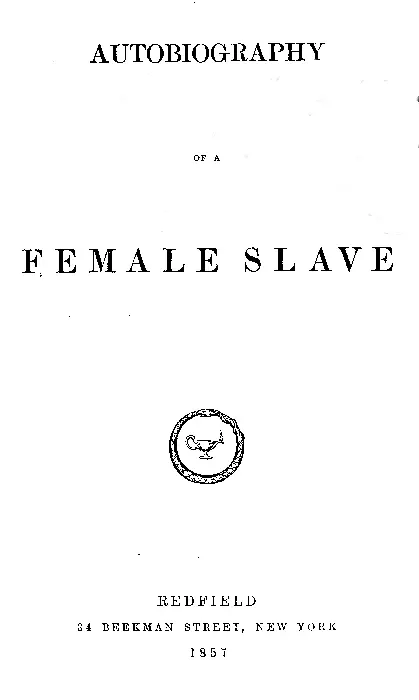
"Autobiography of a Female Slave" by Martha Griffith Browne is a historical account written in the mid-19th century. This compelling narrative offers readers a firsthand perspective of the life of a female slave in the Southern United States, exploring her personal struggles, family ties, and experiences of both cruelty and kindness. The author provides an intimate portrayal of the protagonist's journey, encapsulating the harsh realities of slavery while highlighting the deep emotional bonds that shape her existence. The opening of this autobiography introduces us to the narrator, a young female slave born on a Kentucky farm, detailing her early life, her family's dynamics, and her yearning for education amidst the oppressive backdrop of slavery. As her master falls ill and subsequently passes away, the narrator faces the terrifying prospect of being sold away from her mother, which unveils the traumatic realities of the slave trade. The emotional turmoil felt by both the mother and daughter during this separation takes center stage, illustrating the heart-wrenching impact of slavery on familial relationships. Through vivid descriptions of love, loss, and the hope for a brighter future, the opening sets the tone for a deeply moving exploration of resilience and the quest for freedom.
Introduction adapted from the source catalogue; source summaries may be automatically generated.
Free to read · English · 135,160 words · No account needed
MAKE TIME FOR A GOOD BOOK
On by default. Untick to stop anonymous reading totals. Each page counts after 10 seconds in view. How this works.
Anonymous counting is on unless you have switched it off.
"Don't say nothing 'bout haven' seed me wid dat ar' gemman; fur he used to be my mars'er, and a good one he was too."
I promised that I would say nothing about the matter, but first I inquired what was the nature of the private interview.
"Oh, he jist wanted fur to see me, and know how I was gitten' long."
I said no more; but I was not satisfied with her explanation. I resolved to watch her narrowly, and ferret out, if possible, this seeming mystery. Upon my return to the kitchen, with my bundle of dry sticks, I related what I had seen to Aunt Polly.
"Dat gal is arter sompen not very good, you mark my words fur it."
"Oh, maybe not, Aunt Polly," I answered, though with a conviction that I was speaking at variance with the strong probabilities of the case.
I hurried in the viands and meats for the table, and was not surprised to find Lindy unusually obliging, for I understood the object. There was an abashed air and manner which argued guilt, or at least, that she was the mistress of a secret, for the entire possession of which she trembled. Sundry little acts of unaccustomed kindness she offered me, but I quietly declined them. I did not desire that she should insult my honor by the offer of a tacit bribe.
In the evening, when I was arranging Miss Jane's hair (this was my especial duty), she surprised me by asking, in a careless and incautious manner:
"Ann, what is the matter with Lindy? she has such an excited manner."
"I really don't know, Miss Jane; I have not observed anything very
unusual in her."
"Well, I have, and I shall speak to her about it. Oh, there! slow, girl, slow; you pulled my hair. Don't do it again. You niggers have become so unruly since pa's sickness, that if we don't soon get another overseer, there will be no living for you. There is Lindy in the sulks, simply because she wants a whipping, and old Polly hasn't given us a meal fit to eat."
"Have I done anything, Miss Jane?" I asked with a misgiving.
"No, nothing in particular, except showing a general and continued sullenness. Now, I do despise to see a nigger always sour-looking; and I can tell you, Ann, you must change your ways, or it will be worse for you."
"I try to be cheerful, Miss Jane, but--" here I wisely checked myself.
"Try to be," she echoed with a satirical tone. "What do you mean by trying? You don't dare to say you are not happy here?"
Your reading position is saved on this browser. Take it to another device with a library code. Reading pages adapt to text, rather than matching a printed edition.
BEHIND THE BOOK
This eBook is for the use of anyone anywhere in the United States and most other parts of the world at no cost and with almost no restrictions whatsoever. You may copy it, give it away or re-use it under the terms of the Project Gutenberg License included with this eBook or online at www.gutenberg.org. If you are not located in the United States, you will have to check the laws of the country where you are located before using this eBook. Read the source licence.
The original source file, including credits and licence, is retained by this library. Request an original-format copy at no charge. Please include the book title and Project Gutenberg identifier #55813.
KEEP YOUR CURIOSITY GOING
Cécile Tormay

Moritz Busch
Coulson Kernahan
John L. Ransom

Maurice Baring
Frances Wright