THE CLASSIC COLLECTION✦An outlaw’s diary: the CommuneCLASSIC FREE BOOKS
An outlaw’s diary: the Commune
Cécile Tormay
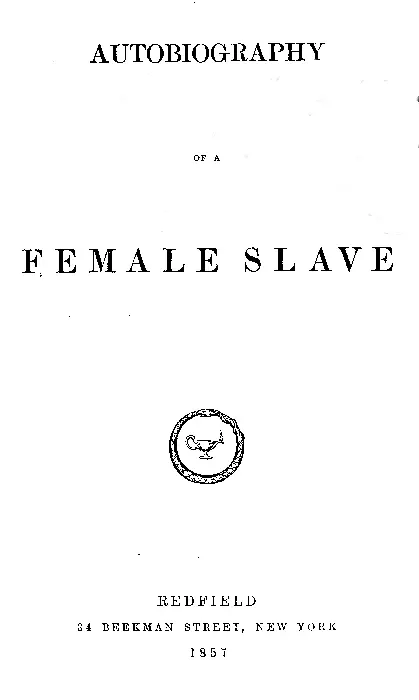
THE CLASSIC COLLECTION · 1857
"Autobiography of a Female Slave" by Martha Griffith Browne is a historical account written in the mid-19th century. This compelling narrative offers readers a firsthand perspective of the life of a female slave in the Southern United States, exploring her personal struggles, family ties, and experiences of both cruelty and kindness. The author provides an intimate portrayal of the protagonist's journey, encapsulating the harsh realities of slavery while highlighting the deep emotional bonds that shape her existence. The opening of this autobiography introduces us to the narrator, a young female slave born on a Kentucky farm, detailing her early life, her family's dynamics, and her yearning for education amidst the oppressive backdrop of slavery. As her master falls ill and subsequently passes away, the narrator faces the terrifying prospect of being sold away from her mother, which unveils the traumatic realities of the slave trade. The emotional turmoil felt by both the mother and daughter during this separation takes center stage, illustrating the heart-wrenching impact of slavery on familial relationships. Through vivid descriptions of love, loss, and the hope for a brighter future, the opening sets the tone for a deeply moving exploration of resilience and the quest for freedom.
Introduction adapted from the source catalogue; source summaries may be automatically generated.
Free to read · English · 135,160 words · No account needed
MAKE TIME FOR A GOOD BOOK
On by default. Untick to stop anonymous reading totals. Each page counts after 10 seconds in view. How this works.
Anonymous counting is on unless you have switched it off.
"Well, if you had died, I would hab got yer close, now you knows you promised 'em to me. So when I hearn Jake say you was dead, I run and got yer new calico dress, and dat ribbon what Miss Jane gib you, an' put dem in my box; den arter while Aunt Polly say you done kum back to life; so I neber say notin' more, I jist tuck de close and put dem back in yer box, and tink to myself, well, maybe I will git 'em some oder time."
It amused me not a little to find that upon mere suspicion of my demise, this little negro had levied upon my wardrobe, which was scanty indeed; but so it is, be we ever so humble or poor, there is always some one to regard us with a covetous eye. My little paraphernalia was, to this half-savage child, a rich and wondrous possession.
"Here, hold up yer foot, Ben, or you shan't hab any meat fur breakus." This threat was addressed to her young brother, whom she nursed like a baby, and whose tiny foot seemed to resist the restraint of a shoe.
I looked long at them, and mused with a strange sorrow upon their probable destiny. Bitter I knew it must be. For, where is there, beneath the broad sweep of the majestic heavens, a single one of the dusky tribe of Ethiopia who has not felt that existence was to him far more a curse than a blessing? You, oh, my tawny brothers, who read these tear-stained pages, ask your own hearts, which, perhaps, now ache almost to bursting, ask, I say, your own vulture-torn hearts, if life is not a hard, hard burden? Have you not oftentimes prayed to the All-Merciful to sever the mystic tie that bound you here, to loosen your chains and set you, soul and body, free? Have you not, from the broken chinks of your lonely cabins at night, looked forth upon the free heavens, and murmured at your fate? Is there, oh! slave, in your heart a single pleasant memory? Do you not, captive-husband, recollect with choking pride how the wife of your bosom has been cruelly lashed while you dared not say one word in her defence? Have you not seen your children, precious pledges of undying love, ruthlessly torn from you, bound hand and foot and sold like dogs in the slave market, while you dared not offer a single remonstrance? Has not every social and moral feeling been outraged? Is it not the white man's policy to degrade your race, thereby finding an argument to favor the perpetuation of Slavery? Is there for us one thing to sweeten bondage? Free African! in the brave old States of the North, where the shackles of slavery exist not, to you I call. Noble defenders of Abolition, you whose earnest eyes may scan these pages, I call to you with a tearful voice; I pray you to go on in your glorious cause; flag not, faint not, prosecute it before heaven and against man. Fling out your banners and march on to the defence of the suffering ones at the South. And you, oh my heart-broken sisters, toiling beneath a tropic sun, wearing out your lives in the service of tyrants, to you I say, hope and pray still! Trust in God! He is mighty and willing to save, and, in an hour that you know not of, he will roll the stone away from the portal of your hearts. My prayers are with you and for you. I have come up from the same tribulation, and I vow, by the sears and wounds upon my flesh, never to forget your cause. Would that my tears, which freely flow for you, had power to dissolve the fetters of your wasting bondage.
Your reading position is saved on this browser. Take it to another device with a library code. Reading pages adapt to text, rather than matching a printed edition.
BEHIND THE BOOK
This eBook is for the use of anyone anywhere in the United States and most other parts of the world at no cost and with almost no restrictions whatsoever. You may copy it, give it away or re-use it under the terms of the Project Gutenberg License included with this eBook or online at www.gutenberg.org. If you are not located in the United States, you will have to check the laws of the country where you are located before using this eBook. Read the source licence.
The original source file, including credits and licence, is retained by this library. Request an original-format copy at no charge. Please include the book title and Project Gutenberg identifier #55813.
KEEP YOUR CURIOSITY GOING
Cécile Tormay

Moritz Busch
Coulson Kernahan
John L. Ransom

Maurice Baring
Frances Wright