THE CLASSIC COLLECTION✦An outlaw’s diary: the CommuneCLASSIC FREE BOOKS
An outlaw’s diary: the Commune
Cécile Tormay
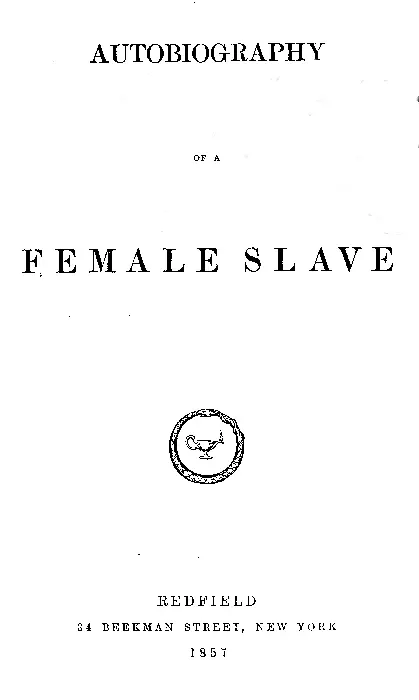
THE CLASSIC COLLECTION · 1857
"Autobiography of a Female Slave" by Martha Griffith Browne is a historical account written in the mid-19th century. This compelling narrative offers readers a firsthand perspective of the life of a female slave in the Southern United States, exploring her personal struggles, family ties, and experiences of both cruelty and kindness. The author provides an intimate portrayal of the protagonist's journey, encapsulating the harsh realities of slavery while highlighting the deep emotional bonds that shape her existence. The opening of this autobiography introduces us to the narrator, a young female slave born on a Kentucky farm, detailing her early life, her family's dynamics, and her yearning for education amidst the oppressive backdrop of slavery. As her master falls ill and subsequently passes away, the narrator faces the terrifying prospect of being sold away from her mother, which unveils the traumatic realities of the slave trade. The emotional turmoil felt by both the mother and daughter during this separation takes center stage, illustrating the heart-wrenching impact of slavery on familial relationships. Through vivid descriptions of love, loss, and the hope for a brighter future, the opening sets the tone for a deeply moving exploration of resilience and the quest for freedom.
Introduction adapted from the source catalogue; source summaries may be automatically generated.
Free to read · English · 135,160 words · No account needed
MAKE TIME FOR A GOOD BOOK
On by default. Untick to stop anonymous reading totals. Each page counts after 10 seconds in view. How this works.
Anonymous counting is on unless you have switched it off.
"'What fur den you do?' says Jake. 'Why, to be sure, I lef it right dar, and run as fas' as my feet would carry me.'
"By dis time de house was full ob de neighbors; all hab collected in de house, fur de news dat Masser was kilt jist fly trough de neighborhood. Miss Bradly hearn in de house 'bout de 'raculous 'pearance ob de sperit, and she kum up to me, and say 'Polly, whar is de body of Ann?' 'Laws, Miss Bradly, it is out in de trough, I won't go agin nigh to it.'
"'Well,' say she, 'where is Jake? let him kum along wid me.'
"'What, you ain't gwine nigh it?' I asked.
"'Yes I is gwine right up to it,' she say, 'kase I knows thar is life in it.' Well this sorter holpd me up, so I said, 'well I'll go too.' So we tuck Jake, and Miss Bradly walked long wid us to de berry spot, and dar you wus a settin up in de water ob de trough where I seed you; it skeered me worse den eber, so I fell right down on de ground, and began to pray to de Lord to hab marcy on us all; but Miss Bradly (she is a quare woman) walked right up to you, and spoke to you.
"'Laws,' says Jake, 'jist hear dat ar' woman talking wid a sperit,' and down he fell, and went to callin on de Angel Gabriel to kum and holp him.
"Fust ting I knowed, Miss Bradly was a rollin' her shawl round yer body, and axed you to walk out ob de trough.
"Well, tinks I, dese am quare times when a stone-dead nigger gits up and walks agin like a live one. Well, widout any help from us, Miss Bradly led you 'long into dis cabin. I followed arter. After while she kind o' 'suaded me you was a livin'. Den I helped her wash you, and got her some goose-greese, and we rubbed you all ober, from your head to yer feet, and den you kind ob fainted away, and I began to run off; but Miss Bradly say you only swoon, and she tuck a little glass vial out ob her pocket, and held it to yer nose, and dis bring you to agin. After while you fell off to sleep, and Miss Bradly bringed de Doctor out ob de house to look at you. Well, he feel ob yer wrist, put his ear down to yer breast, den say, 'may be wid care she will git well, but she hab been powerful bad treated.' He shuck his head, and I knowed what he was tinkin' 'bout, but I neber say one word. Den Miss Bradly wiped her eyes, and de Doctor fetch anoder sigh, and say, dis is very 'stressing,' and Miss Bradly say somepin agin 'slavery,' and de Doctor open ob his eyes right wide and say, ''tis worth your head, Miss, for to say dat in dis here country.' Den she kind of 'splained it to him, and tings just seemed square 'twixt 'em, for she was monstrous skeered like, and turned white as a sheet. Den I hearn de Doctor say sompin' 'bout ridin' on a rail, and tar and feaders, and abolutionist. So arter dat, Miss Bradly went into de house, arter she had bin a tellin' ob me to nurse you well; dat you was way off hare from yer mammy, so eber sence den you has bin a lying right dar on dat bed, and I hab nursed you as if you war my own child."
Your reading position is saved on this browser. Take it to another device with a library code. Reading pages adapt to text, rather than matching a printed edition.
BEHIND THE BOOK
This eBook is for the use of anyone anywhere in the United States and most other parts of the world at no cost and with almost no restrictions whatsoever. You may copy it, give it away or re-use it under the terms of the Project Gutenberg License included with this eBook or online at www.gutenberg.org. If you are not located in the United States, you will have to check the laws of the country where you are located before using this eBook. Read the source licence.
The original source file, including credits and licence, is retained by this library. Request an original-format copy at no charge. Please include the book title and Project Gutenberg identifier #55813.
KEEP YOUR CURIOSITY GOING
Cécile Tormay

Moritz Busch
Coulson Kernahan
John L. Ransom

Maurice Baring
Frances Wright