THE CLASSIC COLLECTION✦An outlaw’s diary: the CommuneCLASSIC FREE BOOKS
An outlaw’s diary: the Commune
Cécile Tormay
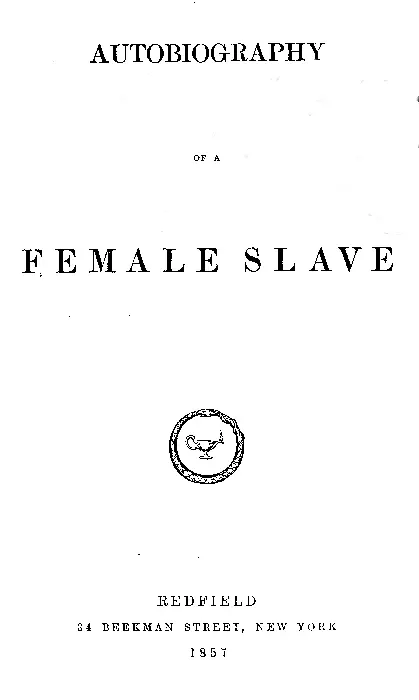
THE CLASSIC COLLECTION · 1857
"Autobiography of a Female Slave" by Martha Griffith Browne is a historical account written in the mid-19th century. This compelling narrative offers readers a firsthand perspective of the life of a female slave in the Southern United States, exploring her personal struggles, family ties, and experiences of both cruelty and kindness. The author provides an intimate portrayal of the protagonist's journey, encapsulating the harsh realities of slavery while highlighting the deep emotional bonds that shape her existence. The opening of this autobiography introduces us to the narrator, a young female slave born on a Kentucky farm, detailing her early life, her family's dynamics, and her yearning for education amidst the oppressive backdrop of slavery. As her master falls ill and subsequently passes away, the narrator faces the terrifying prospect of being sold away from her mother, which unveils the traumatic realities of the slave trade. The emotional turmoil felt by both the mother and daughter during this separation takes center stage, illustrating the heart-wrenching impact of slavery on familial relationships. Through vivid descriptions of love, loss, and the hope for a brighter future, the opening sets the tone for a deeply moving exploration of resilience and the quest for freedom.
Introduction adapted from the source catalogue; source summaries may be automatically generated.
Free to read · English · 135,160 words · No account needed
MAKE TIME FOR A GOOD BOOK
On by default. Untick to stop anonymous reading totals. Each page counts after 10 seconds in view. How this works.
Anonymous counting is on unless you have switched it off.
"Oh, God, how fearful is this!" exclaimed Miss Nancy, as the big tears rolled down her pale cheeks. "Give me, oh, sweet Jesus, the power to pray as Thou didst, to the Eternal Father, 'to forgive them, for they know not what they do!'"
"Come, Ann," continued the impetuous Biddy, "you go with me, and we'll try to find out all about it. We will go to see the woman."
"I cannot leave Miss Nancy."
"Yes, go with her, Ann; but don't allow her to say anything imprudent. Poor Biddy has such a good, philanthropic heart, that she forgets the patient spirit which Christianity inculcates."
With a strange kind of awe, I followed Biddy through the streets, scarcely heeding her impassioned garrulity. The blood seemed freezing in my veins, and my teeth chattered as though it had been the depth of winter. As we drew near the place, I knew the house by the crowd that had gathered around the back and side gates.
"Let us enter here," said Biddy, as she placed her hand upon the heavy plank gate at the back of the lot.
"Stop, Biddy, stop," I gasped out, as I held on to the gate for support, "I feel that I shall suffocate. Give me one moment to get my breath."
"Oh, Ann, you are only frightened," and she led me into the yard, where we found about a dozen persons, mostly colored.
"Where is the woman that's been kilt?" inquired Biddy, of a mulatto
girl.
"She ain't quite dead. Pity she isn't out of her misery, poor soul,"
said the mulatto girl.
"But where is she?" demanded Biddy.
"Oh, in thar, the first room in the basement," and, half-led by Biddy, I passed in through a mean, damp, musty basement. The noxious atmosphere almost stifled us. Turning to the left as directed, we entered a low, comfortless room, with brick walls and floor. Upon a pile of straw, in this wretched place, lay a bleeding, torn, mangled body, with scarcely life in it. Two colored women were bathing the wounds and wrapping greased cloths round the body. I listened to her pitiful groans, until I thought my forbearance would fail me.
"Poor soul!" said one of the colored women, "she has had a mighty bad convulsion. I wish she could die and be sot free from misery."
"Whar is de white folks?" asked another.
"Oh, dey is skeered, an' done run off an' hid up stairs."
"Who done it?"
Your reading position is saved on this browser. Take it to another device with a library code. Reading pages adapt to text, rather than matching a printed edition.
BEHIND THE BOOK
This eBook is for the use of anyone anywhere in the United States and most other parts of the world at no cost and with almost no restrictions whatsoever. You may copy it, give it away or re-use it under the terms of the Project Gutenberg License included with this eBook or online at www.gutenberg.org. If you are not located in the United States, you will have to check the laws of the country where you are located before using this eBook. Read the source licence.
The original source file, including credits and licence, is retained by this library. Request an original-format copy at no charge. Please include the book title and Project Gutenberg identifier #55813.
KEEP YOUR CURIOSITY GOING
Cécile Tormay

Moritz Busch
Coulson Kernahan
John L. Ransom

Maurice Baring
Frances Wright