THE CLASSIC COLLECTION✦An outlaw’s diary: the CommuneCLASSIC FREE BOOKS
An outlaw’s diary: the Commune
Cécile Tormay
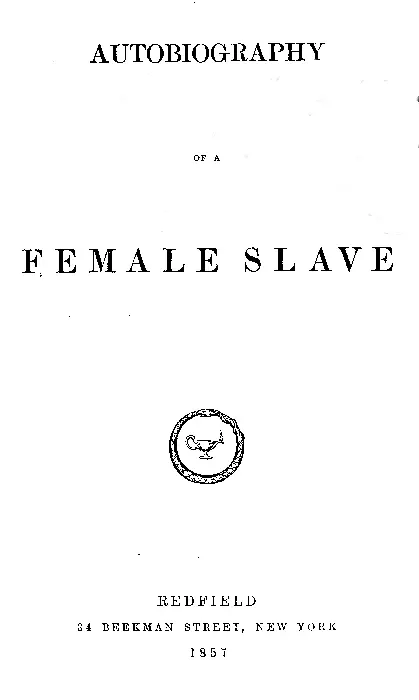
THE CLASSIC COLLECTION · 1857
"Autobiography of a Female Slave" by Martha Griffith Browne is a historical account written in the mid-19th century. This compelling narrative offers readers a firsthand perspective of the life of a female slave in the Southern United States, exploring her personal struggles, family ties, and experiences of both cruelty and kindness. The author provides an intimate portrayal of the protagonist's journey, encapsulating the harsh realities of slavery while highlighting the deep emotional bonds that shape her existence. The opening of this autobiography introduces us to the narrator, a young female slave born on a Kentucky farm, detailing her early life, her family's dynamics, and her yearning for education amidst the oppressive backdrop of slavery. As her master falls ill and subsequently passes away, the narrator faces the terrifying prospect of being sold away from her mother, which unveils the traumatic realities of the slave trade. The emotional turmoil felt by both the mother and daughter during this separation takes center stage, illustrating the heart-wrenching impact of slavery on familial relationships. Through vivid descriptions of love, loss, and the hope for a brighter future, the opening sets the tone for a deeply moving exploration of resilience and the quest for freedom.
Introduction adapted from the source catalogue; source summaries may be automatically generated.
Free to read · English · 135,160 words · No account needed
MAKE TIME FOR A GOOD BOOK
On by default. Untick to stop anonymous reading totals. Each page counts after 10 seconds in view. How this works.
Anonymous counting is on unless you have switched it off.
This man almost made me oblivious of my own grief, in sympathy for his. I did all I could by "moral suasion," as the politicians say, to soften his resentment. I bade him turn his thoughts toward that religion which he had espoused.
"I have no religion for this," he would bitterly say.
And in truth, I fear me much if the heroism of saints would hold out on such occasions. There, fastened to that impassioned husband's heart, playing with its dearest chords, was the fang-like hand of the white man! Oh, slow tortures! in comparison to which that of Prometheus was very pleasure. There is no Tartarus like that of wounded, agonized domestic love! Far away from him, in a lonely cabin, he beheld his stricken wife and all his "pretty chickens" pining and unprotected.
Slowly, after a few days, he relapsed into that stony sort of despair that denies itself the gratification of speech. The change was very painfully visible to me, and I tried, by every artifice, to arouse him; but I had no power to wake him.
"Give sorrow words; the grief that does not speak, Whispers the o'erfraught heart, and bids it break."
And soon learning this, I left him, a remorseless prey to that "rooted
sorrow" of the brain.
One day, as we all sat in the shed-room, engaged at our various occupations, we were roused by a noise of violent weeping, and something like a rude scuffle just without the door, when suddenly Atkins entered, dragging after him, with his hand close about his throat, a poor negro man, aged and worn, with a head white as cotton.
"Oh, please, Masser, jist let me go back, an' tell de ole 'ooman farewell, an' I won't ax for any more."
"No, you old rascal, you wants to run away. If you say another word about the old voman, I'll beat the life out of you."
"Oh lor', oh lor', de poor ole 'ooman an' de boys; oh my ole heart will bust!" and, sobbing like a child, the old man sank down upon the floor, in the most abandoned grief.
"Here, boys, some of you git the fiddle and play, an' I warrant that old fool will be dancin' in a minnit," said Atkins in his unfeeling way.
Of course this speech met with the most signal applause from "de boys"
addressed.
Your reading position is saved on this browser. Take it to another device with a library code. Reading pages adapt to text, rather than matching a printed edition.
BEHIND THE BOOK
This eBook is for the use of anyone anywhere in the United States and most other parts of the world at no cost and with almost no restrictions whatsoever. You may copy it, give it away or re-use it under the terms of the Project Gutenberg License included with this eBook or online at www.gutenberg.org. If you are not located in the United States, you will have to check the laws of the country where you are located before using this eBook. Read the source licence.
The original source file, including credits and licence, is retained by this library. Request an original-format copy at no charge. Please include the book title and Project Gutenberg identifier #55813.
KEEP YOUR CURIOSITY GOING
Cécile Tormay

Moritz Busch
Coulson Kernahan
John L. Ransom

Maurice Baring
Frances Wright