THE CLASSIC COLLECTION✦An outlaw’s diary: the CommuneCLASSIC FREE BOOKS
An outlaw’s diary: the Commune
Cécile Tormay
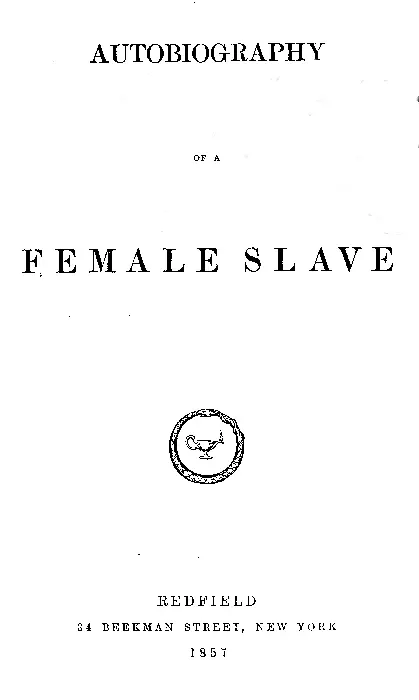
THE CLASSIC COLLECTION · 1857
"Autobiography of a Female Slave" by Martha Griffith Browne is a historical account written in the mid-19th century. This compelling narrative offers readers a firsthand perspective of the life of a female slave in the Southern United States, exploring her personal struggles, family ties, and experiences of both cruelty and kindness. The author provides an intimate portrayal of the protagonist's journey, encapsulating the harsh realities of slavery while highlighting the deep emotional bonds that shape her existence. The opening of this autobiography introduces us to the narrator, a young female slave born on a Kentucky farm, detailing her early life, her family's dynamics, and her yearning for education amidst the oppressive backdrop of slavery. As her master falls ill and subsequently passes away, the narrator faces the terrifying prospect of being sold away from her mother, which unveils the traumatic realities of the slave trade. The emotional turmoil felt by both the mother and daughter during this separation takes center stage, illustrating the heart-wrenching impact of slavery on familial relationships. Through vivid descriptions of love, loss, and the hope for a brighter future, the opening sets the tone for a deeply moving exploration of resilience and the quest for freedom.
Introduction adapted from the source catalogue; source summaries may be automatically generated.
Free to read · English · 135,160 words · No account needed
MAKE TIME FOR A GOOD BOOK
On by default. Untick to stop anonymous reading totals. Each page counts after 10 seconds in view. How this works.
Anonymous counting is on unless you have switched it off.
"Why, Henry, is this you?" and a strong hand was laid upon his shoulder. Looking up, I beheld Charley.
"And is this you, Charles Allen?" asked the other.
"Yes, this is me. I dare say you scarcely expected to find me here, where I never thought I should be."
At this I was reminded of the significant ejaculation that Ophelia makes in her madness, "Lord, we know what we are, but we know not what we may be!"
"I am sold, Henry," continued Charles, "sold away from my poor wife and children;" his voice faltered and the big tears rolled down his cheeks.
"I see from your manner toward Ann, that she is or was expected to be
your wife."
"Yes, she was pledged to be."
"Yes, and is," I added with fervor. At this, Henry only pressed my
hand tightly.
"Yet," pursued Charles, "she is taken from you."
"She is," was the brief and bitter reply.
"Now, Henry Graham, are we men? and do we submit to these things?"
"Alas!" and the words came through Henry's set teeth, "we are not men; we are only chattels, property, merchandise, slaves."
"But is it right for us to be so? I feel the high and lordly instincts of manhood within me. Must I conquer them? Must I stifle the eloquent cry of Nature in my breast? Shall I see my wife and children left behind to the mercy of a hard master, and willingly desert them simply because another man says that, in exchange for this sacrifice of happiness and hope, his daughter shall play upon Chickering's finest piano?"
Heavens! can I ever forget the princely air with which he uttered these words! His swarthy cheek glowed with a beautiful crimson, and his rich eye fairly blazed with the fire of a seven-times heated soul, whilst the thin lip curled and the fine nostril dilated, and the whole form towered supremely in the majesty of erect and perfect manhood!
"Hush, Charley, hush," I urged, "this is no place for the expression of such sentiments, just and noble as they may be."
Again Henry pressed my hand.
"It may be imprudent, Ann, but I am reckless now. They have done the worst they can do. I defy the sharpest dagger-point. My breast is open to a thousand spears. They can do no more. But how can you, Henry, thus supinely sit by and see yourself robbed of your life's treasure? I cannot understand it. Are you lacking in manliness, in courage? Are you a coward, a slave indeed?"
Your reading position is saved on this browser. Take it to another device with a library code. Reading pages adapt to text, rather than matching a printed edition.
BEHIND THE BOOK
This eBook is for the use of anyone anywhere in the United States and most other parts of the world at no cost and with almost no restrictions whatsoever. You may copy it, give it away or re-use it under the terms of the Project Gutenberg License included with this eBook or online at www.gutenberg.org. If you are not located in the United States, you will have to check the laws of the country where you are located before using this eBook. Read the source licence.
The original source file, including credits and licence, is retained by this library. Request an original-format copy at no charge. Please include the book title and Project Gutenberg identifier #55813.
KEEP YOUR CURIOSITY GOING
Cécile Tormay

Moritz Busch
Coulson Kernahan
John L. Ransom

Maurice Baring
Frances Wright