THE CLASSIC COLLECTION✦An outlaw’s diary: the CommuneCLASSIC FREE BOOKS
An outlaw’s diary: the Commune
Cécile Tormay
THE CLASSIC COLLECTION · 1857
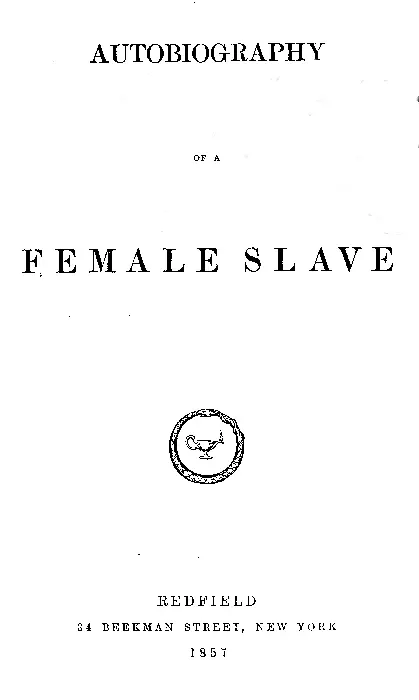
"Autobiography of a Female Slave" by Martha Griffith Browne is a historical account written in the mid-19th century. This compelling narrative offers readers a firsthand perspective of the life of a female slave in the Southern United States, exploring her personal struggles, family ties, and experiences of both cruelty and kindness. The author provides an intimate portrayal of the protagonist's journey, encapsulating the harsh realities of slavery while highlighting the deep emotional bonds that shape her existence. The opening of this autobiography introduces us to the narrator, a young female slave born on a Kentucky farm, detailing her early life, her family's dynamics, and her yearning for education amidst the oppressive backdrop of slavery. As her master falls ill and subsequently passes away, the narrator faces the terrifying prospect of being sold away from her mother, which unveils the traumatic realities of the slave trade. The emotional turmoil felt by both the mother and daughter during this separation takes center stage, illustrating the heart-wrenching impact of slavery on familial relationships. Through vivid descriptions of love, loss, and the hope for a brighter future, the opening sets the tone for a deeply moving exploration of resilience and the quest for freedom.
Introduction adapted from the source catalogue; source summaries may be automatically generated.
Free to read · English · 135,160 words · No account needed
MAKE TIME FOR A GOOD BOOK
On by default. Untick to stop anonymous reading totals. Each page counts after 10 seconds in view. How this works.
Anonymous counting is on unless you have switched it off.
"You devilish old wretch, Polly, what are you gabbling and snubbling here about? Up with your old hide, and git yer supper ready. Don't you know thar is company in the house?" and here he gave another sharp cut of the whip, which descended upon that poor old scarred back with a cruel force, and tore open old cicatriced wounds. The victim did not scream, nor shrink, nor murmur; but her features resumed their wonted hard, encrusted expression, and, rising up from her seat, she went on with her usual work.
"Now, cut like the wind," he added, as he flourished his whip in the direction of the young blacks, who had been the interested auditors of Aunt Polly's hair-breadth escapes, and quick as lightning they were off to their respective quarters, whilst I proceeded to assist Aunt Polly in dishing up the supper.
"This chicken," said I, in a tone of encouragement, "is beautifully cooked. How brown it is, and oh, what a delightful savory odor."
"I'll be bound the white folks will find fault wid it. Nobody ever did please Miss Jane. Her is got some of the most perkuler notions 'bout cookin'. I knows she'll be kommin' out here, makin' a fuss 'long wid me 'bout dis same supper," and the old woman shook her head knowingly.
I made no reply, for I feared the re-appearance of Mr. Jones, and too often and too painfully had I felt the sting of his lash, to be guilty of any wanton provocation of its severity.
Silently, but with bitter thoughts curdling my life-blood, did I arrange the steaming cookies upon the luxurious board, and then, with a deferential air, sought the parlor, and bade them walk out to tea.
I found Miss Jane seated near a fine rosewood piano, and standing beside her was a gentleman, the same whom I had observed with her upon the verandah. Miss Matilda was at the window, looking out upon the western heaven. I spoke in a soft tone, asking them, "Please walk out to tea." The young gentleman rose, and offered his arm to Miss Jane, which was graciously accepted, and Miss Matilda followed. I swung the dining-room door open with great pomp and ceremony, for I knew that anything showy or grand, either in the furniture of a house or the deportment of a servant, would be acceptable to Miss Jane. Fashion, or style, was the god of her worship, and she often declared that her principal objection to the negro, was his great want of style in thought and action. She was not deep enough to see, that, fathoms down below the surface, in all the crudity of ignorance, lay a stratum of this same style, so much worshipped by herself. Does not the African, in his love of gaud, show, and tinsel, his odd and grotesque decorations of his person, exhibit a love of style? But she was not philosopher enough to see that this was a symptom of the same taste, though ungarnished and semi-barbarous.
Your reading position is saved on this browser. Take it to another device with a library code. Reading pages adapt to text, rather than matching a printed edition.
BEHIND THE BOOK
This eBook is for the use of anyone anywhere in the United States and most other parts of the world at no cost and with almost no restrictions whatsoever. You may copy it, give it away or re-use it under the terms of the Project Gutenberg License included with this eBook or online at www.gutenberg.org. If you are not located in the United States, you will have to check the laws of the country where you are located before using this eBook. Read the source licence.
The original source file, including credits and licence, is retained by this library. Request an original-format copy at no charge. Please include the book title and Project Gutenberg identifier #55813.
KEEP YOUR CURIOSITY GOING
Cécile Tormay

Moritz Busch
Coulson Kernahan
John L. Ransom

Maurice Baring
Frances Wright