THE CLASSIC COLLECTION✦An outlaw’s diary: the CommuneCLASSIC FREE BOOKS
An outlaw’s diary: the Commune
Cécile Tormay
THE CLASSIC COLLECTION · 1857
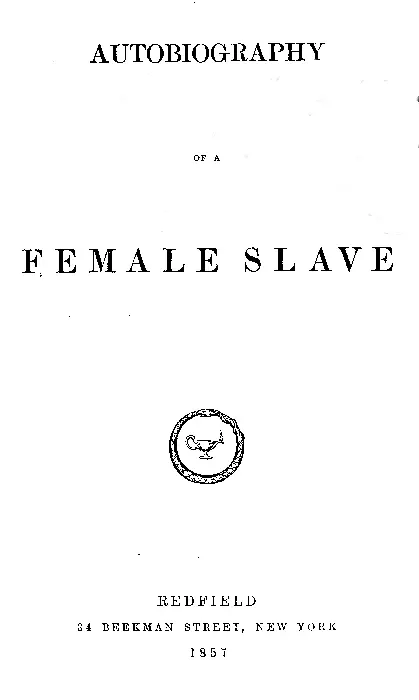
"Autobiography of a Female Slave" by Martha Griffith Browne is a historical account written in the mid-19th century. This compelling narrative offers readers a firsthand perspective of the life of a female slave in the Southern United States, exploring her personal struggles, family ties, and experiences of both cruelty and kindness. The author provides an intimate portrayal of the protagonist's journey, encapsulating the harsh realities of slavery while highlighting the deep emotional bonds that shape her existence. The opening of this autobiography introduces us to the narrator, a young female slave born on a Kentucky farm, detailing her early life, her family's dynamics, and her yearning for education amidst the oppressive backdrop of slavery. As her master falls ill and subsequently passes away, the narrator faces the terrifying prospect of being sold away from her mother, which unveils the traumatic realities of the slave trade. The emotional turmoil felt by both the mother and daughter during this separation takes center stage, illustrating the heart-wrenching impact of slavery on familial relationships. Through vivid descriptions of love, loss, and the hope for a brighter future, the opening sets the tone for a deeply moving exploration of resilience and the quest for freedom.
Introduction adapted from the source catalogue; source summaries may be automatically generated.
Free to read · English · 135,160 words · No account needed
MAKE TIME FOR A GOOD BOOK
On by default. Untick to stop anonymous reading totals. Each page counts after 10 seconds in view. How this works.
Anonymous counting is on unless you have switched it off.
"How close the air is here! Why, Mrs. St. Lucian, the fashionable, dashing lady who occupied this room just before you, Mrs. Somerville, wouldn't allow three persons to be in it at a time; and her servant-girl always slept in my room. By the way, that just reminds me how impolite I've been to you; do excuse me, and I will be glad to relieve you by letting Ann go to my room of nights."
"Oh, it will trouble you, Louise."
"Don't talk or think of troubling me; but come along girl," she said,
turning to me.
"Go with Louise, Ann," added Miss Jane, as she perceived me hesitate, "but come early in the morning to get me ready for breakfast."
Happy even for so small a favor as this, I followed Louise to her room. There I found everything very comfortable and neat. A nice, downy bed, with its snowy covering; a bright-colored carpet, a little bureau, washstand, clock, rocking-chair, and one or two pictures, with a few crocks of flowers, completed the tasteful furniture of this apartment.
All this, I inly said, is the arrangement and taste of a mulatto in the full enjoyment of her freedom! Do not her thrift and industry disprove the oft-repeated charge of indolence that is made upon the negro race?
She seemed to read my thoughts, and remarked, "You are surprised, Ann, to see my room so nice! I read the wonder in your face. I have marked it before, in the countenances of slaves. They are taught, from their infancy up, to regard themselves as unfit for the blessings of free, civilized life; and I am happy to give the lie, by my own manner of living, to this rude charge."
"How long have you been free, Louise, and how did you obtain your
freedom?"
"It is a long story," she answered; "you must be inclined to sleep; you need rest. At some other time I'll tell you. Here, take this arm-chair, it is soft; and your back is wounded and sore; I am going to dress it for you."
So saying, she left the room, but quickly returned with a basin of warm water and a little canteen of grease. She very kindly bade me remove my dress, then gently, with a soft linten-rag, washed my back, greased it, and made me put on one of her linen chemises and a nice gown, and giving me a stimulant, bade me rest myself for the night upon her bed, which was clean, white, and tempting.
Your reading position is saved on this browser. Take it to another device with a library code. Reading pages adapt to text, rather than matching a printed edition.
BEHIND THE BOOK
This eBook is for the use of anyone anywhere in the United States and most other parts of the world at no cost and with almost no restrictions whatsoever. You may copy it, give it away or re-use it under the terms of the Project Gutenberg License included with this eBook or online at www.gutenberg.org. If you are not located in the United States, you will have to check the laws of the country where you are located before using this eBook. Read the source licence.
The original source file, including credits and licence, is retained by this library. Request an original-format copy at no charge. Please include the book title and Project Gutenberg identifier #55813.
KEEP YOUR CURIOSITY GOING
Cécile Tormay

Moritz Busch
Coulson Kernahan
John L. Ransom

Maurice Baring
Frances Wright