THE CLASSIC COLLECTION✦An outlaw’s diary: the CommuneCLASSIC FREE BOOKS
An outlaw’s diary: the Commune
Cécile Tormay
THE CLASSIC COLLECTION · 1857
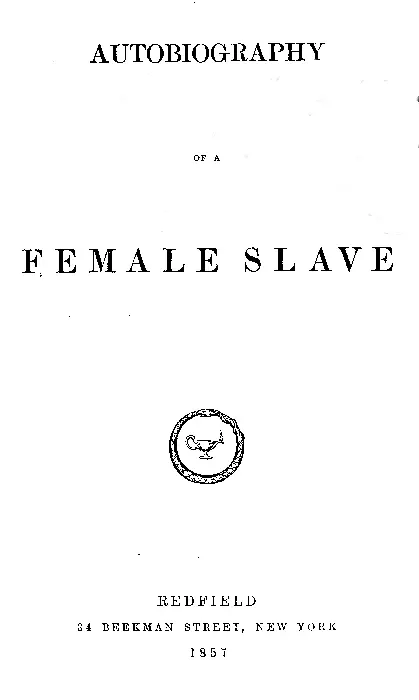
"Autobiography of a Female Slave" by Martha Griffith Browne is a historical account written in the mid-19th century. This compelling narrative offers readers a firsthand perspective of the life of a female slave in the Southern United States, exploring her personal struggles, family ties, and experiences of both cruelty and kindness. The author provides an intimate portrayal of the protagonist's journey, encapsulating the harsh realities of slavery while highlighting the deep emotional bonds that shape her existence. The opening of this autobiography introduces us to the narrator, a young female slave born on a Kentucky farm, detailing her early life, her family's dynamics, and her yearning for education amidst the oppressive backdrop of slavery. As her master falls ill and subsequently passes away, the narrator faces the terrifying prospect of being sold away from her mother, which unveils the traumatic realities of the slave trade. The emotional turmoil felt by both the mother and daughter during this separation takes center stage, illustrating the heart-wrenching impact of slavery on familial relationships. Through vivid descriptions of love, loss, and the hope for a brighter future, the opening sets the tone for a deeply moving exploration of resilience and the quest for freedom.
Introduction adapted from the source catalogue; source summaries may be automatically generated.
Free to read · English · 135,160 words · No account needed
MAKE TIME FOR A GOOD BOOK
On by default. Untick to stop anonymous reading totals. Each page counts after 10 seconds in view. How this works.
Anonymous counting is on unless you have switched it off.
Very calmly I related all that had occurred. Mr. Summerville sprang to his feet and rushed from the room, whilst Miss Jane set up a series of screams loud enough to reach the most distant part of the house. All my services were required to keep her from swooning, or affecting to swoon.
The ladies from the adjoining rooms rushed in to her assistance, and were soon busy chafing her hands, rubbing her feet, and bathing her temples.
"Isn't this terrible!" ejaculated one.
"What is the matter?" cried another.
"Poor creature, she is hysterical," was the explanation of a third.
I endeavored to explain the cause of Miss Jane's excitement.
"You did right," said one lady, whose truly womanly spirit burst through all conventionality and restraint.
"What," said one, a genuine Southern conservative, "do you say it was right for a slave to oppose and resist the punishment which her master had directed?"
"Certainly not; but it was right for a female, no matter whether white or black, to resist, even to the shedding of blood, the lascivious advances of a bold libertine."
"Do you believe the girl's story?"
"Yes; why not?"
"I don't; it bears the impress of falsehood on its very face."
"No," added another Kentucky true-blue, "Mr. Monkton was going to whip her, and she resisted him. That's the correct version of the story, I'll bet my life on it."
To all of this aspersion upon myself, I was bound to be a silent auditor, yet ever obeying their slightest order to hand them water, cologne, &c. Is not this slavery indeed?
When Mr. Summerville left the room, he hastily repaired to the bar, where he made the story known, and getting assistance, forthwith went to the cellar, Mr. Winston forming one of the party of investigation. His Southern prejudices were instantly aroused, and he was ready "to do or die" for the propogation of the "peculiar institution."
The result of their trip was to find Monkton very feeble from the loss of blood, and suffering from the cut made by the broken bottle, but with enough life left in him for the fabrication of a falsehood, which was of course believed, as he had a white face. He stated that he had proceeded to the administration of the whipping, directed by my master; that I resisted him; and finding it necessary to bind me, he was attempting to do so, when I swore that I would kill him, and that suiting the action to the word, I hurled the broken bottle at his temples.
Your reading position is saved on this browser. Take it to another device with a library code. Reading pages adapt to text, rather than matching a printed edition.
BEHIND THE BOOK
This eBook is for the use of anyone anywhere in the United States and most other parts of the world at no cost and with almost no restrictions whatsoever. You may copy it, give it away or re-use it under the terms of the Project Gutenberg License included with this eBook or online at www.gutenberg.org. If you are not located in the United States, you will have to check the laws of the country where you are located before using this eBook. Read the source licence.
The original source file, including credits and licence, is retained by this library. Request an original-format copy at no charge. Please include the book title and Project Gutenberg identifier #55813.
KEEP YOUR CURIOSITY GOING
Cécile Tormay

Moritz Busch
Coulson Kernahan
John L. Ransom

Maurice Baring
Frances Wright