THE CLASSIC COLLECTION✦An outlaw’s diary: the CommuneCLASSIC FREE BOOKS
An outlaw’s diary: the Commune
Cécile Tormay
THE CLASSIC COLLECTION · 1857
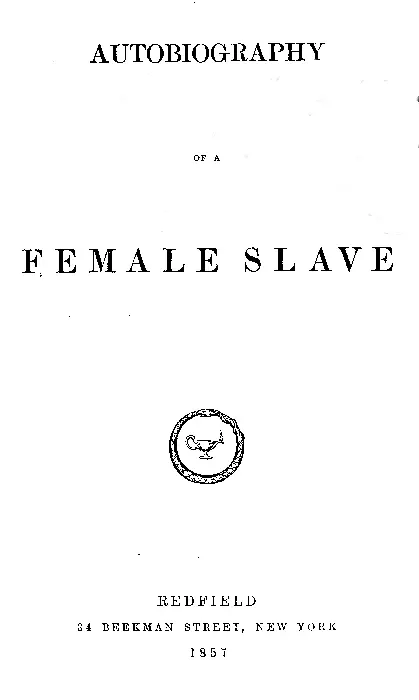
"Autobiography of a Female Slave" by Martha Griffith Browne is a historical account written in the mid-19th century. This compelling narrative offers readers a firsthand perspective of the life of a female slave in the Southern United States, exploring her personal struggles, family ties, and experiences of both cruelty and kindness. The author provides an intimate portrayal of the protagonist's journey, encapsulating the harsh realities of slavery while highlighting the deep emotional bonds that shape her existence. The opening of this autobiography introduces us to the narrator, a young female slave born on a Kentucky farm, detailing her early life, her family's dynamics, and her yearning for education amidst the oppressive backdrop of slavery. As her master falls ill and subsequently passes away, the narrator faces the terrifying prospect of being sold away from her mother, which unveils the traumatic realities of the slave trade. The emotional turmoil felt by both the mother and daughter during this separation takes center stage, illustrating the heart-wrenching impact of slavery on familial relationships. Through vivid descriptions of love, loss, and the hope for a brighter future, the opening sets the tone for a deeply moving exploration of resilience and the quest for freedom.
Introduction adapted from the source catalogue; source summaries may be automatically generated.
Free to read · English · 135,160 words · No account needed
MAKE TIME FOR A GOOD BOOK
On by default. Untick to stop anonymous reading totals. Each page counts after 10 seconds in view. How this works.
Anonymous counting is on unless you have switched it off.
"One would suppose, that if you thought it burdensome, you would be making some effort to relieve yourselves," interposed Mr. Trueman, in that clear and pointed manner that was his peculiarity; "and, if immediate emancipation were deemed impracticable in consequence of the radical hold which this institution has at the South, you might naturally be expected to be doing something toward that end by the encouragement of education among those in bondage, by the sanction of marriage ties between them, and by other efforts to ameliorate their condition. Certain inducements might be presented for the manumission of slaves by individual owners, for there are some of this class, I am happy to think, who, in tender humanity, would release their slaves, if the stringency of the laws did not deter them from it. Would it not be well to abate somewhat of this rigor, and allow all slaves, voluntarily manumitted, to remain in the several States with at least the privileges of the free negroes now resident therein, so that the olden ties, which have grown up between themselves and their owners, might not be abruptly snapped asunder? Besides, to enforce the propriety of this alteration of the law, it would be well to reflect that the South is the native home of most of the slaves, who cherish their local attachments quite as much as ourselves; and hence the law which now requires them, when by any means they have obtained their freedom, to remove beyond the limits of the State, is a very serious hardship and should cease to exist. This would be a long stride toward your own relief from the burden of which you complain. As to the slaves, who you think should be content with their condition, in which they have, as you say, 'no care for necessary food and raiment,' I would suggest that they have the faculty of distinguishing between slavery and bondage, and have sense enough to see that though these things, which are generally of the coarsest kind, are provided by their masters, the means by which they are furnished are but a scanty portion of their own hard earnings. Were they free, they could work in the same way, and be entitled to all the fruits of their labor. Then they would have the same inducements to toil that we now have, and the same ambition to lift themselves higher and higher in the social scale. Those white men whom you believe willing to exchange situations with them, are too indolent to enjoy the privileges of freedom, and would be utterly worthless as slaves. You declaim against the course which the Abolitionists have pursued, and seem disposed, in consequence, to tighten the cords of servitude. You would be let alone, forsooth, to bear this burden as long as you please, and to get rid of it at pleasure. So long as there was any hope that you would do what you ought in the matter, you were let alone, and if you were the only sufferers from your peculiar institution, you might continue undisturbed; but the yoke lies heavy and galling upon the poor slaves themselves, whose voices are stifled, and it is high time for the friends of human rights to speak in their behalf, till they make themselves heard. At this momentous period, when new States and Territories are knocking for admission at the doors of our Union--States and Territories of free and virgin soil, which you are seeking to defile by the introduction of slavery--it is fit that they should persevere in their noble efforts, that they should resist your endeavors, and strive with all their energies to confine the obnoxious institution within its already too-extended bounds; for they know, that, if they would attain their object--the ultimate and entire abolition of slavery from our land--they should oppose strenuously every movement tending to its extension; for, the broader the surface over which it spreads, the more formidable will be the difficulty of its removal. Therefore it is that they are now so zealously engaged, and they address you as men whose 'judgment has not fled to brutish beasts,' with arguments against the evil itself and the weight of anguish it entails. Thus they have ever done, and you tell me that the result has been to rivet the chains of those in whose behalf they plead. As well might the sinner, whose guilt is pointed out to him by the minister of God, resolve for that very reason to plunge more deeply into sin."
Your reading position is saved on this browser. Take it to another device with a library code. Reading pages adapt to text, rather than matching a printed edition.
BEHIND THE BOOK
This eBook is for the use of anyone anywhere in the United States and most other parts of the world at no cost and with almost no restrictions whatsoever. You may copy it, give it away or re-use it under the terms of the Project Gutenberg License included with this eBook or online at www.gutenberg.org. If you are not located in the United States, you will have to check the laws of the country where you are located before using this eBook. Read the source licence.
The original source file, including credits and licence, is retained by this library. Request an original-format copy at no charge. Please include the book title and Project Gutenberg identifier #55813.
KEEP YOUR CURIOSITY GOING
Cécile Tormay

Moritz Busch
Coulson Kernahan
John L. Ransom

Maurice Baring
Frances Wright