THE CLASSIC COLLECTION✦An outlaw’s diary: the CommuneCLASSIC FREE BOOKS
An outlaw’s diary: the Commune
Cécile Tormay
THE CLASSIC COLLECTION · 1857
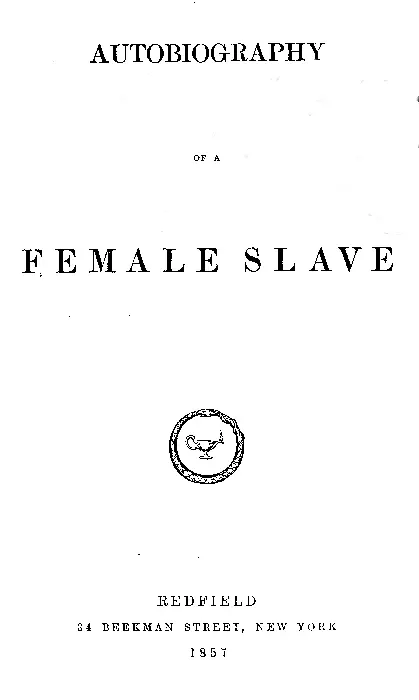
"Autobiography of a Female Slave" by Martha Griffith Browne is a historical account written in the mid-19th century. This compelling narrative offers readers a firsthand perspective of the life of a female slave in the Southern United States, exploring her personal struggles, family ties, and experiences of both cruelty and kindness. The author provides an intimate portrayal of the protagonist's journey, encapsulating the harsh realities of slavery while highlighting the deep emotional bonds that shape her existence. The opening of this autobiography introduces us to the narrator, a young female slave born on a Kentucky farm, detailing her early life, her family's dynamics, and her yearning for education amidst the oppressive backdrop of slavery. As her master falls ill and subsequently passes away, the narrator faces the terrifying prospect of being sold away from her mother, which unveils the traumatic realities of the slave trade. The emotional turmoil felt by both the mother and daughter during this separation takes center stage, illustrating the heart-wrenching impact of slavery on familial relationships. Through vivid descriptions of love, loss, and the hope for a brighter future, the opening sets the tone for a deeply moving exploration of resilience and the quest for freedom.
Introduction adapted from the source catalogue; source summaries may be automatically generated.
Free to read · English · 135,160 words · No account needed
MAKE TIME FOR A GOOD BOOK
On by default. Untick to stop anonymous reading totals. Each page counts after 10 seconds in view. How this works.
Anonymous counting is on unless you have switched it off.
"Exceptions, indeed, they are; but why?" inquired Mr. Trueman. "Exceptions, you know, prove the rule. Now, you infer from the sooty complexion of the Africans, a natural and necessary incapacity for the blessings of self-government and the refinements of education. I have mentioned individuals of this fatal complexion who are in the wise enjoyment of these sublime privileges: one of them has acquired an enviable celebrity as an orator, the other is the accomplished President of the infant Liberian Republic. If color incapacitated, as you seem to think, it would affect all alike; but it has not incapacitated these, therefore it does not incapacitate at all. These are exceptions not to the general capacity of the blacks, but only to their general opportunity. What they have done others may do--the opportunities being equal."
"I have listened to you entire argument," rejoined Mr. Winston, "very patiently, with the expectation of hearing the proposition sustained with which you so vauntingly set out. You will, perhaps, accord to me the credit of being--what in this age of ceaseless talk is rarely met--'a good listener.' But, after all my patience and attention, I am still unsatisfied--if not unshaken. You have failed to meet the argument drawn from the 'curse' pronounced on the progenitors of the unfortunate race: you have failed to present or notice what is generally considered by theologians and moralists the right of a purchaser--in your illustration from stolen goods--to something for the money with which he parts; and here, I think, you manifested great unfairness; and, above all, you have failed to propose any feasible remedy for the state of things against which you inveigh. What have you to say on these material points?"
"Very much, my good sir, as you will find, if, instead of taking advantage of every momentary pause to make out such a 'failure' as you desire, you only prolong your very complimentary patience. I wish you to watch the argument narrowly; to expose the faintest flaw you can detect in it; and, at the end, if unsatisfied, cry out 'failure,' or let it wring from you a reluctant confession. You will, at least, before I shall have done, withdraw the illiberal imputation of unfairness. It would be an easy task for me to anticipate all you can say, and to refute it; but such a course would leave you nothing to say, and, since I intend this discussion to be strictly a conversation, I shall leave you at liberty to present your own arguments in your own way. Now, as to the argument from 'the curse,' you must permit me to observe, that your interpretation is too free and latitudinarian. Mine is more literal, more in accordance with the character of God; it fully satisfies the Divine vengeance, and, whether correct or not, has, at least, as much authority in its favor. Granting the dominion of the white over the black race to be in virtue of 'the curse,' it by no means conveys such power as your Southern institution seeks to justify. The word slave nowhere occurs in that memorable malediction; but there is an obvious distinction between its import and that of the word servant, which it does employ. Surely, for the offence of looking upon the nakedness of his father, Ham could not have incurred and entailed upon his posterity a heavier punishment than they would necessarily suffer as the simple servants of their brethren. And this consideration should induce you to give them, at least, the same share of freedom as is enjoyed by the white servants to be found in many a household in the South. Such servitude would be the utmost that a merciful God could require. Even this, however, was under the old dispensation; and the reign of its laws, customs, and punishments, should melt under the genial rays of the sun of Christianity. Many of your own patriots, headed by Washington and Jefferson, have long since thought so; and but few in these days plead 'the curse' as excuse or justification for that 'damned spot' which all will come ultimately to consider the disgrace of this enlightened age and nation. As to your next point, the right which a purchaser of stolen goods may acquire in them in consideration of the money which he pays, I grant all the benefit that even the most generous theologian or moralist can allow in the best circumstances of such a case. And what does this amount to? A return of the purchase-money, with a reasonable or very high rate of interest for the detention, would be as much as any one could demand. Applying this to the case of the stolen Africans, how many of those who were forced from their native land to this have died on their master's hands without yielding by their labor, not alone the principal, but a handsome percentage upon the money invested in their purchase? Thus purchasers were indemnified--abundantly indemnified, against loss. The indemnity, however, should have been sought from the seller, not from the article or person sold. But, at best, purchasers of stolen goods, to entitle themselves to any indemnity, should at least be innocent; for if they buy such goods, knowing them to be stolen, they are guilty of a serious misdemeanor, which is everywhere punishable under the law. 'He who asks equity must do equity.' When, therefore, you of the South would realize the benefit of the concession of theologians and moralists--the benefit of justice--you should bring yourselves within the conditions they require; you should come into court with clean hands, and with the intention of acting in good faith. Have you done so? Did your fathers do so before you? Not at all. They were not ignorant purchasers of the poor, ravished African; they knew full well that he had been stolen and brought by violence from his distant home: consequently, they were guilty of a misdemeanor in purchasing; consequently, too, they come not within the case proposed by the theologians and moralists, which might entitle them to indemnity; nor were they in a condition to ask it. The present generation, claiming through them, find themselves in the same predicament, with the same title only, and the same unclean hands, perpetuating their foul oppression. None of them, as I have shown, had a right to claim indemnity by reason of having invested their money in that way; and, if they ever had such right, they have been richly indemnified already. Therefore, it is absurd for you to continue the slave business upon this plea. Having thus answered your only objections to my position, I might remind you of your determination, and call upon you to 'liberate your slaves,' and take sides with me in opposition to the cruel institution. You are greatly mistaken in supposing that my omission to propose a plan, by which slave-holders could conveniently, and without pecuniary loss, emancipate their slaves, constitutes the slightest objection to the argument I have advanced. If you defer their emancipation until such a plan is proposed; if you are unwilling to incur even a little sacrifice, what nobility will there be in the act, to entitle you to the consideration of the just and good, or to the approval of your own consciences? I sought by this discussion, to convince you that slavery is an enormous evil; the proposition was declared in all its boldness. You volunteered a pledge to release your slaves if I could sustain it, let the sacrifice be what it might. Some sacrifice, then, you must have anticipated; and, should your conviction now demand it, you have no cause to complain of me. Your pledge was altogether voluntary; I did not even ask it; nor did I design to suggest any such plan of universal emancipation as would suit the convenience of everybody. I am not so extravagantly silly as to hope to do that. But, after all, why wait for a plan? Immediate, universal emancipation is not impracticable, and numberless methods might and would at once be devised, if the people of your States were sincere when they profess to desire its accomplishment. Their real wish, however, whatever it may be, need not interfere between your individual pledge, and its prompt fulfilment."
Your reading position is saved on this browser. Take it to another device with a library code. Reading pages adapt to text, rather than matching a printed edition.
BEHIND THE BOOK
This eBook is for the use of anyone anywhere in the United States and most other parts of the world at no cost and with almost no restrictions whatsoever. You may copy it, give it away or re-use it under the terms of the Project Gutenberg License included with this eBook or online at www.gutenberg.org. If you are not located in the United States, you will have to check the laws of the country where you are located before using this eBook. Read the source licence.
The original source file, including credits and licence, is retained by this library. Request an original-format copy at no charge. Please include the book title and Project Gutenberg identifier #55813.
KEEP YOUR CURIOSITY GOING
Cécile Tormay

Moritz Busch
Coulson Kernahan
John L. Ransom

Maurice Baring
Frances Wright