THE CLASSIC COLLECTION✦An outlaw’s diary: the CommuneCLASSIC FREE BOOKS
An outlaw’s diary: the Commune
Cécile Tormay
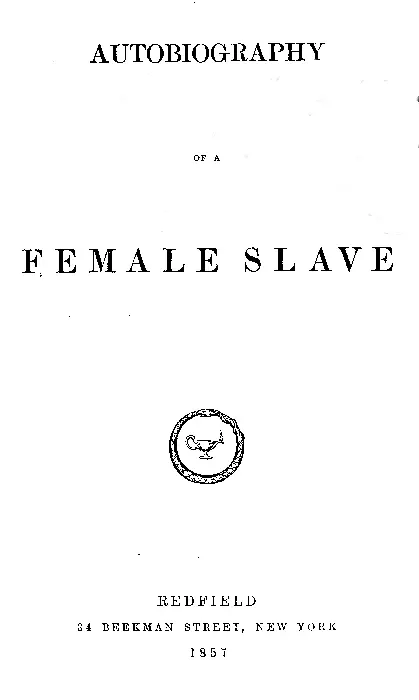
THE CLASSIC COLLECTION · 1857
"Autobiography of a Female Slave" by Martha Griffith Browne is a historical account written in the mid-19th century. This compelling narrative offers readers a firsthand perspective of the life of a female slave in the Southern United States, exploring her personal struggles, family ties, and experiences of both cruelty and kindness. The author provides an intimate portrayal of the protagonist's journey, encapsulating the harsh realities of slavery while highlighting the deep emotional bonds that shape her existence. The opening of this autobiography introduces us to the narrator, a young female slave born on a Kentucky farm, detailing her early life, her family's dynamics, and her yearning for education amidst the oppressive backdrop of slavery. As her master falls ill and subsequently passes away, the narrator faces the terrifying prospect of being sold away from her mother, which unveils the traumatic realities of the slave trade. The emotional turmoil felt by both the mother and daughter during this separation takes center stage, illustrating the heart-wrenching impact of slavery on familial relationships. Through vivid descriptions of love, loss, and the hope for a brighter future, the opening sets the tone for a deeply moving exploration of resilience and the quest for freedom.
Introduction adapted from the source catalogue; source summaries may be automatically generated.
Free to read · English · 135,160 words · No account needed
MAKE TIME FOR A GOOD BOOK
On by default. Untick to stop anonymous reading totals. Each page counts after 10 seconds in view. How this works.
Anonymous counting is on unless you have switched it off.
Miss Jane imagined she had spoken quite conclusively and displayed a vast amount of learning. She looked around for admiration and applause, which was readily given her by her complimentary sister.
"Ah, Jane, you should have been a man, and practiced law. The courts would have been the place for the display of your brilliant talents."
"But the halls of legislation would not, I fear," said Miss Bradly, "have had the benefit of her wise, just, and philanthropic views."
"I should never have allowed the Abolitionists their present weight of influence, whilst the power of speech and the strength of action remained to me," answered Miss Jane, very tartly.
"Oh no, doubtless you would have met the Douglas in his hall, and the lion in his den," laughingly replied Miss Bradly.
Thus the conversation was carried on, upon no very friendly terms, until Miss Jane espied me, when she thundered out,
"Leave the room, Ann, we've no use for negro company here, unless, indeed, as I think most probable, Miss Bradly came to visit you, in which case she had better be shown to the kitchen."
This insult roused Miss Bradly's resentment, and she rose, saying,
"Young ladies, I came this evening to take a pleasant adieu, little expecting to meet with such treatment; but be it as you wish; I take my leave;" and, with a slight inclination of the head, she departed.
"Oh, she is insulted!" cried Miss Tildy.
"I don't care if she is, we owe her nothing. For teaching us she was well paid; now let her take care of herself."
"I am going after her to say I did not wish to insult her; for really, notwithstanding her Abolition sentiments, I like her very much, and I wish her always to like me."
So she started off and overtook Miss Bradly at the gate. The explanation was, I presume, accepted, for they parted with kisses and tears.
That evening, when I was serving the table, Miss Jane reported the
conversation to her father, who applauded her manner of argument
greatly.
"Set my niggers free, indeed! Catch me doing any such foolish thing. I'd sooner be shot. Don't you look for anything of the kind, Ann; I'd sooner put you in my pocket."
And this was the way he kept a sacred promise to his dead son! But cases such as this are numerous. The negro is lulled with promises by humane masters--promises such as those that led the terror-stricken Macbeth on to his fearful doom. They
"Keep the word of promise to the ear,
But break it to the hope."
Your reading position is saved on this browser. Take it to another device with a library code. Reading pages adapt to text, rather than matching a printed edition.
BEHIND THE BOOK
This eBook is for the use of anyone anywhere in the United States and most other parts of the world at no cost and with almost no restrictions whatsoever. You may copy it, give it away or re-use it under the terms of the Project Gutenberg License included with this eBook or online at www.gutenberg.org. If you are not located in the United States, you will have to check the laws of the country where you are located before using this eBook. Read the source licence.
The original source file, including credits and licence, is retained by this library. Request an original-format copy at no charge. Please include the book title and Project Gutenberg identifier #55813.
KEEP YOUR CURIOSITY GOING
Cécile Tormay

Moritz Busch
Coulson Kernahan
John L. Ransom

Maurice Baring
Frances Wright