THE CLASSIC COLLECTION✦An outlaw’s diary: the CommuneCLASSIC FREE BOOKS
An outlaw’s diary: the Commune
Cécile Tormay
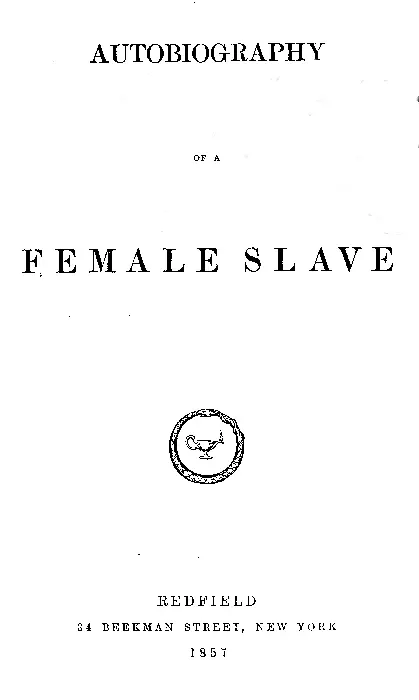
THE CLASSIC COLLECTION · 1857
"Autobiography of a Female Slave" by Martha Griffith Browne is a historical account written in the mid-19th century. This compelling narrative offers readers a firsthand perspective of the life of a female slave in the Southern United States, exploring her personal struggles, family ties, and experiences of both cruelty and kindness. The author provides an intimate portrayal of the protagonist's journey, encapsulating the harsh realities of slavery while highlighting the deep emotional bonds that shape her existence. The opening of this autobiography introduces us to the narrator, a young female slave born on a Kentucky farm, detailing her early life, her family's dynamics, and her yearning for education amidst the oppressive backdrop of slavery. As her master falls ill and subsequently passes away, the narrator faces the terrifying prospect of being sold away from her mother, which unveils the traumatic realities of the slave trade. The emotional turmoil felt by both the mother and daughter during this separation takes center stage, illustrating the heart-wrenching impact of slavery on familial relationships. Through vivid descriptions of love, loss, and the hope for a brighter future, the opening sets the tone for a deeply moving exploration of resilience and the quest for freedom.
Introduction adapted from the source catalogue; source summaries may be automatically generated.
Free to read · English · 135,160 words · No account needed
MAKE TIME FOR A GOOD BOOK
On by default. Untick to stop anonymous reading totals. Each page counts after 10 seconds in view. How this works.
Anonymous counting is on unless you have switched it off.
As I bathed my face and bound it up, I wondered if acts such as these had ever been reported to those clergymen, who so stoutly maintain that slavery is just, right, and almost available unto salvation. I cannot think that they do understand it in all its direful wrongs. They look upon the institution, doubtless, as one of domestic servitude, where a strong attachment exists between the slave and his owner; but, alas! all that is generally fabulous, worse than fictitious. I can fearlessly assert that I never knew a single case, where this sort of feeling was cherished. The very nature of slavery precludes the existence of such a feeling. Read the legal definition of it as contained in the statute books of Kentucky and Virginia, and how, I ask you, can there be, on the slave's part, a love for his owner? Oh, no, that is the strangest resort, the fag-end of argument; that most transparent fiction. Love, indeed! The slave-master love his slave! Did Cain love Abel? Did Herod love those innocents, whom, by a bloody edict, he consigned to death? In the same category of lovers will we place the slave-owner.
When Miss Jane had beaten Amy until she was satisfied, she came, with a face blazing, like Mars, from the "lock-up."
"Well, she confesses now, that she put the forks under the corner of a log, near the poultry coop."
"Its only another one of her lies," replied Miss Tildy.
"Well, if it is, I'll beat her until she tells the truth, or I'll kill
her."
So saying, she started off to examine the spot. I felt that this was but another subterfuge, devised by the poor wretch to gain a few moments' respite.
The examination proved, as I had anticipated, a failure.
"What's to be done?" inquired Miss Tildy.
"Leave her a few moments longer to herself, and then if the truth is not obtained from her, kill her." These words came hissing though her clenched teeth.
"It won't do to kill her," said Miss Tildy.
"I don't care much if I do."
"We would be tried for murder."
"Who would be our accusers? Who the witnesses? You forget that Jones is
not here to testify."
"Ah, and so we are safe."
"Oh, I never premeditate anything without counting the cost."
"But then the loss of property!"
"I'd rather gratify my revenge than have five hundred dollars, which would be her highest market value."
Your reading position is saved on this browser. Take it to another device with a library code. Reading pages adapt to text, rather than matching a printed edition.
BEHIND THE BOOK
This eBook is for the use of anyone anywhere in the United States and most other parts of the world at no cost and with almost no restrictions whatsoever. You may copy it, give it away or re-use it under the terms of the Project Gutenberg License included with this eBook or online at www.gutenberg.org. If you are not located in the United States, you will have to check the laws of the country where you are located before using this eBook. Read the source licence.
The original source file, including credits and licence, is retained by this library. Request an original-format copy at no charge. Please include the book title and Project Gutenberg identifier #55813.
KEEP YOUR CURIOSITY GOING
Cécile Tormay

Moritz Busch
Coulson Kernahan
John L. Ransom

Maurice Baring
Frances Wright