THE CLASSIC COLLECTION✦An outlaw’s diary: the CommuneCLASSIC FREE BOOKS
An outlaw’s diary: the Commune
Cécile Tormay
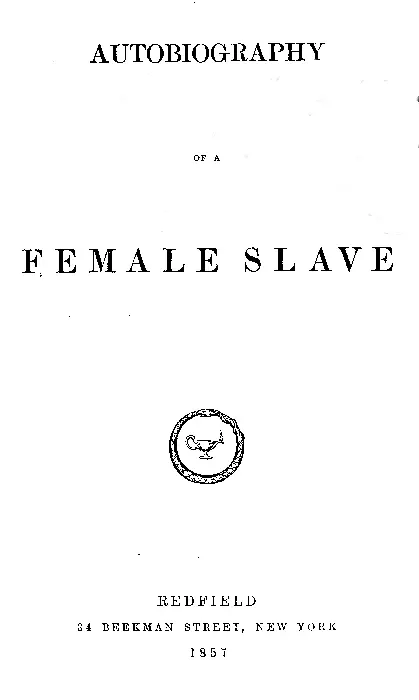
THE CLASSIC COLLECTION · 1857
"Autobiography of a Female Slave" by Martha Griffith Browne is a historical account written in the mid-19th century. This compelling narrative offers readers a firsthand perspective of the life of a female slave in the Southern United States, exploring her personal struggles, family ties, and experiences of both cruelty and kindness. The author provides an intimate portrayal of the protagonist's journey, encapsulating the harsh realities of slavery while highlighting the deep emotional bonds that shape her existence. The opening of this autobiography introduces us to the narrator, a young female slave born on a Kentucky farm, detailing her early life, her family's dynamics, and her yearning for education amidst the oppressive backdrop of slavery. As her master falls ill and subsequently passes away, the narrator faces the terrifying prospect of being sold away from her mother, which unveils the traumatic realities of the slave trade. The emotional turmoil felt by both the mother and daughter during this separation takes center stage, illustrating the heart-wrenching impact of slavery on familial relationships. Through vivid descriptions of love, loss, and the hope for a brighter future, the opening sets the tone for a deeply moving exploration of resilience and the quest for freedom.
Introduction adapted from the source catalogue; source summaries may be automatically generated.
Free to read · English · 135,160 words · No account needed
MAKE TIME FOR A GOOD BOOK
On by default. Untick to stop anonymous reading totals. Each page counts after 10 seconds in view. How this works.
Anonymous counting is on unless you have switched it off.
And thus the trade was closed. Human beings were disposed of with as little feeling as if they had been wild animals.
"I'm sorry you won't, young Miss, let me have that maid of yourn; but I'll be 'long next fall, and, fur a good price, I 'spect you'll be willin' to trade. I wants that yallow wench," and he clicked his fingers at me.
"Say, Peterkin, ken you lend me a wagen to take 'em over to my pen?"
"Oh, yes; and Nace can drive 'em over."
Conscious of having got a good price, Mr. Peterkin was in a capital
humor.
"Come, go with me, Peterkin, and we'll draw up the papers, and I'll pay
you your money."
This was an agreeable sound to master. He ordered Nace to bring out the wagon, and the order was hardly given before it was obeyed. Dismal looked that red wagon, the same which years before had carried me away from the insensible form of my broken-hearted mother. It appeared more dark and dreary, to me, than a coffin or hearse.
"Say, Peterkin, don't let 'em take many close; jist a change. It tires 'em too much if they have big bundles to carry."
"They shan't be troubled with that."
"Now, niggers, git your bundles and come 'long," said master.
"Oh," cried Lindy, "can I git to see young master before I start? I wants to thank him for de comfort he gib me last night," and she wiped the tears from her eyes, and was starting toward the door of the house, when Miss Jane intercepted her.
"No, you runaway hussy, you shan't go in to disturb him, and have a
scene here."
"Please, Miss Jane, I only wants to say good-bye."
"You shan't do it."
Mournfully, and with the tears streaming far down her cheeks, she turned to me, saying, "Please, you, Ann, tell him good-bye fur me, and good-bye to you. I hope you will forgive me for all de harm I has done to you."
I took her hand, but could not speak a word. Silently I pressed it.
"Whar's your close, gal?" asked Tompkins.
"I'm gwine to git 'em."
"Well, be in a hurry 'bout it."
She went off to gather up a few articles, scarcely sufficient to cover her; for we were barely allowed a change of clothing, and that not very decent.
Ginsy, leading her child with one hand, while she held in the other a small bundle, walked up to Miss Jane, and dropping a low courtesy, said,
"Farewell, Miss Jane; can I see Miss Tildy and young master?"
"No, John is sick, and Tildy can't be troubled just now."
Your reading position is saved on this browser. Take it to another device with a library code. Reading pages adapt to text, rather than matching a printed edition.
BEHIND THE BOOK
This eBook is for the use of anyone anywhere in the United States and most other parts of the world at no cost and with almost no restrictions whatsoever. You may copy it, give it away or re-use it under the terms of the Project Gutenberg License included with this eBook or online at www.gutenberg.org. If you are not located in the United States, you will have to check the laws of the country where you are located before using this eBook. Read the source licence.
The original source file, including credits and licence, is retained by this library. Request an original-format copy at no charge. Please include the book title and Project Gutenberg identifier #55813.
KEEP YOUR CURIOSITY GOING
Cécile Tormay

Moritz Busch
Coulson Kernahan
John L. Ransom

Maurice Baring
Frances Wright