THE CLASSIC COLLECTION✦An outlaw’s diary: the CommuneCLASSIC FREE BOOKS
An outlaw’s diary: the Commune
Cécile Tormay
THE CLASSIC COLLECTION · 1857
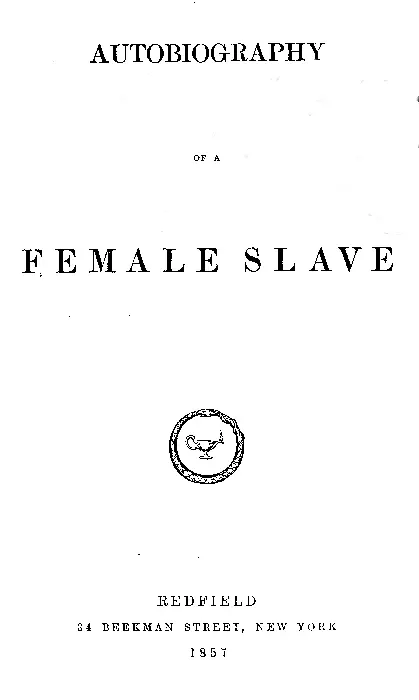
"Autobiography of a Female Slave" by Martha Griffith Browne is a historical account written in the mid-19th century. This compelling narrative offers readers a firsthand perspective of the life of a female slave in the Southern United States, exploring her personal struggles, family ties, and experiences of both cruelty and kindness. The author provides an intimate portrayal of the protagonist's journey, encapsulating the harsh realities of slavery while highlighting the deep emotional bonds that shape her existence. The opening of this autobiography introduces us to the narrator, a young female slave born on a Kentucky farm, detailing her early life, her family's dynamics, and her yearning for education amidst the oppressive backdrop of slavery. As her master falls ill and subsequently passes away, the narrator faces the terrifying prospect of being sold away from her mother, which unveils the traumatic realities of the slave trade. The emotional turmoil felt by both the mother and daughter during this separation takes center stage, illustrating the heart-wrenching impact of slavery on familial relationships. Through vivid descriptions of love, loss, and the hope for a brighter future, the opening sets the tone for a deeply moving exploration of resilience and the quest for freedom.
Introduction adapted from the source catalogue; source summaries may be automatically generated.
Free to read · English · 135,160 words · No account needed
MAKE TIME FOR A GOOD BOOK
On by default. Untick to stop anonymous reading totals. Each page counts after 10 seconds in view. How this works.
Anonymous counting is on unless you have switched it off.
"Oh, my boy! my boy! how much you are like her! This is her mouth, eyes, and nose, and now you 'pears jist like she did when I seed her last. These limbs are stiff and frozen. It can't be death; no, it can't be. I haven't killed you, too--say, Miss Bradly, is he dead?"
"No, sir, only exhausted from the violence of the paroxysm, and the copious hemorrhage, but he requires immediate medical treatment; send, promptly, for Dr. Mandy."
Master turned to me, saying,
"Gal, go order Jake to mount the swiftest horse, and ride for life and death to Dr. Mandy; tell him to come instantly, my son is dying."
I obeyed, and, with all possible promptitude, the message was dispatched. Oh, how different when his son was ill. Then you could see that human life was valuable; had it been a negro, he would have waited until after breakfast before sending for a doctor.
Mr. Peterkin bore his son into the house, placed him on the bed, and, seating himself beside him, watched with a tenderness that I did not think belonged to his harsh nature.
In a very short time Jake returned with Dr. Mandy, who, after feeling young master's pulse, sounding his chest, and applying the stethescope, said that he feared it was an incipient form of lung-fever. We had much cause for apprehension. There was a perplexed expression upon the face of the doctor, a tremulousness in his motions, which indicated that he was in great fear and doubt as to the case. He left some powders, to be administered every hour, and, after various and repeated injunctions to Miss Bradly, who volunteered to nurse the patient, he left the house.
After taking the first powder, young master lay in a deep, unbroken sleep. As I stood by his bedside I saw how altered he was. The cheek, which, when he was walking, had seemed round and full, was now shrunk and hollow, and a fiery spot burned there like a living coal; and the dark, purple ring that encircled the eyes, and the sharp contraction of the thin nostril, were to me convincing omens of the grave. Then, too, the anxious, care-written face of Miss Bradly tended to deepen my apprehension. How my friends were falling around me! Now, just when I was beginning to live, came the fell destroyer of my happiness. Happiness? Oh, does it not seem a mockery for the slave to employ that word? As if he had anything to do with it! The slave, who owns nothing, ay, literally nothing. His wife and children are all his master's. His very wearing apparel becomes another's. He has no right to use it, save as he is advised by his owner. Go, my kind reader, to the hotels of the South and South-west, look at the worn and dejected countenances of the slaves, and tell me if you do not read misery there. Look in at the saloons of the restaurants, coffee-houses, &c., at late hours of the night; there you will see them, tired, worn and weary, with their aching heads bandaged up, sighing for a few moments' sleep. There the proud, luxurious, idle whites sip their sherbets, drink wine, and crack their everlasting jokes, but there must stand your obsequious slave, with a smile on his face, waiter in hand, ready to attend to "Master's slightest wish." No matter if his tooth is aching, or his child dying, he must smile, or be flogged for gruffness. This "chattel personal," though he bear the erect form of a man, has no right to any privileges or emotions. Oh, nation of the free, how long shall this be? Poor, suffering Africa, country of my sires, how much longer upon thy bleeding shoulders must the cross be pressed! Is there no tomb where, for a short space, thou shalt lie, and then, bursting the bonds of night and death, spring up free, redeemed and regenerate?
Your reading position is saved on this browser. Take it to another device with a library code. Reading pages adapt to text, rather than matching a printed edition.
BEHIND THE BOOK
This eBook is for the use of anyone anywhere in the United States and most other parts of the world at no cost and with almost no restrictions whatsoever. You may copy it, give it away or re-use it under the terms of the Project Gutenberg License included with this eBook or online at www.gutenberg.org. If you are not located in the United States, you will have to check the laws of the country where you are located before using this eBook. Read the source licence.
The original source file, including credits and licence, is retained by this library. Request an original-format copy at no charge. Please include the book title and Project Gutenberg identifier #55813.
KEEP YOUR CURIOSITY GOING
Cécile Tormay

Moritz Busch
Coulson Kernahan
John L. Ransom

Maurice Baring
Frances Wright