THE CLASSIC COLLECTION✦An outlaw’s diary: the CommuneCLASSIC FREE BOOKS
An outlaw’s diary: the Commune
Cécile Tormay
THE CLASSIC COLLECTION · 1857
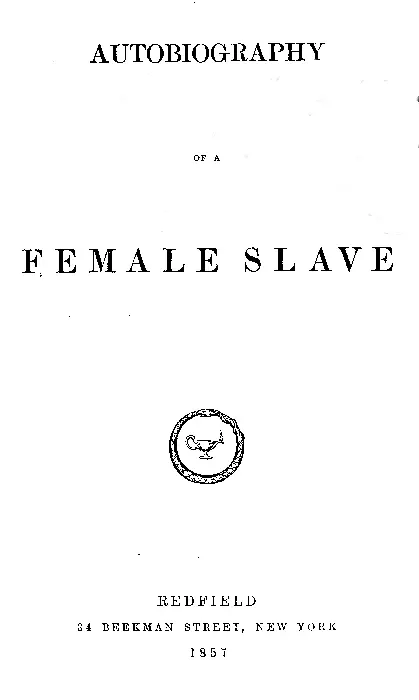
"Autobiography of a Female Slave" by Martha Griffith Browne is a historical account written in the mid-19th century. This compelling narrative offers readers a firsthand perspective of the life of a female slave in the Southern United States, exploring her personal struggles, family ties, and experiences of both cruelty and kindness. The author provides an intimate portrayal of the protagonist's journey, encapsulating the harsh realities of slavery while highlighting the deep emotional bonds that shape her existence. The opening of this autobiography introduces us to the narrator, a young female slave born on a Kentucky farm, detailing her early life, her family's dynamics, and her yearning for education amidst the oppressive backdrop of slavery. As her master falls ill and subsequently passes away, the narrator faces the terrifying prospect of being sold away from her mother, which unveils the traumatic realities of the slave trade. The emotional turmoil felt by both the mother and daughter during this separation takes center stage, illustrating the heart-wrenching impact of slavery on familial relationships. Through vivid descriptions of love, loss, and the hope for a brighter future, the opening sets the tone for a deeply moving exploration of resilience and the quest for freedom.
Introduction adapted from the source catalogue; source summaries may be automatically generated.
Free to read · English · 135,160 words · No account needed
MAKE TIME FOR A GOOD BOOK
On by default. Untick to stop anonymous reading totals. Each page counts after 10 seconds in view. How this works.
Anonymous counting is on unless you have switched it off.
"Hallowed be Thy name." Again she repeated, and so on we prayed, she following accurately after me, though the heavy door separated us. Think ye not, oh, gentle reader, that this prayer was heard above? Never did words come more truly from my heart; and with a low moan, they rung plaintively upon the still, moonlit air! I could tell, from the fervent tone in which Lindy followed, that her whole soul was engaged. When the final amen had been said, she asked, "Ann, what's to become of me?"
I evaded her by saying, "how can I know what master will do?"
"Yes, but haven't you heard? Oh, don't fool me, Ann, but tell me all."
For a moment I hesitated, then said: "Yes, Lindy, I'll deal fairly with you. I have heard that master intends selling you to-morrow to a trader, whom he went to see to-day; and, if the trader is satisfied with you to-morrow, the bargain will be closed."
"Oh, Lord! oh, Lord!" she groaned forth, "oh, is I gwine down de ribber? Oh, Lord, kill me right now; but don't send me to dat dreful place, down de ribber, down de ribber!"
"Oh, trust in the Lord, and He will protect you. Down the river can't be much worse than here, maybe not so bad. For my part, Lindy, I would rather be sold and run the risk of getting a good master, than remain here where we are treated worse than dogs."
"Oh, dar isn't no sort ob hope ob my gitten any better home den dis here one; den I knows you all, and way off dar 'mong strange black folks, oh, no, I never can go; de Lord hab marcy on me."
This begging of the poor negroes to the Lord to have mercy on them, though frequent, has no particular significance. It is more a plaint of agony than a cry for actual mercy; and, in Lindy's case, it most assuredly only expressed her grief, for she had no ripe faith in the power and willingness of Our Father to send mercy to her. Religion she believed consisted in going to church every Sunday twice; consequently it was a luxury, which, like all luxuries, must be monopolized by the whites. From the very depths of my heart I prayed that the light of Divine grace might shine in upon her darkened intellect. Soul of Faith, verily art thou soul of beauty! And though, as a special gift, faith is not withheld from the lowliest, the most ignorant, yet does its possession give to the poorest and most degraded Ethiopian a divine consciousness, an inspiration, that as to what is grandest in the soul exalts him above the noblest of poets.
Your reading position is saved on this browser. Take it to another device with a library code. Reading pages adapt to text, rather than matching a printed edition.
BEHIND THE BOOK
This eBook is for the use of anyone anywhere in the United States and most other parts of the world at no cost and with almost no restrictions whatsoever. You may copy it, give it away or re-use it under the terms of the Project Gutenberg License included with this eBook or online at www.gutenberg.org. If you are not located in the United States, you will have to check the laws of the country where you are located before using this eBook. Read the source licence.
The original source file, including credits and licence, is retained by this library. Request an original-format copy at no charge. Please include the book title and Project Gutenberg identifier #55813.
KEEP YOUR CURIOSITY GOING
Cécile Tormay

Moritz Busch
Coulson Kernahan
John L. Ransom

Maurice Baring
Frances Wright