THE CLASSIC COLLECTION✦An outlaw’s diary: the CommuneCLASSIC FREE BOOKS
An outlaw’s diary: the Commune
Cécile Tormay
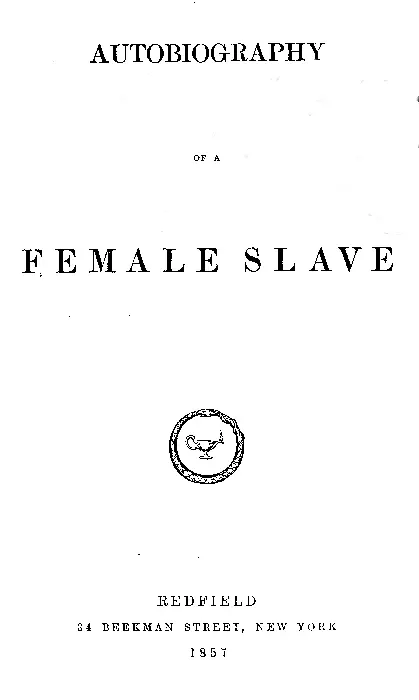
THE CLASSIC COLLECTION · 1857
"Autobiography of a Female Slave" by Martha Griffith Browne is a historical account written in the mid-19th century. This compelling narrative offers readers a firsthand perspective of the life of a female slave in the Southern United States, exploring her personal struggles, family ties, and experiences of both cruelty and kindness. The author provides an intimate portrayal of the protagonist's journey, encapsulating the harsh realities of slavery while highlighting the deep emotional bonds that shape her existence. The opening of this autobiography introduces us to the narrator, a young female slave born on a Kentucky farm, detailing her early life, her family's dynamics, and her yearning for education amidst the oppressive backdrop of slavery. As her master falls ill and subsequently passes away, the narrator faces the terrifying prospect of being sold away from her mother, which unveils the traumatic realities of the slave trade. The emotional turmoil felt by both the mother and daughter during this separation takes center stage, illustrating the heart-wrenching impact of slavery on familial relationships. Through vivid descriptions of love, loss, and the hope for a brighter future, the opening sets the tone for a deeply moving exploration of resilience and the quest for freedom.
Introduction adapted from the source catalogue; source summaries may be automatically generated.
Free to read · English · 135,160 words · No account needed
MAKE TIME FOR A GOOD BOOK
On by default. Untick to stop anonymous reading totals. Each page counts after 10 seconds in view. How this works.
Anonymous counting is on unless you have switched it off.
"Funny is it, father, for your child to love mercy, and deal justly, even with the lowliest?" As he said this, young master stood in the doorway. He looked paler and even more spiritual than was his wont.
Mr. Peterkin sat for full five minutes, gazing at the boy; and, strange to say, made no reply, but strode away from the room.
Miss Jane and Tildy regarded each other with evident surprise. They had expected a violent outburst, and thus to see their father tamed and subdued by the word and glance of their boy-brother, astonished them not a little.
Miss Tildy turned toward young master, and said, in what was meant for a
most caustic tone,
"You are an embryo Van Amburgh, thus to tame the lion's rage."
"But you, Tildy, are too vulpine to be fascinated even by the glance of
Van Amburgh himself."
"Well, now, Johnny, you are getting impertinent as well as spicy."
"Pertinent, you mean," said Mr. Worth. Miss Tildy would not look angry at him; for she was besieging the fortress of his affections, and she deemed kind measures the most advantageous.
Were I to narrate most accurately the conversation that followed, the repartees that flashed from the lips of some, and the anger that burned blue in the faces of others, I should only amuse the reader, or what is more likely, weary him.
I will simply mention that, after a few hours' sojourn, Mr. Worth took his departure, not without first having a long conversation, in a private part of the garden, with young master. Miss Bradly retired to the young ladies' room (for they would not allow her to leave the house), under pretext of headache. Often, as I passed in and out to ask her if she needed anything, I found her weeping bitterly. Late in the evening, about eight o'clock, Mr. Peterkin returned; throwing the reins of his horse to Nace, he exclaimed:
"Well, I've made a good bargain of it; I've sold Lindy to a trader for one thousand dollars--that is, if she answers the description which I gave of her. He is comin' in the mornin' to look at her; and, with a little riggin' up, I think she'll 'pear a rale good-lookin' wench."
When I went into the house to prepare some supper for Mr. Peterkin (the family tea had been despatched two hours before), he was in an excellent humor, well pleased, no doubt, with his good trade.
"Now, Ann, be brisk and smart, or you might find yourself in the trader's hands afore long. Likely yellow gals like you sells mighty well; and if you doesn't behave well you is a goner."
Your reading position is saved on this browser. Take it to another device with a library code. Reading pages adapt to text, rather than matching a printed edition.
BEHIND THE BOOK
This eBook is for the use of anyone anywhere in the United States and most other parts of the world at no cost and with almost no restrictions whatsoever. You may copy it, give it away or re-use it under the terms of the Project Gutenberg License included with this eBook or online at www.gutenberg.org. If you are not located in the United States, you will have to check the laws of the country where you are located before using this eBook. Read the source licence.
The original source file, including credits and licence, is retained by this library. Request an original-format copy at no charge. Please include the book title and Project Gutenberg identifier #55813.
KEEP YOUR CURIOSITY GOING
Cécile Tormay

Moritz Busch
Coulson Kernahan
John L. Ransom

Maurice Baring
Frances Wright