
The Writing of News A Handbook with Chapters on Newspaper Correspondence and Copy Reading
Charles G. (Charles Griffith) Ross
THE CLASSIC COLLECTION · 1914
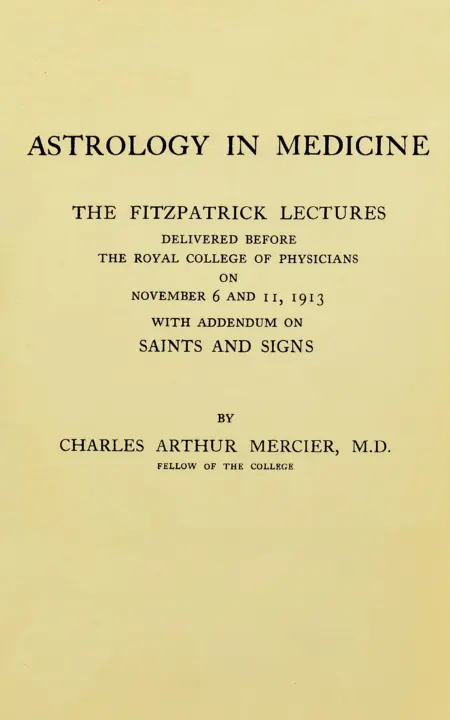
"Astrology in Medicine" by Charles Arthur Mercier is a scholarly lecture series written in the early 20th century. It explores how astrological doctrine was built and why it once seemed indispensable to physicians, laying out its technical system (signs, planets, houses, aspects, and humours) and arguing that it hindered medical progress even as it shaped practice for centuries.
The opening of the work surveys astrology’s vast historical reach and abrupt extinction, then sets out its basic machinery so readers can see how it was meant to guide doctors. Mercier explains the four elemental qualities and the zodiac arranged by triplicities, linking each sign to humours, life stages, and body parts. He introduces the seven traditional planets, their “fortunate” or “unfortunate” character, and their sweeping jurisdictions (including animals, plants, metals), then shows how a planet’s power varies by sign, house, aspect, motion, and hour. He defines the twelve Houses of Heaven and their meanings, details aspects from conjunction to opposition, and notes practical rules like planetary days and hours (tracing the Rx/Jupiter symbol atop prescriptions). To illustrate how an astrologer would reason, he interprets a nativity to predict a warlike career crowned with disaster—an example used to reveal both the system’s internal logic and its arbitrariness.
Introduction adapted from the source catalogue; source summaries may be automatically generated.
Free to read · English · 19,959 words · No account needed
MAKE TIME FOR A GOOD BOOK
On by default. Untick to stop anonymous reading totals. Each page counts after 10 seconds in view. How this works.
Anonymous counting is on unless you have switched it off.
Having discovered in the last Lecture the general principles of Astrology, we are now in a position to discuss their application to medicine. We have already found that every Zodiacal Sign and every Planet has its own complexion, or pair of elementary qualities, as hot and dry, hot and moist, cold and dry, or cold and moist, and that each has, accordingly, power over the corresponding humour—yellow bile, blood, black bile or phlegm. We must now remark that among the powers of the Signs and the Planets are some, specially appertaining to medicine, that were omitted in the previous review.
Each Planet has its own peculiar power over the developing fœtus, and exercises this power at a certain period of pregnancy. Saturn has power in the first month after conception, and by its own frigidity (Saturn being cold and dry) infrigidates the fœtus, coagulates it, and drys it up, so causing early abortions. Jupiter is potent in the second month, and bestows on the embryo the spiritus naturalis. Mars, in the third month, supplies the concept with bones, and generally composes, or, as we should say, differentiates, the various internal organs. Sol, in the fourth month, supplies the concept with blood, and perfects the heart and liver. Venus, in the fifth month, gives to the concept ears, eyebrows and pudenda. Mercury, in the sixth month, opens the nose and mouth; and Luna, in the seventh month, causes the development of the lungs, and divides the fingers and toes according to their places.
After birth, each Planet takes under its jurisdiction certain organs and tissues of the body, and certain faculties of the mind; and has, moreover, jurisdiction over certain diseases and certain modes of death.
Saturn, which is cold and dry, and therefore regulates the black bile, presides also over the bones, teeth, cartilages, the right ear, the spleen and the bladder; and over the memory. It has power, of course, over the diseases of these parts, and in addition, over quartan fever, scabies, lepra, tabes, melancholia, paralysis, icterus niger, dropsy, cancer, cough, asthma, phthisis, deafness of the right ear, and hernia. Under Saturn occur sudden and violent deaths by falls, precipitation, ship-wreck, suffocation, hanging, lead-poisoning, and death at the hands of the public executioner.
Your reading position is saved on this browser. Take it to another device with a library code. Reading pages adapt to text, rather than matching a printed edition.
BEHIND THE BOOK
This eBook is for the use of anyone anywhere in the United States and most other parts of the world at no cost and with almost no restrictions whatsoever. You may copy it, give it away or re-use it under the terms of the Project Gutenberg License included with this eBook or online at www.gutenberg.org. If you are not located in the United States, you will have to check the laws of the country where you are located before using this eBook. Read the source licence.
The original source file, including credits and licence, is retained by this library. Request an original-format copy at no charge. Please include the book title and Project Gutenberg identifier #78150.
KEEP YOUR CURIOSITY GOING
Charles G. (Charles Griffith) Ross
Hannah Webster Foster

Emily Lawless
Edwin Hamlin Carr

Charles De Lano Hine
Andrew Ure