
The Writing of News A Handbook with Chapters on Newspaper Correspondence and Copy Reading
Charles G. (Charles Griffith) Ross
THE CLASSIC COLLECTION · 1914
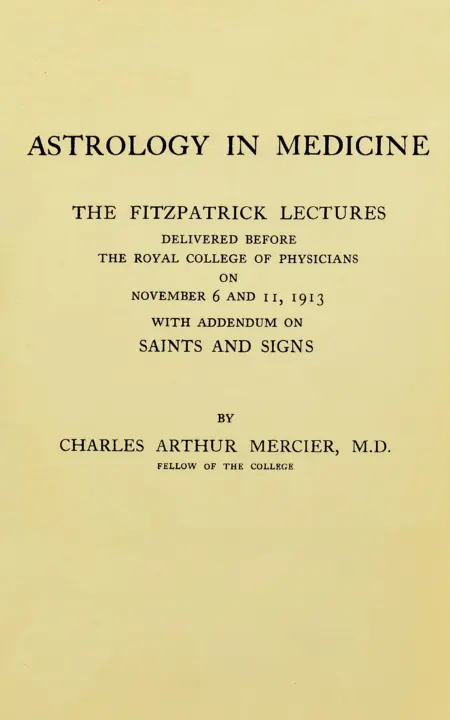
"Astrology in Medicine" by Charles Arthur Mercier is a scholarly lecture series written in the early 20th century. It explores how astrological doctrine was built and why it once seemed indispensable to physicians, laying out its technical system (signs, planets, houses, aspects, and humours) and arguing that it hindered medical progress even as it shaped practice for centuries.
The opening of the work surveys astrology’s vast historical reach and abrupt extinction, then sets out its basic machinery so readers can see how it was meant to guide doctors. Mercier explains the four elemental qualities and the zodiac arranged by triplicities, linking each sign to humours, life stages, and body parts. He introduces the seven traditional planets, their “fortunate” or “unfortunate” character, and their sweeping jurisdictions (including animals, plants, metals), then shows how a planet’s power varies by sign, house, aspect, motion, and hour. He defines the twelve Houses of Heaven and their meanings, details aspects from conjunction to opposition, and notes practical rules like planetary days and hours (tracing the Rx/Jupiter symbol atop prescriptions). To illustrate how an astrologer would reason, he interprets a nativity to predict a warlike career crowned with disaster—an example used to reveal both the system’s internal logic and its arbitrariness.
Introduction adapted from the source catalogue; source summaries may be automatically generated.
Free to read · English · 19,959 words · No account needed
MAKE TIME FOR A GOOD BOOK
On by default. Untick to stop anonymous reading totals. Each page counts after 10 seconds in view. How this works.
Anonymous counting is on unless you have switched it off.
The first omen that attracts our attention is that Mars, the military planet, occupies the twelfth House, the House of battles and of enemies. We predict, therefore, that
No joys to him pacific scepters yield,
War sounds the trump, he rushes to the field;
Peace courts his hand, but spreads her charms in vain; ‘Think nothing gain’d,’ he cries, ‘till nought remain!’
Venus, in the second House, does not aspect the native, and exerts no influence over him; and Charles XII was notoriously insusceptible to the charms of love. He was a neglecter and despiser of women—
O’er love, o’er fear extends his wide domain, Unconquer’d lord of pleasure and of pain.
Sol, in the Ascendent, predicts for the native an illustrious and glorious career, and equips him with the necessary qualities—
A frame of adamant, a soul of fire,
No dangers fright him, and no labours tire;
Behold surrounding kings their pow’r combine,
And one capitulate, and one resign.
But Mars is an unpropitious Planet, a Planet of ill omen, and his presence in the House of battles cannot but signify military disaster: Luna, in sextile to the Ascendent, exerts an evil influence, which Jupiter, sequestered in the second House from exerting any counteracting sway, is powerless to restrain. What is the inevitable consequence?—
He comes, not want nor cold his course delay;— Hide, blushing Glory, hide Pultowa’s day: The vanquish’d hero leaves his brok’n bands, And shews his miseries in distant lands; Condemn’d a needy supplicant to wait, While ladies interpose, and slaves debate.
Finally, Saturn, a very malevolent Planet, is most ominously situated in the eighth House, the House of Death, a certain indication that death will come early and in disastrous circumstances. How true the indication let the poet testify:
But did not Chance at length her error mend? Did no subverted empire mark his end? Did rival monarchs give the fatal wound? Or hostile millions press him to the ground? His fall was destin’d to a barren strand, A petty fortress, and a dubious hand; He left a name, at which the world grew pale, To point a moral, or adorn a tale.
Your reading position is saved on this browser. Take it to another device with a library code. Reading pages adapt to text, rather than matching a printed edition.
BEHIND THE BOOK
This eBook is for the use of anyone anywhere in the United States and most other parts of the world at no cost and with almost no restrictions whatsoever. You may copy it, give it away or re-use it under the terms of the Project Gutenberg License included with this eBook or online at www.gutenberg.org. If you are not located in the United States, you will have to check the laws of the country where you are located before using this eBook. Read the source licence.
The original source file, including credits and licence, is retained by this library. Request an original-format copy at no charge. Please include the book title and Project Gutenberg identifier #78150.
KEEP YOUR CURIOSITY GOING
Charles G. (Charles Griffith) Ross
Hannah Webster Foster

Emily Lawless
Edwin Hamlin Carr

Charles De Lano Hine
Andrew Ure