
The Writing of News A Handbook with Chapters on Newspaper Correspondence and Copy Reading
Charles G. (Charles Griffith) Ross
THE CLASSIC COLLECTION · 1914
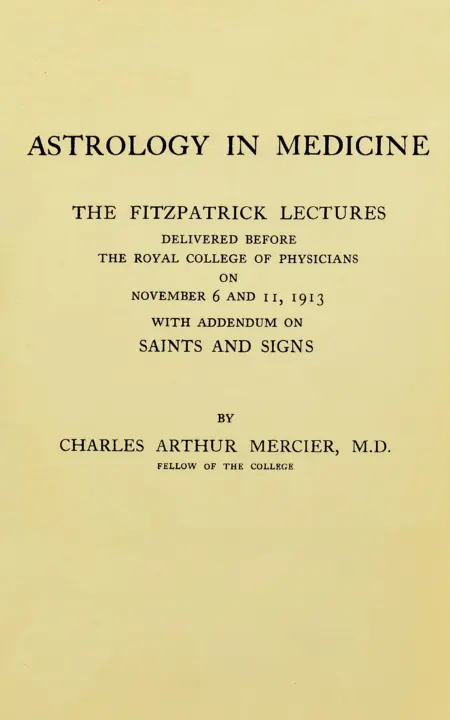
"Astrology in Medicine" by Charles Arthur Mercier is a scholarly lecture series written in the early 20th century. It explores how astrological doctrine was built and why it once seemed indispensable to physicians, laying out its technical system (signs, planets, houses, aspects, and humours) and arguing that it hindered medical progress even as it shaped practice for centuries.
The opening of the work surveys astrology’s vast historical reach and abrupt extinction, then sets out its basic machinery so readers can see how it was meant to guide doctors. Mercier explains the four elemental qualities and the zodiac arranged by triplicities, linking each sign to humours, life stages, and body parts. He introduces the seven traditional planets, their “fortunate” or “unfortunate” character, and their sweeping jurisdictions (including animals, plants, metals), then shows how a planet’s power varies by sign, house, aspect, motion, and hour. He defines the twelve Houses of Heaven and their meanings, details aspects from conjunction to opposition, and notes practical rules like planetary days and hours (tracing the Rx/Jupiter symbol atop prescriptions). To illustrate how an astrologer would reason, he interprets a nativity to predict a warlike career crowned with disaster—an example used to reveal both the system’s internal logic and its arbitrariness.
Introduction adapted from the source catalogue; source summaries may be automatically generated.
Free to read · English · 19,959 words · No account needed
MAKE TIME FOR A GOOD BOOK
On by default. Untick to stop anonymous reading totals. Each page counts after 10 seconds in view. How this works.
Anonymous counting is on unless you have switched it off.
Jupiter has jurisdiction over the radical moisture, over the blood, the liver, the pulmonary veins, the diaphragm, and the muscles of the trunk; over the senses of touch and smell; over the judgment, and the appetitus concupiscibilis; over the diseases of these parts and faculties, and in addition over small-pox, angina, inflammation, pleurisies and peripneumonias. Deaths due to the influence of Jupiter occur in war, in duels, and by the command of Princes.
Mars has power over the yellow bile, the gall-bladder, the left ear, the pudenda and the kidneys. He prompts the appetitus irascibilis. The diseases due to his influence are acute fevers, plague, yellow jaundice, convulsions, hæmorrhages, carbuncles, erysipelas, ulcers, and phagedæna. He causes death by weapons of steel, from fire, from projectiles, by beheading, mutilation, bites of animals, especially venomous animals, by the slaughters and blood-letting of ignorant surgeons, and death from burns.
Sol regulates the heart, the arteries, the right eye, the right side in men and the left side in women; the vital spirits and the bilious blood; the sight of the right eye in men, and of the left in women, and all good desires. The diseases due to the influence of the sun are ephemeral fevers, syncope, spasm, catarrhs, and diseases of the eyes. When Sol causes death, it is by plague, by syncope, or on the field of battle.
Venus presides over the pituitous blood and semen: over the throat, the breasts, the abdomen, the uterus and genitalia; over taste and smell, touch and the pleasurable sensations, and the appetitus concupiscibilis. The diseases due to Venus are lues venerea, gonorrhœa, priapism, barrenness from cold and moisture (Venus being cold and moist), lientery, and abscesses. Deaths due to her influence are those from poison and from sexual excess.
Mercury has jurisdiction over the animal spirits, over the legs and feet, the hands and fingers, the tongue, the nerves, and the ligaments; over taste and hearing, common sense, imagination and reason. The diseases that he influences are erratic and relapsing fevers, mania, phrenitis, deliria, insanity, epilepsy, convulsion, balbuties, and cough with profuse expectoration. Under his influence occur deaths by poison, by witchcraft, and by process of law for perjury, forgery, and false money.
Finally, Luna presides over the phlegm, the brain, the left eye, the right side in women and the left in men, the stomach, and the membranes; over the sight of the right eye in women and of the left in men; over fear; over quotidian fevers, epilepsy, apoplexy, fatuity, vomiting, fluxes, such as diarrhoea and menorrhagia, dropsy, and cold abscesses. She brings those deaths that occur from superpurgation and from drowning.
Your reading position is saved on this browser. Take it to another device with a library code. Reading pages adapt to text, rather than matching a printed edition.
BEHIND THE BOOK
This eBook is for the use of anyone anywhere in the United States and most other parts of the world at no cost and with almost no restrictions whatsoever. You may copy it, give it away or re-use it under the terms of the Project Gutenberg License included with this eBook or online at www.gutenberg.org. If you are not located in the United States, you will have to check the laws of the country where you are located before using this eBook. Read the source licence.
The original source file, including credits and licence, is retained by this library. Request an original-format copy at no charge. Please include the book title and Project Gutenberg identifier #78150.
KEEP YOUR CURIOSITY GOING
Charles G. (Charles Griffith) Ross
Hannah Webster Foster

Emily Lawless
Edwin Hamlin Carr

Charles De Lano Hine
Andrew Ure