THE CLASSIC COLLECTION✦The Athenian ConstitutionCLASSIC FREE BOOKS
The Athenian Constitution
Aristotle
THE CLASSIC COLLECTION · 1887
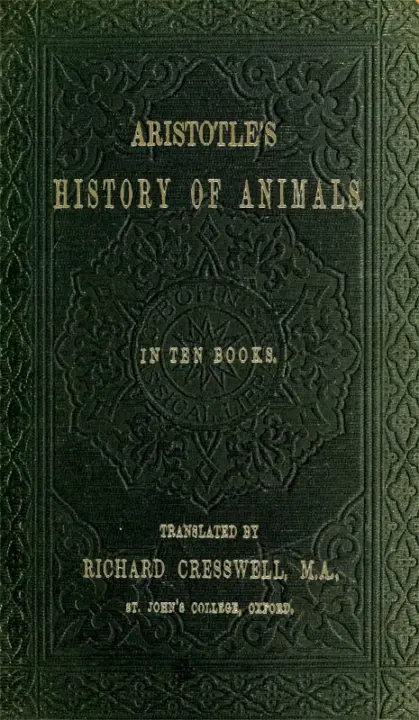
"Aristotle's History of Animals" by Aristotle is a scientific publication written in the late 4th century BC. The work serves as one of the earliest comprehensive surveys of zoology, analyzing and categorizing various animal species based on their anatomy, behaviors, and habitats. It combines observations with the knowledge inherited from previous naturalists to create a foundational text in the history of biological sciences. The opening of "Aristotle's History of Animals" sets the stage for a detailed examination of the animal kingdom. Aristotle begins by classifying animal parts into simple and compound components, continuing with a discussion on the similarities and differences among various species based on their physical attributes and lifestyles. He lays out an extensive framework for understanding animals, including their modes of life—aquatic versus terrestrial—and anatomical structures, using comparative anatomy to illustrate his points. This introduction effectively establishes the categories and criteria Aristotle will use throughout the work to structure his exploration of the biological world.
Introduction adapted from the source catalogue; source summaries may be automatically generated.
Free to read · English · 129,772 words · No account needed
MAKE TIME FOR A GOOD BOOK
On by default. Untick to stop anonymous reading totals. Each page counts after 10 seconds in view. How this works.
Anonymous counting is on unless you have switched it off.
Ὕστριξ, porcupine, Hystrix cristata, 138;
compared with the bear, 175;
hybernates, 215;
throws out its quills, 260.
Φαβοτύπος, a kind of hawk, Falco palumbarius, 201.
Φάγρος, a sea-fish, Sparus pagrus, 211, 218.
Φαλάγγιον, a kind of spider, Phalangium, Aranea Tarantula, 100,
107, 121, 123;
reproduction, 132;
patient of hunger, 204;
hostile to the ichneumon, 232;
several kinds described, 258, 259.
Φάλαγξ, a spider, 231.
Φάλαινα, whale, Physeter Chacalotus, Strack, P. macrocephalus, 8,
69, 152;
respiration, 196.
Φαλαρὶς, coot, Fulica atra, 203.
Φαληρικὴ ἀφύη, some kind of spawn, 158.
Φασιανὸς, pheasant, Phasianus Colchicus, 134, 139, 277.
Φασσοφόνος, a hawk, probably the same as φαβοτύπος, 253.
Φάττα, a kind of pigeon, Columba palumbus, 45, 47;
the largest of the pigeon kind, 111;
reproduction and eggs, 138, 144, 145, 147, 202;
migrates, 210;
sometimes hybernates, 215;
likes drought, 217;
mode of drinking, 240;
habits, ib.;
does not coo in winter, 276.
Φὰψ, a kind of dove, Columba livia, the male and female incubate by
turns, 147, 202, 240;
nest, 249.
Φήνη, perhaps the osprey, Vultur ossifragus, Buffon, nurses the young
of the eagle, 146;
its food and shape, 201, 251.
Φθείρ, louse, Pediculus capitis and P. pubis, κόνις, nit, 120, 134;
in birds, ib.;
in fish, Lernea, 97, 135;
in the fish chalcis, 220.
Φθείρα, a fish that follows the dolphin, Centronotus, 135.
Φλέως, a water plant, Poterium spinosum, 266.
Φοινοκούρος, redstart, Sylvia Phœnicurus, 276; in winter called ἐρίθακος.
Φοξῖνος, a river fish, Cyprinus phoxinus, Strack, 153, 155.
Φρύνη, toad, Bufo vulgaris, 39, 87;
eaten by the buzzard, 232;
injurious to bees, 265.
Φρυνολόχος, a kind of hawk, perhaps the buzzard, 253.
Φυκίον, fucus, sea-weed, 122, 125, 154, 199, 200, 255.
Φυκὶς, a fish living on sea-weed, Gobius niger, 154;
food, 200;
changes its colour, and is the only fish that makes nests, 228.
Φύκος, fucus, 154, 158, 218, 220.
Φώκαινα, porpoise, Delphinus Phocæna, 152, 212.
Φώκη, seal, Phoca vitulina, P. monachus, 4, 7, 14, 22, 25, 26, 30,
39, 44, 69;
reproduction and habits, 103, 152, 153, 196;
food, 205;
fight together, 231.
Φωλὶς, a fish enclosing itself in mucus, 256;
Blennius pholis, Strack.
Φὼρ, a kind of bee, the thief, 259.
Χάλαξα, Hydatids in swine, 221.
Χαλκεὺς, a fish, Dory, Zeus Faber, Strack, 95.
Χαλκὶς, a lizard, with a bright stripe on its back, Lacerta
chalcides, 223.
Χαλκὶς, a bird, the same as κύμινδις, Stryx flammea, Strack, 244.
Χαλκὶς, a fish, perhaps Mugil auratus, Spratt's Lycia, Clupea picta, 108, 155, 156, 256.
Χαλκῖτις λίθος, lime stone, 126.
Χάννη, or χάνη, a fish with a wide mouth, Perca cabrilla, 99, 153;
food, 199;
marine, 211.
Χαραδριὸς, lapwing or curlew, Charadrius œdicnemus, Schneider,
203, 243.
Χελιδὼν, swallow, Hirundo urbica and rustica, 4, 40, 45, 64;
reproduction and nests, 111, 138, 145, 239;
eat animal food, 202;
migration, 215;
kill bees, 265.
Χελιδὼν, flying fish, 95;
Exocetus volitans.
Χέδροπες, leguminous plants, 205.
Χέλων, or χάλλων, a fish like the cestreus, 109, 159, 199.
Χελώνη, the river tortoise, Testudo orbicularis and Europæa, 34, 39,
41, 42, 46, 65, 84, 87, 96;
reproduction, 103, 104, 123;
marine, Chelonia cephalo, 196;
lives on shell-fish and sea-weed, 198;
does not change its skin, 216, 238.
Χήμη, a large bivalve shell, Chama, 117.
Χὴν, goose, Anser domesticus and Anas segetum, 6, 27, 45, 47;
gosling, 140, 141;
incubation, 146, 147;
different kinds, 203, 210.
Χηναλώπηξ, an Egyptian goose, Anas tadorna, Strack, 140, 203.
Χίμαιρα, probably the she goat, 72.
Χλωρεὺς, perhaps the same as χλωρίων, a foe to the woodpecker, and kills the turtle dove, Falco lanarius, 232.
Χλωρὶς, Motacilla fitis, or Loxia chloris, Strack, eats worms, 202; shape, eggs, nest, 245, 249.
Χλωρίων, perhaps oriole, Oriolus galbula, Strack, attacks the
blackbird, 233, 248.
Χοιροπίθηκος, ape, Simia rostrata, S. porcaria, 34.
Χρὲμψ, a fish joined with labrax, 92.
Χρόμις, a sea-fish, Sciæna nigra, 92, 94, 108, 218.
Χρυσομήτρις, a bird (thistle finch), Fringilla serinus, 202.
Χρύσοφρυς, Sparus aurata L., 8, 44;
sleeps, 98;
reproduction, 109, 160;
food, 200;
near the shore, 211;
in estuaries, ib.;
hybernates, 214;
impatient of cold, 218.
Χύμινδις, the same as χαλκις, 244.
Χυτοὶ, fish that swim in shoals, 109.
Ψάρος, starling, Sturnus vulgaris, 215, 249.
Your reading position is saved on this browser. Take it to another device with a library code. Reading pages adapt to text, rather than matching a printed edition.
BEHIND THE BOOK
This eBook is for the use of anyone anywhere in the United States and most other parts of the world at no cost and with almost no restrictions whatsoever. You may copy it, give it away or re-use it under the terms of the Project Gutenberg License included with this eBook or online at www.gutenberg.org. If you are not located in the United States, you will have to check the laws of the country where you are located before using this eBook. Read the source licence.
The original source file, including credits and licence, is retained by this library. Request an original-format copy at no charge. Please include the book title and Project Gutenberg identifier #59058.
KEEP YOUR CURIOSITY GOING
Cécile Tormay

Moritz Busch
John L. Ransom
Frances Wright
Cécile Tormay

Mabel Potter Daggett