THE CLASSIC COLLECTION✦The Athenian ConstitutionCLASSIC FREE BOOKS
The Athenian Constitution
Aristotle
THE CLASSIC COLLECTION · 1887
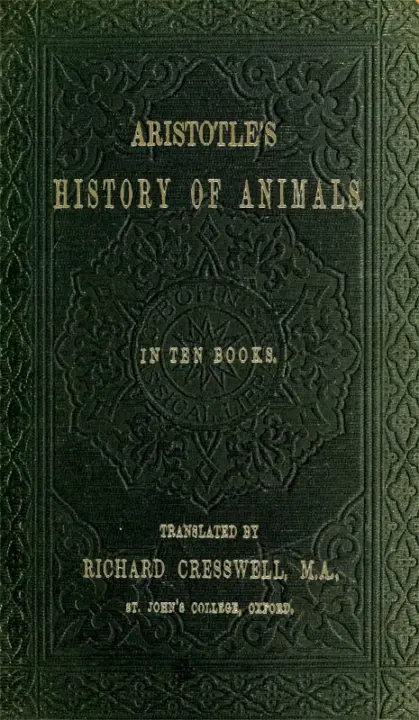
"Aristotle's History of Animals" by Aristotle is a scientific publication written in the late 4th century BC. The work serves as one of the earliest comprehensive surveys of zoology, analyzing and categorizing various animal species based on their anatomy, behaviors, and habitats. It combines observations with the knowledge inherited from previous naturalists to create a foundational text in the history of biological sciences. The opening of "Aristotle's History of Animals" sets the stage for a detailed examination of the animal kingdom. Aristotle begins by classifying animal parts into simple and compound components, continuing with a discussion on the similarities and differences among various species based on their physical attributes and lifestyles. He lays out an extensive framework for understanding animals, including their modes of life—aquatic versus terrestrial—and anatomical structures, using comparative anatomy to illustrate his points. This introduction effectively establishes the categories and criteria Aristotle will use throughout the work to structure his exploration of the biological world.
Introduction adapted from the source catalogue; source summaries may be automatically generated.
Free to read · English · 129,772 words · No account needed
MAKE TIME FOR A GOOD BOOK
On by default. Untick to stop anonymous reading totals. Each page counts after 10 seconds in view. How this works.
Anonymous counting is on unless you have switched it off.
Σφήξ, wasp, Vespa vulgaris, V. tectorum, V. crabro, generic name,
3, 4, 88, 89;
larva, 124;
a kind called ichneumon, Ammophila sabulosa, 127, 130;
a diligent insect, 258;
the annual wasp, 260;
hostile to bees, 265, 267;
two species, 268.
Σφύραινα, a gregarious sea-fish, Esox sphyræna, 234.
Σχοίνικλος or σχοινίων, a water-bird, Emberiza Schœniclus L. Schneider, 203, 234.
Σχοινίων, Sylvia arundinacea, 234.
Σωλὴν, Solen, Soleneuntus trigillatus, Spratt's Lycia, 82, 94,
117, 118, 195.
Ταινία, a long thin fish, probably Cepola tænia, Strack, 37.
Ταινίαι πλατείαι, flat entozoa, 238.
Ταπύνος, see τύμπανος.
Ταῦρος, bull, Bos taurus, 48, 67, 68, 168;
horns, 100;
fierce in the breeding season, 161;
bulls fight together, 163.
Ταὼς, peacock, Pavo cristatus, 6;
barren eggs, reproduction, 140, 148.
Τενθρηδὼν, a kind of bee or wasp, Apis terrestris, Strack, makes
honey, 260;
reproduction, 271.
Τερηδὼν, a caterpillar in bee-hives, 225.
Τέτριξ, a species of grouse, Tetrac tetrix, or Otis tetrix, Strack,
138, 139.
Τεττιγομήτρα, the edible larva of the locust or grasshopper, 134.
Τεττιγόνιον, a small kind of grasshopper, 90, 133.
Τέττιξ, grasshopper, Cicada orni, 90;
several kinds, 95;
origin, 123;
reproduction, 133;
Cecropis Spumarius, 134;
changes its skin, 216;
not found in Milesia and Cephalenia, 225.
Τευθὶς, Loligo vulgaris, Owen, 9, 10, 74, 75;
reproduction, 105, 123;
food, 177;
its ink, 257.
Τεῦθος, Loligo media, 10, 74, 75, 123; perhaps incorrectly in 234 as the name of a gregarious fish.
Τήθυα, Ascidian mollusks, Ascidia phlusa, Strack, 82, 87, 94, 117; fleshy nature of their body, 195.
Τίγρις, Tiger, Felis tigris, the Indian dogs are said to be crossed
with the tiger, 227.
Τίλλων, a fresh-water fish, Cyprinus brama, 156, 220.
Τίφαι, grass or straw used as food for swine, Secale, 221.
Τράγος, the he-goat, voice, 96, 161, 175.
Τράγος, the male of the fish mænis, Sparus Maina, Strack, 228.
Τρίγλη, Red mullet, Spratt's Lycia, Mullus surculentus, Strack,
44, 108;
suffers from parasites, 135;
season of reproduction, 159;
gregarious, ib., 234;
can bury itself, 200;
lives near the land, 211;
in estuaries, ib.;
not carnivorous, 256;
in season in the autumn, 257.
Τριόρχης, Buzzard, Buteo vulgaris, 201;
eats toads and serpents, 232;
the first genus of the hawks, 253.
Τριχὰς, Fieldfare or thrush, Turdus trichias, Strack, T.
pilaris, 248.
Τριχίας or τριχὶς, a small kind of fish, or spawn, Clupea Sprattus, 108, 158, 212.
Τροχίλος, Sylvia trochilus, Strack, also called Presbys, and Basileus, perhaps the wren, Sylvia troglodytes, S. regulus, 203, 233; also a bird living by the sea, charadrius Egyptiacus, 203; picks the teeth of the crocodile, 238; hates the eagle, 232.
Τρύγγας, perhaps Tringa ochropodes, Schneider, T. vanellus, 203, 244.
Τρυγὼν, Turtle dove, Columba turtur, the smallest of the dove
tribe, 111;
young and eggs, 138, 145, 240;
food, 202;
migrates, 210;
hybernates, 215;
an enemy to the pyrallis, but killed by the chloreus, 232;
friendly with the cottyphus, 234;
life, 240;
habitation, ib.;
perhaps Psophila crepitans, or Rallus crex, 277.
Τρυγὼν, a sea-fish, Raia pastinaca, 8, 104, 149, 211;
method of taking its prey, 255.
Τρυγὼν, some oviparous quadruped, 103.
Τύραννος, golden-crested wren, Motacilla Regulus, 202.
Τυφλίνης, blind worm, Lacerta Apus, Schneider, 154, 223.
Ὕαινα, Hyæna Striata, 176;
also called γλάνος, 204.
Ὑβρὶς, a night bird of prey, 244.
Ὕδρος, a water-serpent, Coluber natrix, 3, 44.
Ὑπαίετος, a kind of eagle, also written γυπαίετος, 252.
Ὕπερα, a kind of caterpillar, Geometra, 124.
Ὑπολαΐς, hedge sparrow, Sylvia hortensis or curruca, 147, 202, 249.
Ὑποτριόρχης, buzzard, 253, see τριόρχης.
Ὕς, swine, Sus scropha, 26;
with single hoof in Pœonia, 27, 29;
boar, 31, 32;
swine, 35, 42, 46, 66;
heats, 69;
voice, 96;
sow, is without tusks, 100;
reproduction, 107, 112, 114, 135, 162, 163;
domestic swine, 164;
μετάχοιρα, 173;
they dig up the runs of mice, 178;
eat roots, 206;
how fattened, ib.;
diseases, 221;
swine in Mount Athos, 227;
killed by scorpions, ib.;
devour serpents, 233;
gelding of sows, 278.
Ὓς ἄγριος, the wild boar, 5, 26, 161, 174.
Your reading position is saved on this browser. Take it to another device with a library code. Reading pages adapt to text, rather than matching a printed edition.
BEHIND THE BOOK
This eBook is for the use of anyone anywhere in the United States and most other parts of the world at no cost and with almost no restrictions whatsoever. You may copy it, give it away or re-use it under the terms of the Project Gutenberg License included with this eBook or online at www.gutenberg.org. If you are not located in the United States, you will have to check the laws of the country where you are located before using this eBook. Read the source licence.
The original source file, including credits and licence, is retained by this library. Request an original-format copy at no charge. Please include the book title and Project Gutenberg identifier #59058.
KEEP YOUR CURIOSITY GOING
Cécile Tormay

Moritz Busch
John L. Ransom
Frances Wright
Cécile Tormay

Mabel Potter Daggett