
Last letters from the living dead man
David Patterson (Spirit) Hatch
THE CLASSIC COLLECTION · 1894
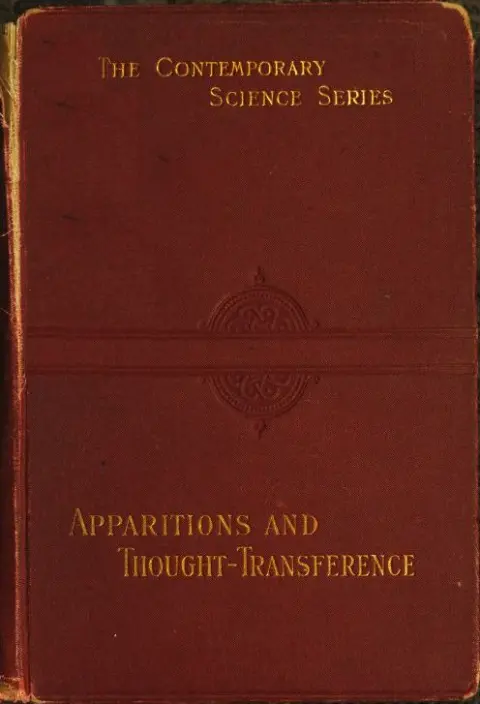
"Apparitions and Thought-Transference: An Examination of the Evidence for Telepathy" by Frank Podmore is a scientific publication written in the late 19th century. This work delves into the topic of telepathy, presenting a detailed examination and critique of various experimental evidence and case studies concerning thought transfer and associated phenomena. The book aims to provide the reader with a clearer understanding of telepathic communication that occurs outside the known sensory channels, while also acknowledging the complexities and challenges in achieving conclusive proof. The opening of the book introduces the context for the ongoing study of psychical research, pointing to the emergence of the Society for Psychical Research and the foundations laid by previous scientific inquiries. Podmore discusses the historical perspectives on supernatural phenomena, particularly apparitions and clairvoyance, and underscores the skepticism that comes from both the scientific community and the general public. He outlines fundamental challenges in the research, such as defining telepathy, potential errors in observation, common misconceptions, and the need for rigorous experimentation to validate the phenomena observed. Overall, the introduction sets a tone of inquiry, caution, and a commitment to applying scientific rigor in exploring the enigmatic territory of thought-transference.
Introduction adapted from the source catalogue; source summaries may be automatically generated.
Free to read · English · 144,986 words · No account needed
MAKE TIME FOR A GOOD BOOK
On by default. Untick to stop anonymous reading totals. Each page counts after 10 seconds in view. How this works.
Anonymous counting is on unless you have switched it off.
Dramatic Criticism, as we now understand it--the systematic appraisement from day to day and week to week of contemporary plays and acting--began in England about the beginning of the present century. Until very near the end of the eighteenth century, "the critics" gave direct utterance to their judgments in the theatre itself, or in the coffee-houses, only occasionally straying into print in letters to the news-sheets, or in lampoons or panegyrics in prose or verse, published in pamphlet form. Modern criticism began with modern journalism; but some of its earliest utterances were of far more than ephemeral value. During the earlier half of the present century several of the leading essayists of the day--men of the first literary eminence--concerned themselves largely with the theatre. Under the title of
will be issued, in three volumes, such of their theatrical criticisms as seem to be of abiding interest.
THE FIRST SERIES will contain selections from the criticisms of LEIGH HUNT, both those published in 1807 (long out of print), and the admirable articles contributed more than twenty years later to The Tatler, and never republished.
THE SECOND SERIES will contain selections from the criticisms of WILLIAM HAZLITT. Hazlitt's Essays on Kean and his contemporaries have long been inaccessible, save to collectors.
THE THIRD SERIES will contain hitherto uncollected criticisms by JOHN FORSTER, GEORGE HENRY LEWES, and others, with selections from the writings of WILLIAM ROBSON (The Old Playgoer).
The Essays will be concisely but adequately annotated, and each volume will contain an Introduction by WILLIAM ARCHER, and an Engraved Portrait Frontispiece.
London: WALTER SCOTT, LIMITED, 24 Warwick Lane.
Cloth Elegant, Large Crown 8vo, Price 3/6 per vol.
THE HUMOUR OF FRANCE. Translated, with an Introduction and Notes, by Elizabeth Lee. With numerous Illustrations by Paul Frénzeny.
THE HUMOUR OF GERMANY. Translated, with an Introduction and Notes, by Hans Müller-Casenov. With numerous Illustrations by C. E. Brock.
THE HUMOUR OF ITALY. Translated, with an Introduction and Notes, by A. Werner. With 50 Illustrations and a Frontispiece by Arturo Faldi.
THE HUMOUR OF AMERICA. Selected with a copious Biographical Index of American Humorists, by James Barr.
THE HUMOUR OF HOLLAND. Translated, with an Introduction and Notes, by A. Werner. With numerous Illustrations by Dudley Hardy.
THE HUMOUR OF IRELAND. Selected by D. J. O'Donoghue. With numerous Illustrations by Oliver Paque. [Ready Sept. 1894.
THE HUMOUR OF SPAIN. Translated, with an Introduction and Notes, by S. Taylor. With numerous Illustrations by H. R. Millar. [Ready Oct. 1894.
THE HUMOUR OF RUSSIA. Translated, with Notes, by E. L. Boole, and an Introduction by Stepniak. With 50 Illustrations by Paul Frénzeny.
Your reading position is saved on this browser. Take it to another device with a library code. Reading pages adapt to text, rather than matching a printed edition.
BEHIND THE BOOK
This eBook is for the use of anyone anywhere in the United States and most other parts of the world at no cost and with almost no restrictions whatsoever. You may copy it, give it away or re-use it under the terms of the Project Gutenberg License included with this eBook or online at www.gutenberg.org. If you are not located in the United States, you will have to check the laws of the country where you are located before using this eBook. Read the source licence.
The original source file, including credits and licence, is retained by this library. Request an original-format copy at no charge. Please include the book title and Project Gutenberg identifier #56489.
KEEP YOUR CURIOSITY GOING
David Patterson (Spirit) Hatch
Coulson Kernahan

Ralph Waldo Emerson
Frances Wright

Edwin Abbott Abbott

Joseph Droz