
Last letters from the living dead man
David Patterson (Spirit) Hatch
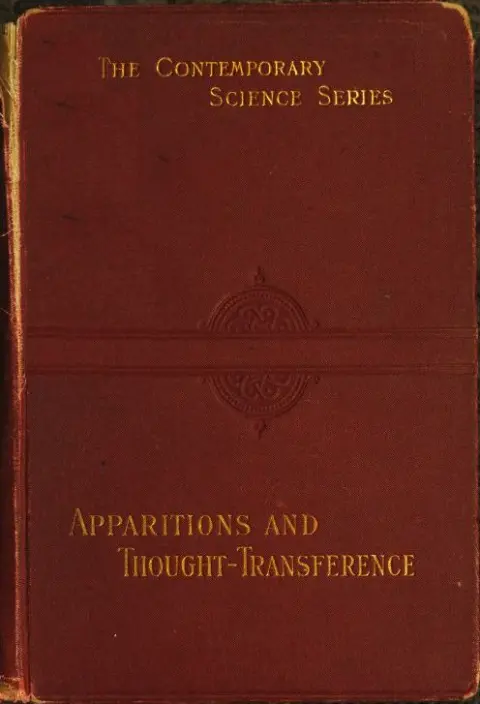
THE CLASSIC COLLECTION · 1894
"Apparitions and Thought-Transference: An Examination of the Evidence for Telepathy" by Frank Podmore is a scientific publication written in the late 19th century. This work delves into the topic of telepathy, presenting a detailed examination and critique of various experimental evidence and case studies concerning thought transfer and associated phenomena. The book aims to provide the reader with a clearer understanding of telepathic communication that occurs outside the known sensory channels, while also acknowledging the complexities and challenges in achieving conclusive proof. The opening of the book introduces the context for the ongoing study of psychical research, pointing to the emergence of the Society for Psychical Research and the foundations laid by previous scientific inquiries. Podmore discusses the historical perspectives on supernatural phenomena, particularly apparitions and clairvoyance, and underscores the skepticism that comes from both the scientific community and the general public. He outlines fundamental challenges in the research, such as defining telepathy, potential errors in observation, common misconceptions, and the need for rigorous experimentation to validate the phenomena observed. Overall, the introduction sets a tone of inquiry, caution, and a commitment to applying scientific rigor in exploring the enigmatic territory of thought-transference.
Introduction adapted from the source catalogue; source summaries may be automatically generated.
Free to read · English · 144,986 words · No account needed
MAKE TIME FOR A GOOD BOOK
On by default. Untick to stop anonymous reading totals. Each page counts after 10 seconds in view. How this works.
Anonymous counting is on unless you have switched it off.
[Footnote 162: See, for instance, the Report on Spiritualism of the London Dialectical Society; Experiences of Mr. Stainton Moses in Proc. S.P.R., vol. ix. p. 245; and article, "Spiritualism," in the Encyclopædia Britannica, by Mrs. Henry Sidgwick, and in Chambers' Encyclopædia, by Alfred Russel Wallace, F.R.S.]
[Footnote 163: It need hardly be said that the oft-quoted story of the European who came late and unobserved to the performance of an Indian Fakir, and from a distant tree saw him cutting up a pumpkin when the crowd saw him cutting up a child, is merely ben trovato. Nor, indeed, until we have contemporaneous accounts of these performances from carefully trained observers is there need of any such hypothesis to explain the feats of Indian jugglery. See Mr. Hodgson's article in Proc. S.P.R., vol. ix. p. 354.]
[Footnote 164: The explanation suggested in the text for the physical phenomena of Spiritualism is worked out in some detail by Von Hartmann, the philosopher of the unconscious, in a little treatise on Spiritism, which has been translated into English by "C.C.M.," 1885. But Von Hartmann believes that some of the phenomena are produced by a hypothetical nerve-force under the direction of the somnambulic self of the medium--a prodigality of hypotheses which in the circumstances is surely superfluous.]
[Footnote 165: See Phantasms of the Living, vol. i. pp. 110-113.]
[Footnote 166: Presidential Address to the Section of Mathematics and Physics of the British Association, August 1891.]
[Footnote 167: "If all individuals of higher or lower order are rooted in the Absolute, retrogressively in this they have a second connection among themselves, and there is requisite only a restoration of the rapport or telephonic junction (Telephonanschluss) between two individuals in the Absolute, by an intense interest of the will, to bring about the unconscious interchange between them without sense-mediation." (Spiritism, by Ed. von Hartmann, trans. C.C.M., p. 75.)]
[Footnote 168: Des Propriétés physiques d'une force particulière du
corps humain, 1882.]
[Footnote 169: De la Suggestion mentale, Paris, 1887, pp. 511, 512.]
[Footnote 170: American Journal of Psychology, vol. i., No. 1.]
[Footnote 171: See, for instance, Professor Lodge's paper in Proc.
S.P.R., vol. vii. p. 374.]
[Footnote 172: Annales des Sciences Psychiques, vol. i. p. 317.]
[Footnote 173: See his articles on the "Subliminal Consciousness,"
etc., Proc. S.P.R., vol. vii. p. 298; vol. viii. p. 333, pp. 436 et
seq.]
Aksakof A., cases recorded by, 184, 266
American Society for Psychical Research, founding of, 4;
experiments by, 15, 27
Anæsthesia telepathically produced, 101-104
Anxiety as cause of hallucination, 216, 223
Auditory hallucinations, 25, 218, 247-251, 274-276
Automatic writing, 91-96, 183
Azam, Dr., experiments by, 59
Babinski, 375
Backman, Dr., experiments by, 338, 349, 357
Barber, Mrs., case recorded by, 168
Baréty, Dr., 384
Barnby, Sir Joseph, case recorded by, 358
Barrett, Professor, 19, 72;
experiments by, 84
Beard, S. H., 83
Your reading position is saved on this browser. Take it to another device with a library code. Reading pages adapt to text, rather than matching a printed edition.
BEHIND THE BOOK
This eBook is for the use of anyone anywhere in the United States and most other parts of the world at no cost and with almost no restrictions whatsoever. You may copy it, give it away or re-use it under the terms of the Project Gutenberg License included with this eBook or online at www.gutenberg.org. If you are not located in the United States, you will have to check the laws of the country where you are located before using this eBook. Read the source licence.
The original source file, including credits and licence, is retained by this library. Request an original-format copy at no charge. Please include the book title and Project Gutenberg identifier #56489.
KEEP YOUR CURIOSITY GOING
David Patterson (Spirit) Hatch
Coulson Kernahan

Ralph Waldo Emerson
Frances Wright

Edwin Abbott Abbott

Joseph Droz