
Last letters from the living dead man
David Patterson (Spirit) Hatch
THE CLASSIC COLLECTION · 1894
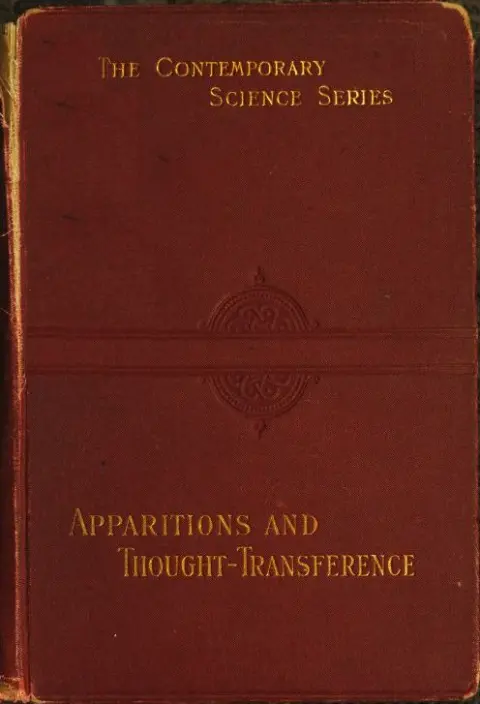
"Apparitions and Thought-Transference: An Examination of the Evidence for Telepathy" by Frank Podmore is a scientific publication written in the late 19th century. This work delves into the topic of telepathy, presenting a detailed examination and critique of various experimental evidence and case studies concerning thought transfer and associated phenomena. The book aims to provide the reader with a clearer understanding of telepathic communication that occurs outside the known sensory channels, while also acknowledging the complexities and challenges in achieving conclusive proof. The opening of the book introduces the context for the ongoing study of psychical research, pointing to the emergence of the Society for Psychical Research and the foundations laid by previous scientific inquiries. Podmore discusses the historical perspectives on supernatural phenomena, particularly apparitions and clairvoyance, and underscores the skepticism that comes from both the scientific community and the general public. He outlines fundamental challenges in the research, such as defining telepathy, potential errors in observation, common misconceptions, and the need for rigorous experimentation to validate the phenomena observed. Overall, the introduction sets a tone of inquiry, caution, and a commitment to applying scientific rigor in exploring the enigmatic territory of thought-transference.
Introduction adapted from the source catalogue; source summaries may be automatically generated.
Free to read · English · 144,986 words · No account needed
MAKE TIME FOR A GOOD BOOK
On by default. Untick to stop anonymous reading totals. Each page counts after 10 seconds in view. How this works.
Anonymous counting is on unless you have switched it off.
Considered purely in its physiological aspect, such a theory appears to present no special difficulty; or rather, to put the matter more exactly, our ignorance of the ultimate nature of nerve-processes is so nearly complete as to permit us to theorise in vacuo, with little risk of encountering any insuperable obstacle. It is true that Professor G. Stanley Hall,[170] in commenting on such physical theories of telepathy, maintains that they contravene well-established physical laws:--"The law of 'isolated conductivity,' formulated fully by Johannes Müller, which Helmholtz compares in importance to the law of gravity, first brought order into the field of neurology by insisting that impressions never jump from one fibre to another.... Is it likely that a neural state should jump from one brain to another, through a great interval, when intense stimuli on one nerve cannot affect another in the closest contact with it?" But it is clear that the "law" in question is merely a generalisation from observed facts, and from facts, moreover, not of the same order as those now under discussion. For the question here is not of the affection of another nerve-fibre in the same organism, but of a nerve-centre in another organism. And whilst it must have seemed à priori probable that between nerves belonging to the same system induction would not take place, because the alternative could hardly fail to be injurious to the organism, and that the susceptibility to such induction, if originally present, would have been eliminated in the course of evolution, it is at least theoretically conceivable that between different organisms induction might have persisted as innocuous, or even have been developed as positively beneficial.
In current theories it is assumed that there are changes in brain-substance correlated with psychical events, and that these changes, in their ultimate analysis, are of the nature of vibrations. That these vibrations should be capable of in some way propagating themselves through the surrounding medium would seem therefore a natural corollary. The real objections to such physical theories appear to be of a more general kind--viz., the improbability that any such capacity of nervous induction should have remained unobserved until now; and the difficulty of supposing vibrations so minute to be capable of producing effects at so great a distance, and to have a selective capacity so finely adjusted that out of all the thousands of persons within the radius, say, of such a brain-wave as that set a-going by Mr. Cleave (p. 234), only one set of brain-molecules should be stirred to sympathetic vibration. The first difficulty in its psychical aspect has already been touched upon at the commencement of this chapter, and need not here be further considered. The second is more serious. It is difficult to find an exact parallel for the transmission across a considerable intervening space of energy at once so minute in quantity and so highly specialised. Mr. W. H. Preece has indeed shown that a current can be induced in a closed circuit at a distance of some three miles or more, and Professor Lodge has reminded us (loc. cit.) that "all magnets are sympathetically connected, so that, if suitably suspended, a vibration from one disturbs others, even though they be distant ninety-two million miles." But the forces engaged are in the one case on a commercial, in the other on a cosmic scale. Yet the difficulty is not, perhaps, insuperable. The amount of energy which has been proved capable, at the distance of half a mile, of inducing sleep in a French peasant woman may be readily conceived as not more attenuated than those "sweet influences" which are yet potent enough to summon up before us the vision of the Pleiades or the glowing nebula of Orion. Nor need the difficulty of selection trouble us much; for, after all, one of the chief characteristics of organic life in general is the power--a power ever more differentiated in the higher organisms--of reacting only to selected stimuli. In short, it is too soon to say that any physical communication between living beings of the kind suggested is inconceivable. We shall be justified in affirming or denying its possibility on the day when we have guessed the secret of our own existence, and are able to explain how some fraction of a millegramme of albumen can contain not merely the promise of life, but the germ of a particular and individual organism, which shall reveal its own pedigree and contain in itself an epitome of life on our planet.
Your reading position is saved on this browser. Take it to another device with a library code. Reading pages adapt to text, rather than matching a printed edition.
BEHIND THE BOOK
This eBook is for the use of anyone anywhere in the United States and most other parts of the world at no cost and with almost no restrictions whatsoever. You may copy it, give it away or re-use it under the terms of the Project Gutenberg License included with this eBook or online at www.gutenberg.org. If you are not located in the United States, you will have to check the laws of the country where you are located before using this eBook. Read the source licence.
The original source file, including credits and licence, is retained by this library. Request an original-format copy at no charge. Please include the book title and Project Gutenberg identifier #56489.
KEEP YOUR CURIOSITY GOING
David Patterson (Spirit) Hatch
Coulson Kernahan

Ralph Waldo Emerson
Frances Wright

Edwin Abbott Abbott

Joseph Droz